Documentary on the Dubai Creek's secrets
Filmmaker Ted Kennedy's documentary has now introduced the bustling area to the world
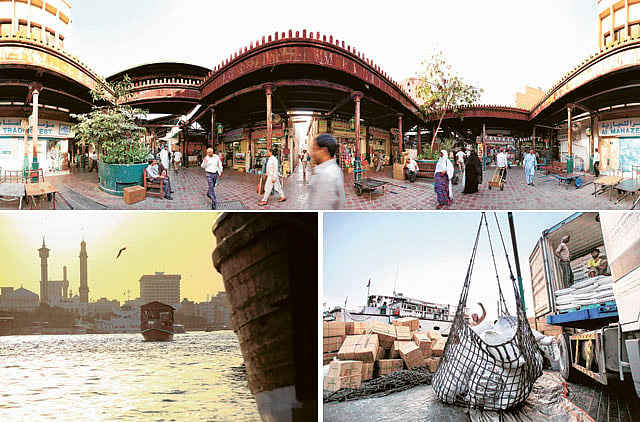
The waves of the sky-blue waters of the Gulf sparkle when touched by the sun's rays. The buzz of the traders and workers fills the air. People are loading and unloading trading vessels with many things — from cars and furniture to foodstuffs.
The cinematic and panoramic images tell the story of the "origin" of Dubai. They tell the story of the Creek, the vital waterway of the city, known for being a regional business hub for many centuries.
The story of the place is narrated in The Floating Life of Dubai Creek — a nearly-25-minute documentary. It tells also the story of the sailors, the traders and the Creek's adjacent urban areas.
The screening of the film on life in Dubai, a place in the East, yet influenced by other cultures, aptly had Rimsky Korsakov's Scheherazade as the theme music. Scheherazade is a composition that is based on One Thousand and One Nights, or The Arabian Nights, which itself inspires splendid imagination as it reflects on the daily life of the Dubai Creek.
Contrary to the perception that Westerners are usually captivated by the desert and its life, it was the Creek that drew American Ted Kennedy, the maker of the film, who has been living in Dubai for seven years and is a professor of Architecture, Art and Design at the American University of Sharjah.
"My training is in landscape and filmmaking," the soft-spoken Kennedy told Weekend Review. "So there are three forms in the desert that are particular. One is the oasis, the other is the wadi, and the third is the waterway in the desert ... [The image of] water running through the desert is remarkable and acrobatic. So the Creek is like that, like water running in the desert.
"But if you are in the desert and come down to the Creek, you will take a breath, and smell the water," he added. "I look at the colour of the Gulf water and suddenly I am relaxed and refreshed, so that is what attracts me. I always come to the Creek if I want to relax and get away from things."
A native of New York, Kennedy received his BA in landscape architecture from Cornell University before going on to study film and photography at the San Francisco Art Institute. He taught at several schools in the US including the University of Georgia and North Dakota State University.
Apart from the dhows and sailors, the film has captured the surrounding environment: a baker in his shop, a woman dining in a restaurant, a butcher cutting meat, another person pouring tea, a carpenter measuring columns of wood and some merchants and workers playing dominos and cards — a lot of them from different countries. Later, an Arab man holding his little girl smiles at the camera, a gemstones shop displays a tray full of precious stones, a laundry, a fabric shop, — all appear to the beat of the drums in the soundtrack.
Shooting of the film started in 2009 and took two years to complete, as Kennedy did it on weekends, especially Friday afternoons when "you can see more and more relaxed" people. Throughout the two years, the desire to better understand Dubai's culture kept Kennedy motivated. He sought to appreciate a culture different from his and bridge the gap between the two.
"Now I have a much better understanding of how the culture works. It is just not separate anymore," he said.
Earlier, before screening his film, Kennedy told the audience that "when I came to Dubai, I saw it in a different way" than a person who is raised in the US and influenced by Hollywood films would. Interestingly, Kennedy's film on the daily life at the Creek doesn't show many Arabs. Some consider it a shortcoming, but Kennedy defended it, saying "there are few Arabs in the Creek's life now. Because this is what typically happens in a development cycle — the original groups move out to the suburbs. This happens in most American cities, and most cities around the world of our time." Yet he maintained that the Arab presence and influence in the Creek is still there: "There are merchants who still have their businesses. It is still Arab-run, but there is an influx of new groups of people. It is a very dynamic community of many different cultures."
To show the rapid development of the place, Kennedy showed several pictures of the Creek, one from 1950, another from ten years later and a third from 1971.
Cargo heading from and to Dubai is connecting the Creek with several nearby coastal cities and ports, in Iran, Oman, Yemen and Pakistan, among others.
However, Dubai has a distinct feature from other cities, Kennedy said. "I was talking to some old-timer, who used to call Dubai ‘Al Wasel', or a midpoint or midway. So it is a transit port, and as a port, it is always in fast influx," he noted.
It is the video camera that Kennedy counts on to record the moments of change. "Film is my first language," he said, when asked about his photographs. "So even the still pictures have a cinematic quality to them. I am still a filmmaker."
Taking the creek around the world
‘The Floating Life of Dubai Creek' was shown in Dubai earlier this month at the US Consulate as the first in a series of ‘A Dive into Culture' programme. It was funded by a grant from the American University of Sharjah. It was screened in different places in Asia, Europe and America, at universities and during film festivals, including the New York City International Film Festival last July.
The film, which was also screened during a conference in Singapore, was recently awarded best film at the third Ares Film and Media Festival held in Siracuse, Italy.
Ted Kennedy expects to make a film about another location in Dubai once the funding is secured.
Sign up for the Daily Briefing
Get the latest news and updates straight to your inbox
Network Links
GN StoreDownload our app
© Al Nisr Publishing LLC 2026. All rights reserved.