Unadmittedly self-serving
Donald Rumsfeld's memoir reveals many details of American politics but leaves out a lot more
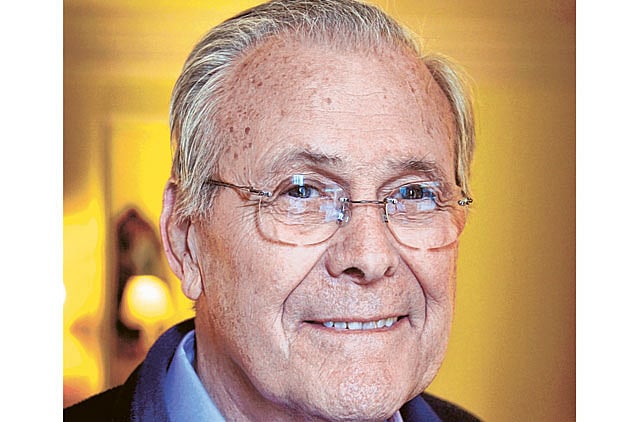
Donald Rumsfeld is a skilled artist who cherishes life, liberty and the pursuit of happiness and who believes in a strong defence for his country. These are laudable goals, as the former secretary of defence recounts his intimate knowledge of, and close involvement in, America's critical policies.
One must state at the outset, as the author wishes a briefer (or a reviewer) to get his "assumptions right, [so that whatever] strategy, tactics and details follow logically" can be substantiated. This is a well-written and fabulously researched book, even if it relies on memos galore.
For example, his attributions to Sultan Qaboos of Oman (pages 380 and 381) are copied verbatim from an October 6, 2001, memo to president Bush, titled My Visits to Saudi Arabia, Oman, Egypt, Uzbekistan and Turkey (available online among the hundreds of declassified documents posted on the author's website www.rumsfeld.com).
But more important, the book is far from being objective, although historians will have to plough through it for years to discover nuggets and decipher Washington complexities.
As expected, Rumsfeld devotes valuable space to his middle-class childhood in Illinois, growing up during the Great Depression and the Second World War, attending Princeton University on scholarships to earn a BA, serving in the United States navy and launching his political career during the Eisenhower administration.
His recollections of the Kennedy and Johnson years are valuable, as are his insights into the Nixon and Ford administrations, when Rumsfeld accepted his first cabinet appointments. There is also significant discussion of his business experiences with GD Searle, the giant pharmaceutical firm that invented aspartame, and the pressures of being a CEO in the private sector that borders on the self-fawning (pages 245 to 257).
Still, the book's focus on national security matters, starting with the 1983 US Marines bombings in Beirut and Rumsfeld's subsequent appointment by president Ronald Reagan as a special envoy, created various opportunities for the politically astute politician. The most memorable of these was the face-to-face meeting with Saddam Hussain in 1983, whose images could not be ignored, and that would prove embarrassing for the US in 2003.
Sadly, while Iraq haunts America and is likely to preoccupy it for a while, Rumsfeld's discussion is largely self-serving.
Unabashedly, the author focuses on the presidency of George W. Bush in 2001, when Rumsfeld was mandated to transform the military for a new century. Needless to say that 9/11 dramatically, and perhaps permanently, altered these calculations. In fact, Rumsfeld's descriptions and discussions of 9/11 are revealing.
His decision to fight terrorism and his support for wars in the Middle East are equally shocking. Where he errs, and he does so with gusto, is in his failure to mention that a number of folks working with the Bush regime had already wanted to invade Iraq long before 9/11.
Two key points need to be made at this juncture. First, although Known and Unknown provides a wealth of details, it leaves out a whole lot more. For example, although Rumsfeld acknowledges signing a letter that called for the removal of Saddam Hussain from power in the late 1990s (page 417), there is no mention in this voluminous book of the Project for a New American Century (PNAC) that originated the petition.
That recommendation, to which Rumsfeld and his deputy Paul Wolfowitz signed on (along with 16 other neo-conservative elements that formed a cabal of sorts), was a January 26, 1998, letter to then president Bill Clinton suggesting regime change. At the time, Wolfowitz called for a "New Pearl Harbor" as the only way Americans will go for a war on Iraq, which meant that an event of 9/11's proportion could eventually justify the war of Iraq.
Likewise, Rumsfeld brushes aside the critical work of the "Office of Special Plans" under the leadership of Douglas Feith, which circumvented the CIA as it devoted significant energy to finding an intelligence link between 9/11 and Iraq. In the event, no such links were found, simply because there were none.
Rumsfeld is equally coy about a 1996 study report prepared for then Israeli Prime Minister Benjamin Netanyahu (whose "conversation" was deemed valuable enough to be included in an action memo to Bush, as admitted on page 354), titled A Clean Break, which called for the removal of the Iraqi regime. It was co-authored by Richard Perle and Douglas Feith, two neo-cons with established links to Israeli interests and, in Feith's case, as an attorney for the Northrop defence contractor.
It would have added to Rumsfeld's credibility had he mentioned that Perle and Feith wanted to remove Saddam a few years before 9/11.
With nearly 100 pages devoted to Iraq, especially in terms of intra-administration disputes, Rumsfeld's attacks on then National Security Council adviser Condoleezza Rice (pages 324 to 330) are devastating, illustrating pettiness, hatred and disrespect. Peppered with examples throughout the book, such cat-and-mouse games, which are fairly standard procedures in every administration, clarify George W. Bush's mediocre management skills when his principals were literally wasting time scoring points against each other.
No wonder few could handle the unending controversies, from the revelations of shameful abuses at Abu Ghraib prison to "allegations" of torture at Guantánamo Bay prison.
As thorough as Known and Unknown is, simple but relevant bits of information are never presented as such and while few can deny Rumsfeld's significant experience in several administrations, one cannot help but wonder why an intelligent man can be so obtuse.
A tragic figure, Rumsfeld will go down in US history as the man who never shouldered blame for his gargantuan errors, including making recommendations to launch premeditated wars in the name of national security.
Plainly affirmed, admitting mistakes would be out of character for a CEO who "managed" the Defence Department as if it were a mere corporation and who further detracted from America's authority, reputation, prestige and goodwill.
Dr Joseph A. Kéchichian is the author of the forthcoming Legal and Political Reforms in Saudi Arabia (2011).
Known and Unknown: A Memoir By Donald Rumsfeld, Sentinel, 832 pages, $29.95
Sign up for the Daily Briefing
Get the latest news and updates straight to your inbox
Network Links
GN StoreDownload our app
© Al Nisr Publishing LLC 2026. All rights reserved.