‘Ek Mulaqaat’: A play about unfulfilled love
The play, starring Bollywood actors Deepti Naval and Shekhar Suman, this weekend portrays the relationship between poets Sahir Ludhianvi and Amrita Pritam
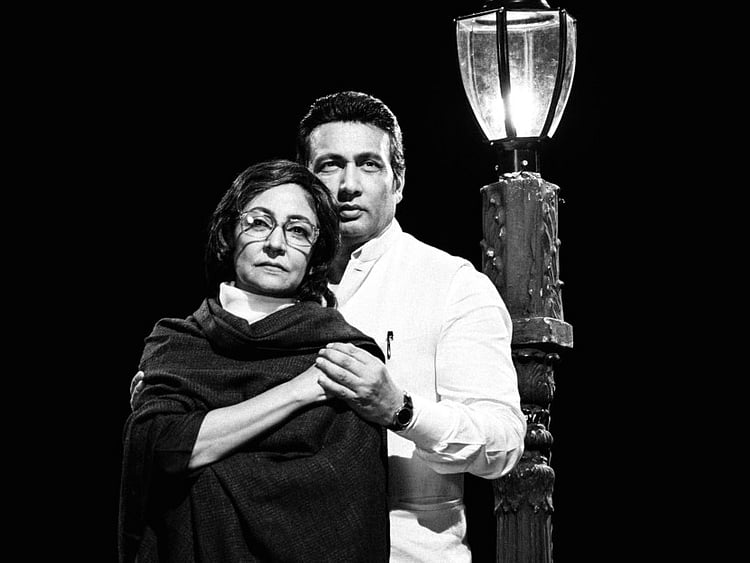
She was a modern, rebellious, bold and vocal Punjabi writer. He was just as rebellious but spoke only through his writing. She told the world about her love for him, he never spoke of it in public. Amrita Pritam and Sahir Ludhianvi — two giants of modern Indian poetry — conveyed their emotions to each other more through silence than the words that made them who they were, Pritam has been often quoted as saying.
And now their unfulfilled love story is being portrayed on stage by Bollywood actors Deepti Naval and Shekhar Suman and will probably be featured in a film about Ludhianvi starring Irrfan Khan.
Ek Mulaqaat [A Rendezvous], a play by Saif Hyder Hasan, a journalist turned playwright and director, depicts a fictional meeting between the two poets where they reveal their love through poetry.
“Sahir shared a beautiful relationship with Amrita Pritam,” Suman told tabloid!. “But Sahir was a commitment-phobic so this relationship could not really blossom. However, the fact remains that even when they were apart they still loved each other. Amrita did find a companion in [artist and writer] Imroz later but never really got over Sahir. And neither did he [get over her]. This play is about one meeting between them, when he comes to her home completely out of the blue. Though it’s in a fictional space, it deals with a lot of reality”.
Director Hasan agrees that such a love story is not bound by time.
“To quote [poet] Harivansh Rai Bachchan, these are times of ‘aapa dhaapi’ (chaos). I think a love story is always relevant,” said Hasan. “We’ve done nearly 20 shows in India and we realised that people are hungry for language-based works and romance in the true sense. This story is told both with honesty and passion”. Hasan told tabloid! that the play is the beginning of a trilogy.
“Gardish Mein Taare [which stars Sonali Kulkarni and Arif Zakaria] goes into a similar vein that talks about two people whose marriage doesn’t work, even though there was a lot of love. It is based on the married life of late filmmaker Guru Dutt and singer Geeta Dutt. It is about love which was unfulfilled despite consummation. The third Yaad Piya Ki Aaye is still under production. It is based on the relationship between ghazal singer Bade Ghulam Ali Khan sahab and a courtesan. The three plays go on a similar terrain of unfulfilled love, music, thrift and death.
“There was a point when I was fed up of writing and directing urban angst stories. So I told myself no, let me work in my period milieu, in which I grew up, which was the Urdu language and some interesting characters. Sahir and Amrita just clicked and I discussed it with my co-writer, Sumana Ahmad. We had a beginning, a middle and a climax, based on which we decided to do the play and it was written in 20-odd days. It’s a story of unfulfilled love but we feel fulfilled as an audience”.
Deepti Naval on playing Amrita Pritam
“Having known her personally, I always considered it remarkable about [Amrita’s] personality that though she had a lot of strength as a female writer – she was one of the key figures in Punjabi literature – she was this demure, gentle person. And that’s how I’ve tried to portray her on stage.
“Even if they were here in this age, I don’t think they would have been able to consummate this relationship even today, despite all the freedom society offers. Amrita was very committed to Imroz sahab. In fact that’s another love story. We admire them for the time and environment they lived in and how they tackled their situation then.
“I think her writing has affected this whole generation of women both as a female writer and someone who believed in living her life on her own terms. And that is something what one knowingly or unknowingly imbibes when you meet someone like her. I grew up in New York so I always had the confidence and I wanted to do with my life what I felt right for me. When I met her later, it just reaffirmed my entire conviction that one must do what made you truly happy inside.
“She would always tell me ‘why don’t you write in Punjabi?’ and I couldn’t because I was more comfortable expressing myself in English, Urdu or Hindi. But it always remained in the back of my mind that maybe someday… She wrote in theth (rustic) Punjabi. I always had a little difficulty in grasping the language when she narrated her poems to me from a little notepad, sitting up in bed smoking in her home in Hauz Khas [in Delhi], where I’d go to meet her. I would actually just go to look at her face and listen to her poetry. Those moments are some of my most cherished”.
Working with Shekhar Suman
“Shekhar and I have known each other for a long time. We had done a film together in the 1980s which never got a release. Working with him now has been a new phase. I remember this one song we had shot together but not so much the film it was in. After that one knew him as a very suave narrator. He’s so skilled in articulation, he never fumbles for words. And then people knew him as someone who could make them laugh. He has this excellent talafuz [diction] and lehja [style of speaking]. That was me seeing him from the audience. Then I knew him as a director [Naval acted in Suman-directed Heartless] and realised Shekhar Suman is not about comedy at all. He may project flamboyance in his personality but he is a very intense human being.
“And all that kind of came together when we were doing the play. I saw a completely different side of him, which most people don’t know. He is so much into poetry and he is fascinated with the Urdu language. I grew up in Amritsar listening to Lahore Radio all the time. So Urdu was my second language. We relate on that common ground of poetry and music”.
Shekhar Suman on playing Sahir Ludhianvi
“I’ve been greatly influenced by the literary works of Sahir Ludhianvi as a kid. I was presented his book of nazms [poems] called Parchhaiyaan by one of my uncles, which then of course I understood nothing of. But it intrigued me and as I grew older I read more on Sahir and his writing. I realised he was a man of great intensity and great literary predilection. I was completely enamoured by him. So I immediately agreed when Hyder came to me with the script. I’m quintessentially a theatre actor and this was one role I couldn’t let go off of.
“I think Sahir’s intensity, passion and rhythm is what influenced me. When he came into the film industry there were poets and lyricists who would conform to the musicians making the tunes first and then writing poetry to fit them. Sahir vehemently opposed that. He said he couldn’t write anything which had a pre-set tune. ‘I write, you compose,’ is what he would say and refused to change a single word of his poem, whether anyone understood it or not. ‘It’s you who has to find the meaning of what I’m writing,’ he would say.
“Also what I liked about Sahir was his tremendous conviction in what he said and how he said it. While poets sang paeans to Taj Mahal, he wrote the poem Mere mehboob kahin aur aake mila kar mujhe [my beloved meet me some place else]. He wrote:
Ye chamanzar, ye Jamna ka kinara…
Ye mahal ye munaqqash dar-o-deewar, ye mehrab, ye taq…
Ek Shahenshah ne daulat ka sahara le kar, hum gharibon ki muhabbat, ka udaya hai mazaq…
[This garden, this bank of the river Jamuna, this palace of extreme architectural beauty and the mausoleum an emperor has built using wealth, and mocked the love we poor share].
“That is the kind of rebelliousness he had. He was anti-establishment even though he was born in a rich family but the way his father behaved and treated his mother had made him resent the rich and the wealth. He had a communist/socialist view to life and believed everyone should be treated the same. He even mentions it in the play to Amrita. He says, ‘I know you objected to me keeping the kind of company that I did because I always was friendly to the carpenters and mechanics and plumbers. But that’s where my poetry comes from’. Poetry always emerges out of pain. Life teaches you poetry and for that he had to come out of the cocoon of luxury that his father had created”.
“He was a shy, reticent guy. But I liked his arrogance. He was a man of few words, which is a dichotomy because his alfaz [words] and his ashaar [verses] were his best friends. He would be there sitting with you for hours not speaking a word. He was almost like an enigma. There are stories of his love affairs — I don’t know how far they are true — but his love for Amrita was very intense as long as he lived. The play deals with all those facets and very cleverly”.
Don’t miss it!
Ek Mulaqaat will be held at Ductac, Mall of the Emirates, at 8pm on Friday and Saturday. Tickets priced at Dh150, Dh300 and Dh500. Log on to ductac.org
Sign up for the Daily Briefing
Get the latest news and updates straight to your inbox
Network Links
GN StoreDownload our app
© Al Nisr Publishing LLC 2026. All rights reserved.