Shaikh Zayed's secretary shares reflections from the past
Butti Bin Bishr recalls what life was like when a driver was considered an extremely important person
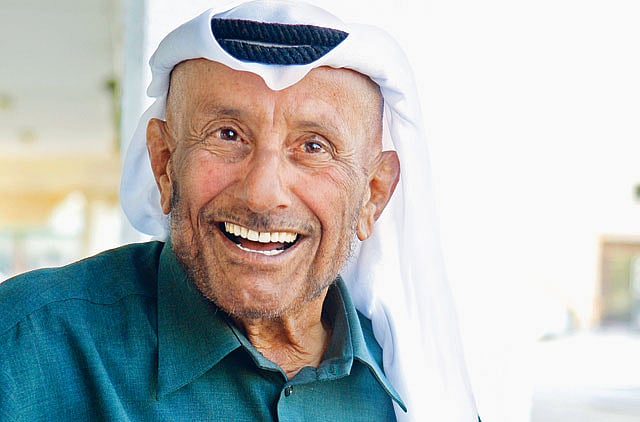
He remembers a time when a man who knew how to drive a car was given pride of place in Dubai. Bedouins would prepare a feast for him each time he came visiting.
He also remembers an era when the road from Dubai to Abu Dhabi would see a mere ten cars daily, mostly belonging to royalty.
This bygone age is dear to 69-year-old Butti Bin Bishr, because it was during those days, 40 years ago, that he became close to the late Shaikh Zayed Bin Sultan Al Nahyan. Bin Bishr's personality reflected his transparency in talking about life in the past. It also reflected his lucid memory, which has helped him remember events by their exact dates and people by their names.
Bin Bishr shared with Weekend Review some of the important moments which he has lived and witnessed, including the formation of the federation.
Rare pictures of him accompanying Shaikh Zayed in hunting and recreational trips are seen in his office, besides old pictures of Dubai as a city.
Besides being known for accompanying Shaikh Zayed as his personal secretary, Bin Bishr is a well-known figure among the national community for his philanthropic work and support of youth.
He was also close to Shaikh Rashid Bin Saeed Al Maktoum.
Shaikh Zayed's secretary
"My father was a friend of Shaikh Zayed in the Fifties and we used to exchange visits with Al Nahyan family members frequently," said Bin Bishr on how he came to know Shaikh Zayed.
"I was a friend of Shaikh Saeed Bin Shakbout, Shaikh Zayed's uncle. He used to call me when he used to head to Al Ain for recreation. I used to go to him in Abu Dhabi in my car and then we used to head to Al Ain or sometimes I used to meet him in Al Ain directly from Dubai.
"The reason was that at that time, the number of cars in Abu Dhabi did not exceed ten, which were owned by royalty. At that time, a Land Rover used to be used as a taxi," he said.
He recalled how a driver at that time was considered an extremely important person and the Bedouins used to prepare feasts for him if he visited them.
"At that time, I was also friends with Majid Al Ghurair, who was thinking of opening Oman Bank (Mashreq Bank now) in the Sixties. He chose Abdullah Bin Hareb, Ahmad Bel Hasa and me to be with him in that. He then wanted to open the bank's branch in Abu Dhabi but Shaikh Shakbout refused. I suggested that Al Ghurair open the branch in Al Ain. Shaikh Zayed was the ruler of Al Ain then. A group of us went to see him [Shaikh Zayed]. I told him the bank's story and that we wanted to open the branch in Al Ain. He welcomed the idea but said I had to be the branch manager. This was in 1965," he said.
Bin Bishr said Shaikh Zayed then inaugurated the branch. In 1966, Shaikh Zayed went on to become the ruler of Abu Dhabi. "On December 25 of the same year, we had New Year holidays. As we were heading to Al Ain to spend the holidays, we spotted military cars near an oasis, so we knew that Shaikh Zayed was in the area. We went to greet him. At that time, he asked me: ‘Where is your bag?' I said it was in my car. He ordered one of his guards to take my bag from my car and put it in his. It was then that he chose me to be his personal secretary."
Bin Bishr said Shaikh Zayed used to consult him and ask for his opinion or how well he knew a certain person.
"I even held the position of the undersecretary at the Public Works Ministry and supervised most of the construction projects in the eastern region," he said.
About the personality and nature of Shaikh Zayed, Bin Bishr said: "Shaikh Zayed used to encourage people to be educated despite the hardships and the lack of materials. He was a loveable person and had good relationships with everyone. He was very down-to-earth."
Bin Bishr said he would sit with Shaikh Zayed on Abu Dhabi Corniche, which was the first corniche at the time. "It used to be a very casual seating, where people would just pass by, greet Shaikh Zayed and talk to him without any formalities," he said.
Bin Bishr said Shaikh Zayed used to even encourage people to trade and open up shops and groceries.
"Once he caught a man and encouraged him to open a grocery, although at that time, it was not acceptable for us to open groceries, because Bedouins usually would not."
Shaikh Rashid's vision
Bin Bishr also recalled how Shaikh Rashid, when he became the ruler of Dubai, first focused on education.
"He used to take the youth from the UAE and send them off to study abroad but in a way that they could come and teach others here," he said. The curriculum back then was religious and used to start with memorising the Quran, according to Bin Bishr.
"I think the education system back then was more useful. Pupils would start learning Arabic and the correct pronunciation of words. After that they would start memorising the Quran and learn mathematics. Back then, we used to calculate easily and solve complicated mathematical questions ourselves. However, pupils nowadays instantly use the calculator, which I think is a drawback in the way of teaching, as there is no stimulation of the pupils' minds."
Bin Bishr was the first to excel in using the typewriter back then.
"I used to hold the first place in typing in Arabic at that time. I used to type 75 words per minute. People would come to see Bin Bishr type on the typewriter," he recalled.
About the life in Dubai back then, Bin Bishr said people used to have two meals a day, lunch and dinner, while the breakfast was a cup of tea and some dates. Some people would even skip dinner.
People used to spend most of their time at work, which required a lot of travelling — whether for trading, fishing or diving. They used to spend winters in the Al Shindagha area and in summer, they used to move to Bur Dubai, which was a forest of palm trees and farms and the temperature would be low, compared to other areas.
"Allah has blessed this country with leaders who worked hard to provide stability and security for citizens. All sectors, from trading, fishing and other jobs, were encouraged and they also flourished, especially because there was no tax on traders or businessmen," he said.
Sign up for the Daily Briefing
Get the latest news and updates straight to your inbox
Network Links
GN StoreDownload our app
© Al Nisr Publishing LLC 2026. All rights reserved.