Confronting filth
Repulsive on the face of it, ‘Dirt' hides enlightenment underneath
The Wellcome Collection's riveting new show, Dirt, opens with a shocker: a window so filthy, not an inch of glass is visible beneath the grime, a thick brown substance that twinkles repulsively in the gallery lights. It is gutter dirt, pavement dirt, the dirt of cities blown with dust and litter. It causes immediate recoil.
And it covers the sill and frame, this unspeakable stuff, so that the whole thing becomes a solid block of dirt. You cannot see through the glass — if you can bear to look — its transparency stopped, its vision blocked. This window is effectively blind.
It would be hard to overstate the physical effect of James Croak's 1991 sculpture, which is literally cast from street-sweeper's dirt. No matter how much art history it condenses — figurative yet abstract, with its resemblance to American minimalist sculpture; realist yet conceptual, with its wink at Duchamp's Large Glass — it is the primitive impact that counts.
Does it smell? Is it shedding filth? Asbestos? Germs? You stand away. Dirt is everywhere and we do not wish to confront it.
Anyone prepared to overcome this natural aversion, however, will be enthralled and enlightened by the Wellcome show.
The exhibition has more than 200 displays, from paintings, films and sculptures to Antonie van Leeuwenhoek's amazing 17th-century microscopes and Joseph Lister's earliest sterilising inventions, from hilarious soap advertisements and quaint portraits of Victorian mudlarks and Inspectors of Nuisance to dark exhibits from the Dresden Hygiene Museum: This is dirt as devastating racial metaphor.
The curators rake the murky world of dirt thoroughly, and dramatically, pondering the associations with cleanliness, godliness and social order.
Arrest All Dirt! exhorts the 1920s London Bobby, scouring what looks remarkably like Westminster with his torch as well as religion, ethics, class and mortality. You I are Earth, declares the script on a Delft plate over which someone has taken exquisite, if poignantly futile, care. What binds it all together is a central theme. The show is very purely about seeing, appearances, visibility. We think something is dirty because it looks dirty (though what about soil, for instance, source of so much sustenance?).
But then again, a century of relentless advertising has persuaded us that dirt is invisible too — because something looks clean doesn't mean that it is.
Dirt is grey, brown, something mouse-coloured between the two. It seems to have a base colour in some people's minds. But of course we cannot see most of it (the world's worst and least polluted air appear identical in Angela Palmer's installation of glass vials), and if we could, then it might alter some preconceptions.
Dust mites, for examples, turn out to be a beautiful mother-of-pearl pink. Algae can be green, cobalt, turquoise. Beneath Leeuwenhoek's microscope, he could see the plaque scraped from his own teeth dancing like fireflies. (You can see what he saw too, enlarged on a plasma screen).
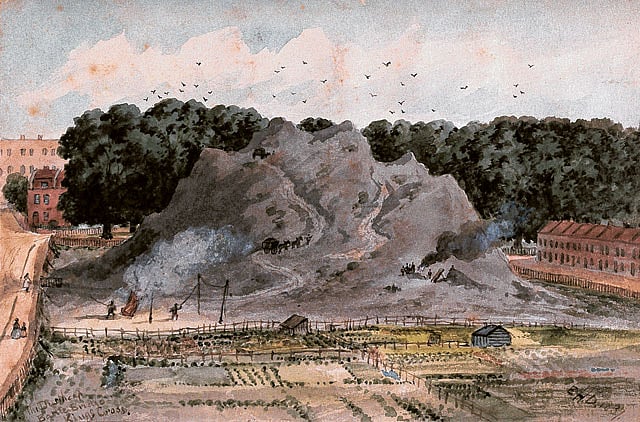
For every Victorian painting of The Great Dust Heap at Kings Cross, or its modern equivalent, video of teeming developing-world landfills, there is a focus on detection, on bringing the invisible to light. Indeed the show's central work is surely John Snow's map of Soho during the cholera outbreak that devastated the area around Broad Street in 1854.
Snow was obsessed with discovering the source of the plague. He walked every street, knocked on every door, interviewed every survivor he could find. The dead are recorded as black rectangles on his map, eerily like coffins or dominos, stacking up corpse by corpse, house by house. From the visual patterns Snow was able to deduce his momentous conclusion that the Broad Street water pump must be the source of the infection. Without this map, black and white and utterly unforgettable, the understanding of cholera would have been held back. It is a masterpiece of information expressed through design. It is, of course, easier to look at a map than a flask full of human fluids infected with cholera.
I cannot pretend that there are no moments of revulsion in Dirt. The vast installations of tomb-like slabs made of human faeces by the artist Santiago Sierra, the horrifying photographs of Victorian slums in Glasgow, clogged with filth in which infants sit. Some exhibits are actually frightening. The primitive "epidemic ambulance", a black trunk on wheels, halfway between pram and coffin, with a tiny window for the entombed victim to look out, is the embodiment of dread. It pierces the imagination more effectively than many a work of art.
And given that most dirt is either ugly or invisible, it is no small thing that the curators have managed to materialise its presence, its effects, so strongly. Who could forget the 1831 engraving of a young Venetian woman before and after contracting cholera, from health to agony in a matter of hours, the characteristic hue of the skin most potently imitated and conveyed by the blue tinting of the print.
It's a great art show that can alter your way of looking.
‘Dirt: The filthy reality of everyday life' is on through August 31 at Wellcome Collection in London.
Sign up for the Daily Briefing
Get the latest news and updates straight to your inbox
Network Links
GN StoreDownload our app
© Al Nisr Publishing LLC 2026. All rights reserved.