Rising cost of groceries at top of Asia agenda
As food prices hit record highs, food processing companies are regarded as the hot investment sector this year
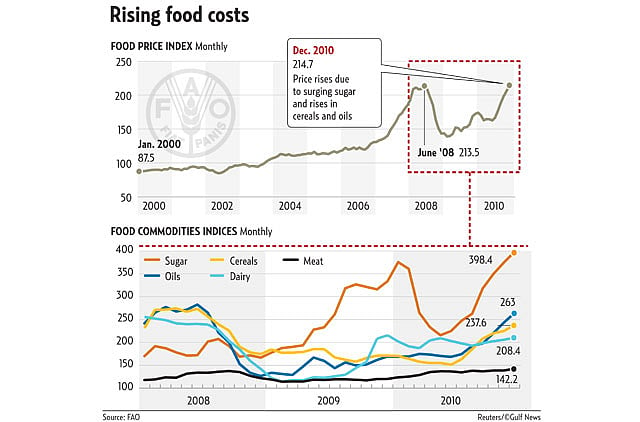
Singapore: Record high food prices are moving to the top of the agenda for many Asian policymakers as the prospect of higher inflation in 2011 poses a major threat to the region's strong revival from the global financial crisis.
The United Nations food agency (FAO) said Wednesday that food prices hit a record high last month, moving beyond the levels that prompted riots in 2008 in countries as far afield as Egypt, Cameroon and Haiti.
Food inflation in many Asian countries, including China and India, is already in double digits, raising fears that the price pressures could spread more broadly to other sectors and pose a threat to both economic and social stability as millions of Asians live in poverty.
Surging food prices have proved a trigger for social protests in the past, forcing governments to cave in to demands for action. They were a factor in the fall from power of Indonesia's long-term autocrat Suharto in 1998.
"Food price inflation could really go into double digits across the region and rise to such an extent that it undermines the purchasing power of households and as a result then slows consumer demand and overall economic growth," said Frederic Neumann, regional economist at HSBC in Hong Kong.
"And that's a problem for Asian economic growth. But really it's also a problem for the rest of the world because as the Asian consumer increasingly is helping to stabilise world demand, it's actually a challenge of wider global significance."
Indeed, South Korean authorities sounded the alarm yesterday over rising commodity prices.
The finance ministry said it would make an effort "on all fronts" to curb price pressures, which it blamed on surging oil and commodities prices and the central bank signalled rate rises to come by saying it would keep inflation within its target zone of two per cent to four per cent.
Illustrating the food price pressures, wheat rose 47 per cent last year, buoyed by a series of weather events including drought in Russia and its Black Sea neighbours. US corn rose more than 50 per cent and US soybeans jumped 34 per cent.
There is little reason now to expect any let up in the price rallies, said Luke Matthews, a commodity strategist at Commonwealth Bank of Australia.
"We do believe that the structural drivers behind high food prices are likely to persist for some time," he said. "We have tight stocks in the corn and sugar markets, we have world wheat stocks susceptible to turn lower with forecasts of La Nina to persist for the next three months or so."
La Nina is a weather pattern that brings cooling temperatures, resulting in higher rainfall in Australia and parts of Southeast Asia.
Vegetable growers
The structural drivers make food commodities and the stocks of food companies hot investment sectors this year, said Terence Wong, an analyst at brokerage DMG in Singapore.
He cited vegetable grower and processor China Minzhong and animal drug maker China Animal Healthcare as his top tips in the local market.
Fan Cheuk Wan, head of Asia Pacific research at the private banking division of Credit Suisse, favours Indonesian palm oil firm Indofood Agri Resources and suggested investors avoid companies that could get hit by price controls.
The FAO said sugar and meat were at their highest since its records began in 1990, but that wheat, rice and corn were at their highest since 2008.
However, benchmark Asian prices for rice suggested a different picture.
The region's staple food now stands at half its 2008 levels of more than $1,000 (Dh3,672) a tonne that prompted several governments at the time to impose curbs on exports to protect their domestic markets.
World Bank President Robert Zoellick urged governments in a newspaper opinion column to avoid protectionist measures as food prices rise and called upon the Group of 20 leading economies to take steps to make sure the poor get adequate food supply.
Still, Asia's rapidly rising consumption as developing economies such as India, China and Indonesia emerge on the world stage is a major factor behind the rise in food prices.
China is expected to buy 60 per cent of internationally traded soybeans in 2010-11, double its purchases of four years earlier.
Several countries have implemented measures to try to keep food prices under control, worried about a repeat of the inflation spiral in 2008, when a surge in world commodity prices prompted inflation to jump and left many countries with a deep trade deficit.
India's food prices rose to a one-year high of more than 18 per cent in the year to the end of December, data yesterday showed.
That, along with rising fuel prices, is the main reason analysts expect the central bank to raise rates this month.
The Indian government has operated a range of measures for years to ensure stable food prices, but since last year has boosted the release of national stocks of grains and has pledged to continue with duty-free imports of crude vegetable oils.
In China, several cities have implemented direct controls to limit food price increases and the central government has vowed to eliminate speculation in the country's commodities markets.
The cost of food rose 11.7 per cent in the year to November, while non-food items were up just 1.9 per cent. Consumer goods prices and housing costs showed clear jumps.
Vietnam, the world's second-biggest rice exporter, decreed in November it would tightly control overseas sales of the grain to ensure sufficient domestic supply and avoid a price surge ahead of the Lunar New Year holiday due to start next month. The country's food inflation is 18 per cent.
Sign up for the Daily Briefing
Get the latest news and updates straight to your inbox
Network Links
GN StoreDownload our app
© Al Nisr Publishing LLC 2026. All rights reserved.