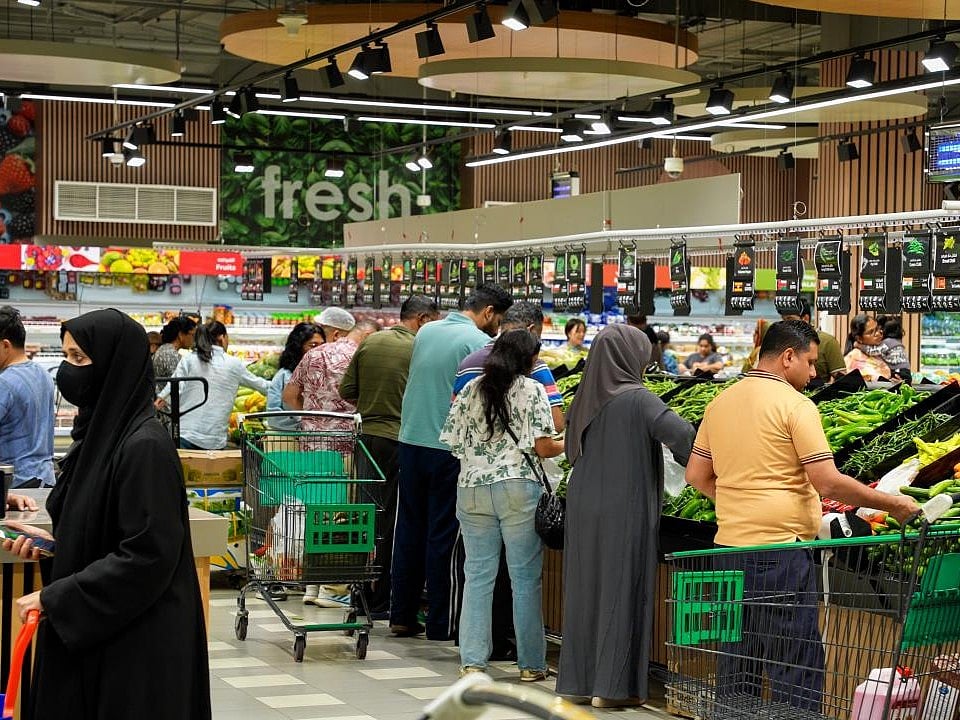
Grocery shopping at Lulu hypermarket
Dubai: UAE residents looking to manage grocery spending can compare listed prices for rice, eggs, milk and cooking oil through the Ministry of Economy and Tourism’s Essential Goods Prices Platform.
The dashboard identifies retailers and pack quantities, helping households assess the cost of everyday purchases using a common measure. The prices are updated as of October 8, 2026, providing a dated reference for shoppers planning their baskets.
The table below shows the lowest calculated unit prices among its displayed retailer entries. These figures use the ministry’s pack prices and quantities, rather than estimates drawn from supermarket websites or delivery apps.
Where to find lower prices
Products can differ in brand, size and specifications. A listed unit price helps identify an option to investigate; shoppers should check the actual product and pack quantity before making a purchase.
| Commodity | Unit | Lowest listed price | Retailer | ||
|---|---|---|---|---|---|
| White sliced bread | kg | Dh4.92 | Umm Al Quwain Coop | ||
| Fresh whole chicken | kg | Dh11.31 | Emirates Coop | ||
| Canola oil | litre | Dh7.28 | Emirates Coop | ||
| Corn oil | litre | Dh7.25 | Carrefour | ||
| Sunflower oil | litre | Dh5.10 | Emirates Coop | ||
| Fresh whole milk | litre | Dh3.75 | Emirates Coop | ||
| Powdered milk | kg | Dh15.33 | Sharjah Coop | ||
| Yoghurt | kg | Dh3.48 | KM Trading | ||
| Brown eggs | egg | Dh0.49 | Carrefour | ||
| White eggs | egg | Dh0.23 | Choithrams | ||
| Beans | kg | Dh4.53 | Al Maya | ||
| Fava beans | kg | Dh3.83 | Emirates Coop | ||
| White chickpeas | kg | Dh3.99 | Carrefour | ||
| Green lentils | kg | Dh4.38 | Umm Al Quwain Coop and Union Coop | ||
| Red lentils | kg | Dh3.88 | Al Maya | ||
| Basmati rice | kg | Dh4.38 | LuLu | ||
| White sugar | kg | Dh2.35 | LuLu | ||
| Flour | kg | Dh6 | Spinneys, Nesto, Carrefour, LuLu and Emirates Coop | ||
Unit prices are calculated from displayed pack prices and quantities and rounded where needed. The platform groups dry and canned products together for beans, fava beans, chickpeas and lentils, so their form needs checking.
Rice and sugar
LuLu’s listed 5kg basmati rice pack costs Dh21.90, equivalent to Dh4.38 per kilogram. Its listed 5kg sugar pack costs Dh11.75, or Dh2.35 per kilogram.
For a household considering both products, those packs would cost Dh33.65 combined. That calculation covers only the two listed packs and does not represent a complete grocery basket.
A larger quantity can make a unit price attractive without matching every household’s needs. Residents should consider how much they use and can store before choosing a pack solely because of its price per kilogram.
Eggs and chicken
Choithrams lists white eggs at Dh3.45 for 15, equivalent to 23 fils per egg. Carrefour’s listed brown eggs cost Dh14.55 for 30, or approximately 49 fils each.
These are separate product listings, so shell colour should not be the only basis for choosing between them. Shoppers should check the egg size, brand and other specifications alongside the carton quantity.
Emirates Coop’s fresh whole chicken listing costs Dh12.44 for 1.1kg, equivalent to about Dh11.31 per kilogram. The purchase price is Dh12.44; the kilogram figure provides a standard measure for comparison.
Oil and dairy
Emirates Coop’s listed sunflower oil costs Dh25.50 for five litres, equivalent to Dh5.10 per litre. Its canola oil listing costs Dh26.20 for 3.6 litres, or about Dh7.28 per litre.
Carrefour’s corn oil listing costs Dh21.75 for three litres, equivalent to Dh7.25 per litre. These are different oil types, which households should assess separately according to their requirements.
For fresh whole milk, Emirates Coop lists one litre at Dh3.75. KM Trading’s yoghurt listing costs Dh34.75 for 10kg, equivalent to approximately Dh3.48 per kilogram.
The yoghurt example shows why the quantity behind a unit price deserves attention. The displayed calculation does not mean shoppers can buy a single kilogram for that amount.
Supply costs matter
Government price monitoring means wholesalers must keep their prices competitive enough for retailers to maintain regulated price levels, according to Dubai-based food commodities supplier Avisa General Trading.
“This puts additional pressure on importers to optimise sourcing and logistics costs,” the Dubai-based food commodities supplier said in its March market analysis.
Its commentary linked that pressure to government price monitoring and identified diversified sourcing, forward purchasing contracts and consolidated shipments among strategies for managing costs. Those observations provide supply-chain context, rather than evidence of October price movements.
Track monthly spending
Arsh Marketing, a UAE ad agency, describes the shopping pattern in its retail commentary: “Smaller, more frequent baskets mean more visits but less spend per visit.”
The platform also lets users select products and compare total bills, with filters for category, brand, unit, location, store and branch. Building a list around your regular purchases helps make the comparison relevant to the items your household actually needs.
Spending less per visit does not establish a lower monthly bill. Compare identical products and quantities across the same period, keeping receipts and recording promotions separately.

Justin is a personal finance author and seasoned business journalist with over a decade of experience. He makes it his mission to break down complex financial topics and make them clear, relatable, and relevant—helping everyday readers navigate today’s economy with confidence. Before returning to his Middle Eastern roots, where he was born and raised, Justin worked as a Business Correspondent at Reuters, reporting on equities and economic trends across both the Middle East and Asia-Pacific regions.
Sign up for the Daily Briefing
Get the latest news and updates straight to your inbox
Network Links
GN StoreAbout Gulf NewsTerms & ConditionsReach by GNSitemapContact usPrivacy PolicyGN FocusHave your sayWork with usAdvertise with usGulf News epaperPrinting Services
Download our app
© Al Nisr Publishing LLC 2026. All rights reserved.