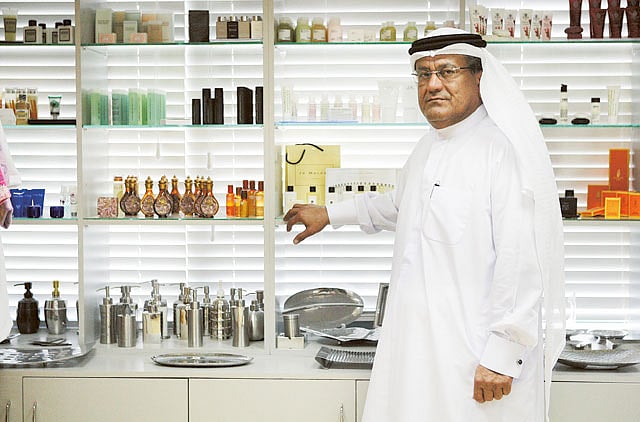
Mohamed started Dimara International in 2005. Dimara supplies and manufactures of guest amenities, bed and bath linen, in-room accessories, and disposables for hotels, airlines, and hospitals Dimara counts all major hotel chains and airlines as clients. The trading strategy has increased value-addition in Dubai over the years reflected in increased product variety, product development, branding, and local manufacturing.
How did Dimara start?
Watching my country grow and prosper, I wanted to start a business that corresponded with the growth and success of the tourism sector of the economy. I looked for products to serve the hospitality industry where I could add value. I found a niche of ‘amenities’ where the trade was leaving a ‘space’ for innovation and creativity led growth; they were the ‘little things that always make a difference’ to the hotel experience. Inspiration came from hoteliers who believed that local companies could not provide them products of similar or better standards than companies from the US, UK, France, or Germany. We have proven them wrong.
How did this happen?
I had two things when I started Dimara - I had sensed an opportunity in the hospitality business and had passion and commitment to serve customers to my utmost professional capacity. Many companies were trading. I was determined that we will not supply the hospitality industry blindly, trading boxes in and out, but would add value based on developing a deeper knowledge and understanding of customers. This became my business focus and purpose. To achieve this we have steadily worked to acquire innovative products and brands, customize solutions for customers, and provide exceptional service. We didn’t achieve this overnight. It has been a challenging journey.
How did you enter the market?
The first six months was tough. It was not easy to win the trust of buyers in the hotel industry. They were more comfortable working with Europeans. I was an Emirati wanting to sell products to hotels! Clients would look at me and wonder whether I knew anything about what I was selling. Fortunately, I was blessed with a strong team that through dedication and persistence helped me prove that we could surpass the standards set by European companies.
Is being an Emirati businessman a challenge?
Initially yes. People have developed biases which are difficult to change. They think Emiratis do not pay attention to detail and are not hard working. I had to prove to my customers that I care about what I am selling, about my business, and that I can meet their expectations.
How did you overcome this barrier?
I did not anticipate the extreme scrutiny of our buyers. The only thing that helped me overcome the hurdle of establishing our place in the market was persistence, and not giving up.
I did actual selling after gaining knowledge of the product. I worked with my manager to handle uncertainty of customers. We divided the work amongst us. Sometimes she fronted with the customer, ‘pushing’ the sale, and I supported her. At other places I led the dialogue and she complemented me. On occasion we brought the sales managers of the foreign companies, our partners, to assist us. I found at times that customers preferred to work with foreigners, even if I have better product knowledge.
I also discovered ‘hidden’ costs involved in purchase. Buyers and suppliers had ‘cozy’ arrangements. Buyers were uncertain how to deal with an Emirati, worried about their ‘invisible’ benefits. I learnt to rise above this and get business, setting an example in the industry for honest practices.
How did you win customers?
We developed a marketing plan based on target customers and market research, and allocated a budget to accomplish goals set. To position ourselves as different from others and gain customers we used ‘cutthroat’ prices and easier payment terms. We took risks in the start-up phase. We made some mistakes and learned from them. I made it a principle to live the belief that ‘the customer is always right’ to satisfy customers in their transactions with Dimara. I think what helped Dimara was our decision to provide value-added services to our customers that our competitors did not have – an in-house design team, consultancy team that works closely with clients, and production units to make and customize products.
You had to learn everything about the business.
I learned by doing, through trial and error. To a lay observer the products we sell are simple and uncomplicated. Initially even I was completely misled. Amenities are more than just a shampoo and soap. A ‘science’ underlies the creation and production of products and development programs that we implement for hotels. Business has two parts – the products and the business itself. We are engaged in design, details of product composition, selection of fragrances, packaging design, and branding of products we sell. I visited factories to understand production and to position our products. I learned to choose business partners and make strategic alliances. I learnt how different costs make up the final price of the product – the cost of product, packaging and branding - and price mark ups. To learn the ‘business of the products’ took even more time. I had to ‘manage’ the suppliers, consistently manage quality, to talk to customers about the products, and satisfy them.
I recount an important step that I took in the beginning that has helped the business. I appointed a person, whom I knew, to manage the operations of the company. And I focused on developing the market, making strategic alliances with well-known hotel chains.
Did suppliers trust you?
Trust is something that is earned; when any new business starts there is a doubt about its ability to pay. Factories would manufacture goods after we paid 50% of order value as an advance. The balance was paid when goods were ready for dispatch. Our order volumes are now much higher and we have earned some flexibility with suppliers; we don’t have to make advance payments. However we still make payments before delivery.
In B2B selling payments are delayed.
I give credit to customers that are well-known in the market and have an established relationship with us. Local customers delay payments, however eventually they do pay. My initial investment into the company was a few million.
How has the business developed?
The business has evolved partially as planned and in unforeseen areas. We seized an unforeseen growth opportunity when we hired a tailor to make minor alterations to some of our products for a client. Today we run a complete tailoring and production unit. We found that we were able to reduce costs, provide better delivery times to our clients, and have more flexibility with raw materials with our own production unit. The decision to start a linen manufacturing unit three years ago was again unforeseen. It was influenced by a delayed delivery issue with an overseas supplier and urgency to fulfill our commitment with a client. We realized the economic value of local manufacturing. From that time onwards we strive to provide enhanced service to our clients by local manufacturing.
Learning from the business?
There is a big difference in being employed and running a business. The service industry has no fixed hours, and to meet customer needs we sometimes work on Fridays. We also arrange deliveries during Eid; our clients have high occupancy during the festival and we accommodate them. My family sometime feels that if I was employed, I would have given them more time. One has to make choices, either you build a business or are employed all your life.
Is competition a worry in trading?
Trading is a competitive business. Getting in mindset of your client is the key to being successful in trading. Some clients want superior products while others are interested in the price. I strive to have products that are unmatched in their quality. And when we couple that with high service standards we set ourselves apart from the rest.
Sign up for the Daily Briefing
Get the latest news and updates straight to your inbox
Network Links
GN StoreDownload our app
© Al Nisr Publishing LLC 2026. All rights reserved.