Dubai: Investors in real estate in the Middle East and North Africa (Mena) region have done an about-face from two years ago and are now asking governments to play a larger role in regulating the industry.
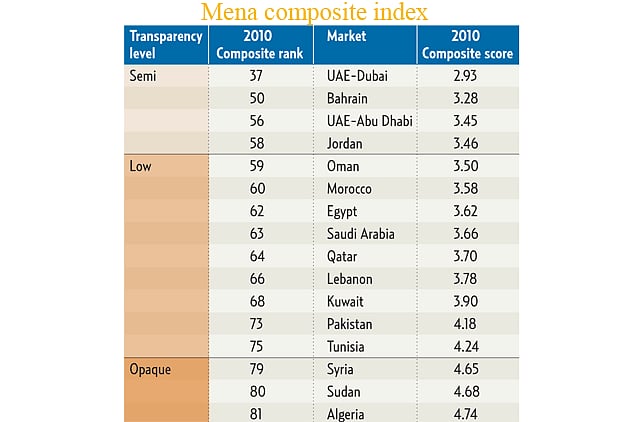
Mena is the only region where there are no countries or cities ranked higher than semi-transparent on the Jones Lang LaSalle global real estate transparency index.
The four semi-transparent areas in Mena find themselves in the company of the likes of Brazil, Chile, Greece, Taiwan, Romania and Russia.
"Dubai still finds itself at a semi-transparent level when seen globally, but the improvement over the years has been unprecedented, making it the leader in the Middle East," said Blair Hagkull, managing director, Jones Lang LaSalle Middle East.
Dubai ranks 37th on the global list and heads the semi-transparent group followed by Bahrain, Abu Dhabi and Jordan. Abu Dhabi, according to the report, is one of the largest improvers in the region this year, thanks to the introduction of various reforms and laws in the real estate sector.
The ranking includes the categories highly transparent, semi transparent, low transparency and opaque.
Turnaround
In what could be described as a U-turn from the laissez faire attitude real estate players where demanding during the good times, they are now crying out for regulations, legislations and transparency.
"During the boom time about five years ago developers and investors were asking government to get out of the way whilst now the sentiment is please do get involved in the industry," said Hagkull.
Jones Lang LaSalles' Middle East office carries out regular surveys to measure investor sentiment in the market. It transpired that investors back in October 2008 ranked returns on investment as their highest priority, now that has dropped to third place, risk being the second most important concern.
At the top of the wish list are regulations and legislation increasing in importance from 2008 over October 2009 to its highest level now, Hagkull remarked. Around 45 per cent of those questioned voted for an increase in regulations and transparency.
"The downturn is a good opportunity for reforms and transparency to take hold. Dubai has seen a bit of inertia after introducing the regulations, which have been slow to be adopted in the market, but Dubai's Real Estate Regulatory Agency [RERA] is eager to reengage," Hagkull said.
Theme
Regulations and transparency were the theme running through yesterday's Cityscape Connect breakfast meeting. Experts in the real estate sphere questioned whether regulations were as affective as they could be.
Michael Lunjevich, Partner, head of commercial and real estate, Hadef & Partners, pointed out that self-regulation didn't work welcoming the major steps taking in introducing various regulations, but pointed out there was room for improvement.
"Regulations don't work unless there are stiff penalties, including monetary and prison sentences to make people comply," he said.
On the consumer protection front, sales by developers to buyers ultimately amount to a collective investment scheme that could be regulated a bit more and increased disclosure is paramount for buyers to know what they are getting themselves into, he added.
The valuation sector is also calling for more in-depth data to achieve a level of transparency allowing for effective consolidation of buildings to increase confidence in the market.
"Education is paramount but we need key accountable data on buildings to do fair valuations," said Jim Drysdale, director, RICS Mena.
Prices remain stable
The prices of apartments, villas and commercial properties remained stable in Dubai in the second quarter of this year compared to the previous three months, with minimal reductions in villas across just two areas of the city, according to a new report by real estate management company Asteco.
The Asteco Q2 2010 Report said that no change was recorded in the sales price of apartments and offices, with flats in Dubai International Financial Centre (DIFC) and on Palm Jumeirah still commanding the highest prices.
"The market is, however, at a stage where pricing can vary from unit to unit in any particular property. We have noticed some overseas clients, who bought property on Palm Jumeirah, are prepared to sell at a much lower price per square foot as the exchange rate is more favourable without them incurring any discount," said Elaine Jones, CEO, Asteco Property Management.
Villas, meanwhile, also remained on a par with the first quarter of 2010 in all areas except The Meadows and The Springs, where prices declined 5 and 6 per cent respectively "mainly due to the large number of units available in the area, their age and the fact that owners who initially bought into this development at low launch prices, are in the position to reduce their asking price without making a loss", said the report.
Palm Jumeirah villas remain the most expensive at Dh1,800 per square foot due to its iconic water-front development, with the Green Community at the opposite end of the scale with villas selling for Dh700 per square foot.
It was a different story on the rental side, however, as an increase in the number of units coming online in Dubai over the second quarter of 2010 forced prices down, providing tenants with the opportunity to move to better locations or larger properties. Overall, apartment rents declined an average of 8 per cent compared to the first quarter of 2010.
Dubai Marina proved particularly popular with people previously living in Jumeirah Lakes Towers (JLT), attracted by the wealth of amenities. This movement then had a knock-on effect down the price chain as those in Discovery Gardens upgraded to JLT and people in International City looked for flats in Discovery Gardens.
Commenting on the trend, Jones said: "Although relocation trends from Abu Dhabi and Northern Emirates have slowed due to price correction in those markets, internal movement in Dubai is at its peak with tenants looking for upgrades in terms of quality, size or location. But there is an exceptionally broad range of prices, depending on the motivation of the landlord. As a consequence the rental market, especially for apartments, is very active."
The report added: "Palm Jumeirah has also seen a significant amount of new supply with the handover of Marina Residences in the first quarter and the delivery of Oceana Residences in the second quarter of this year. This has put a strain on the already large inventory in Shoreline Apartments and Golden Mile. However, rental rates in Tiara and Oceana are above average due to the superior quality and exclusivity of the facilities [such as private beach, state-of-the-art health club, etc]."
Villas, on the other hand, fared better with rental reductions of just 4 per cent on average across Dubai despite also seeing an increase in supply. Villas in Jumeirah proved the most resistant, seeing falls of just 1 per cent thanks to its established community.
"The handover of developments such as Layan in Dubailand, the Cedre Villas in Dubai Silicon Oasis and the Shorooq Villas in Mirdiff inevitably put pressure on rents. Although these projects have limited infrastructure, facilities and landscaping, these properties attracted some people to move to take advantage of cheaper rents and larger unit sizes despite the lack of infrastructure," said the report.
On the commercial front, the Dubai Q2 2010 Report found that rents still show a downward trend in office rents. Office inventory continues to enter the market especially in the new commercial areas of Business Bay, DIFC and Jumeirah Lakes Towers. — N.W.
Sign up for the Daily Briefing
Get the latest news and updates straight to your inbox
Network Links
GN StoreDownload our app
© Al Nisr Publishing LLC 2026. All rights reserved.