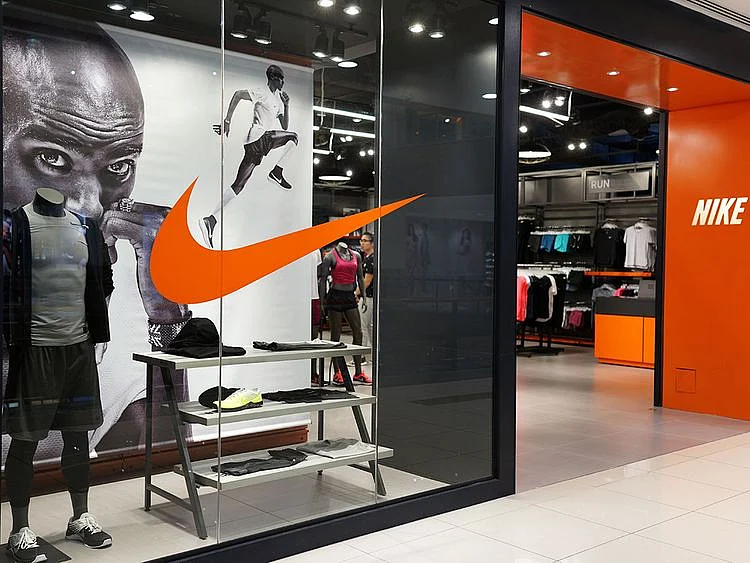
US and European sneaker, clothing and jewelry makers plunged amid a shock to supply chains after President Donald Trump announced new tariffs on crucial production countries including Vietnam and Indonesia.
The US imposed a 46 per cent tariff rate on Vietnamese goods as part of Trump’s growing global trade war. Other new tariffs include 49 per cent on Cambodia and rates of more than 30 per cent on China, Indonesia and Thailand.
Nike Inc. plunged as much as 13 per cent in New York trading, hitting the lowest level since 2017. Lululemon Athletica Inc., Abercrombie & Fitch Co. and Gap Inc. also posted share declines. In Europe, Adidas AG shares fell as much as 11 per cent in Frankfurt trading while Puma SE declined as much as 14 per cent. Hennes & Mauritz AB, Pandora A/S and JD Sports Fashion Plc also fell.
“One of the biggest surprises” is how every company in the apparel industry will be impacted, according to a research note from UBS analysts led by Jay Sole. “Our view is that, given how extensive the list of tariffs is, the industry will realize there are few ways to mitigate the impact in the medium term other than by raising prices.”
Increased reliance on Vietnam factories
Sneaker makers such as Adidas, Puma and Nike have increased their reliance on factories in Vietnam and Indonesia, especially after Trump targeted China with tariffs in his first term as president. Today, about half of all Nike brand shoes and 39 per cent of Adidas shoes are made in Vietnam, according to regulatory filings.
Vietnam is the largest supplier of footwear for both companies, and shoes produced in the country account for more than $20 billion in combined annual revenue.
Sports companies may struggle to find a better place for production, to renegotiate terms with suppliers or to raise prices on consumers much anytime soon, Piral Dadhania, an analyst at RBC Capital Markets, said in a note. That could force the companies to absorb much of the costs of the higher duties, eating into profits. Nike and Puma are probably more exposed to this right now than Adidas, the analyst predicted.
“Tariffs are a tax paid by the US importer that will be passed along to the end consumer,” said David French, executive vice president of government relations at the National Retail Federation.
China to retaliate
China quickly vowed to retaliate against the US, putting the world’s largest economies on a collision course that could further upend global supply chains and imperil economic growth. The European Union issued a similar warning, with leaders raising the prospect of potential retaliatory tariffs and targeting American services and technology companies.
Among shoe brands, Nike faces additional challenges because it’s so dominant in the US, the world’s single biggest sports market. Yet Adidas and Puma would probably need to raise their prices by about 5 per cent around the globe in order to maintain current profitability levels, James Grzinic, an analyst at Jefferies, said in a note. Nike, Adidas and Puma didn’t immediately respond to requests for comment.
On Holding AG, the Zurich-based shoemaker, is also in the cross-hairs. Last year, it produced 90 per cent of its footwear in Vietnam and 10 per cent in Indonesia. Meantime, nearly two-thirds of its revenue came from the Americas, mostly in the US, according to filings. Shares of the New York-listed company fell as much as 17 per cent in New York.
On said it regularly assesses and updates its supply chain and is confident that the strength of its brand will enable it to “navigate uncertain and volatile environments,” according to an emailed statement.
Shares of Shenzhou International Group Holdings Ltd., which makes products for US brands including Nike in Asia, fell 14 per cent in Hong Kong on Thursday, the most since 2008.
Tariffs add to the trade turbulence that shoe sellers are trying to navigate. Nike already said it expects its gross margin to decline sharply this quarter, in part due to US tariffs on products from China and Mexico.
“Shifting supply chains is not an option given performance footwear requires a very specific skill set and factories,” said Poonam Goyal, an analyst at Bloomberg Intelligence. “I can’t see how prices to consumers don’t go up.”
Major fashion retailers such as Uniqlo owner Fast Retailing Co. and H&M also count Vietnam as one of their biggest suppliers. The country exported $44 billion in textiles last year, with the US as its largest market, according to the Vietnam Textile and Apparel Association.
The footwear and apparel industries boosted production in Vietnam during Trump’s first term in the White House as the trade war with China escalated. Vietnam has low labor costs, a skilled workforce already adept at manufacturing shoes and clothes, transportation infrastructure, and was seen as less of a threat to be involved in geopolitical clashes. It also boasted trade agreements with the US and the European Union.
Hints that Vietnam could get entangled in Trump’s trade wars began in 2019, when Trump said that Vietnam took advantage of the US “even worse than China.” Vietnam has been among Asia’s fastest growing economies. Its gross domestic product grew 7.1 per cent last year, surpassing both government projections and estimates from analysts surveyed by Bloomberg.
'Will play golf all-day'
Just days after Trump re-entered the White House in January, Secretary of State Marco Rubio encouraged senior officials in Vietnam to address trade imbalances. Vietnam’s trade surplus with the US was more than $123 billion last year, according to US Census Bureau data, and officials have said they’ve been urging increased purchases of US products. Only China and Mexico have larger trade surpluses with the US.
Vietnam Prime Minister Pham Minh Chinh said in January that he’d be willing to visit Trump at Mar-a-Lago to “golf all day long” if it helps resolve trade quarrels. Since then, the government has been trying to appease the Trump administration by cutting its own tariffs on US cars, ethanol and liquefied natural gas.
Sign up for the Daily Briefing
Get the latest news and updates straight to your inbox
Network Links
GN StoreDownload our app
© Al Nisr Publishing LLC 2026. All rights reserved.