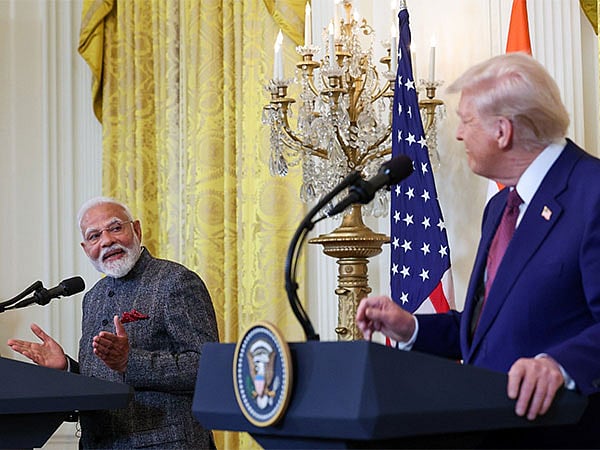
US President Donald Trump slapped India with some of the highest tariff rates imposed on any major US trading partner, saying his good personal ties with Prime Minister Narendra Modi did not affect his decision.
The Trump administration imposed a 26% tariff on imports from India, which is slightly higher than the 20% levy for the European Union, the 24% for Japan and the 25% for South Korea. China was hit with one the highest rates for a major US trading partner and now faces a tariff of at least 54% on many goods.
The tariffs are a setback for Modi’s government, which had sought to ward off the new levies by rolling out sweeping concessions on issues central to Trump’s agenda. During a visit to Washington by Modi in February, the two nations agreed to work toward a trade pact this year.
“India, very, very tough. Very, very tough,” Trump said at a news event at the White House on Wednesday to announce the tariffs. “The prime minister just left, and he’s a great friend of mine. But I said, you’re a friend of mine, but you’re not treating us right. They charge us 52%.”
Delhi overhauls tariffs
The levies are likely to ratchet up pressure on officials in New Delhi to hash out a trade pact with Washington to win a reprieve.
Ahead of the move, the Trump administration has been signaling India would be a target of the new duties, given that New Delhi charges some of the highest tariffs of any major economy. Trump has repeatedly criticized India’s high levies, branding the country as the “tariff king.”
Over the past few weeks, New Delhi overhauled its tariff regime, reducing import duties on some 8,500 industrial items, including on prominent American goods like bourbon whiskey and high-end motorcycles made by Harley-Davidson Inc., satisfying a longtime grievance of the US president.
India also indicated its willingness to buy more American oil, LNG and defense equipment to narrow its bilateral trade surplus. Officials have also signaled that more tariff cuts would be in the offing.
India to cut tariffs deeper?
Modi, who was one of the first foreign leaders to meet Trump after his return to the Oval Office, recently lavished praise on the US president, underscoring their close personal ties. The two nations agreed to conclude the first tranche of a trade deal by the fall of this year and boost bilateral trade to $500 billion by 2030, up from $127 billion in 2023, following the meeting.
The levies will also add further pressure on India to make even deeper cuts to its tariff regime. As a part of the discussions, India is considering US demands of duty cuts on US farm products, Bloomberg News reported last week, although agriculture is a politically sensitive issue in India. Officials were optimistic of a favorable outcome in wake of these concessions.
The new duties could also push New Delhi to yield to the US demand on dismantling non-tariff trade barriers, such as opaque import restrictions and licensing requirement on some imports.
Trump and Modi held multiple meetings during the US president’s first term. The US over multiple administrations has cultivated India as a regional partner and a bulwark against a more assertive China.
Sign up for the Daily Briefing
Get the latest news and updates straight to your inbox
Network Links
GN StoreDownload our app
© Al Nisr Publishing LLC 2026. All rights reserved.