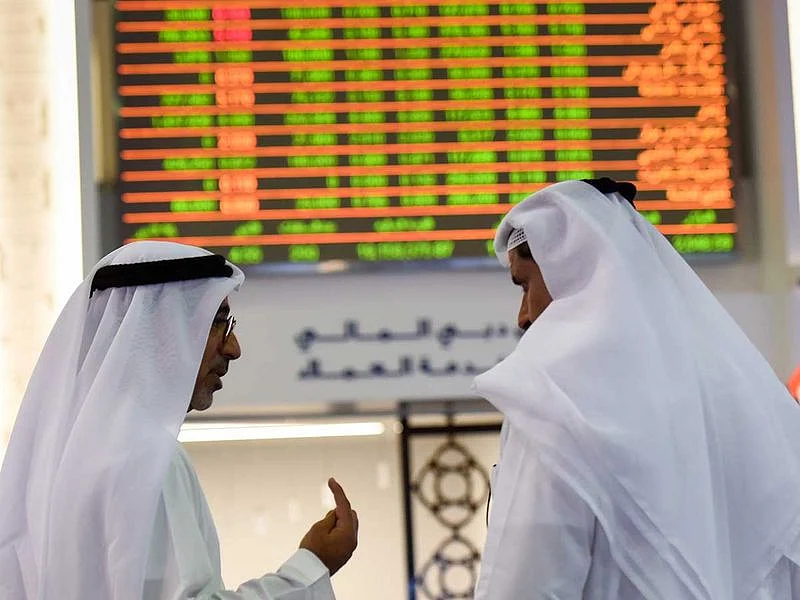
Dubai: The Dubai Financial Market (DFM) rose 3.95 per cent in late trade on Wednesday, its biggest daily gain since April 8. On Thursday it continued in the green, up 0.17 per cent and trading at 6,051.23.
The gains have pushed DFM's market capitalization back above Dh1 trillion, compared with Dh967.22 billion a day earlier. The Abu Dhabi exchange is also trading in the positive, reaching a high of 9572.69 on Wednesday.
Telecoms led the sectors with a 7.81 per cent gain. Real estate climbed 4.2 per cent and banks rose 3.99 per cent. Emaar Properties gained 4.4 per cent and Emaar Development 4.89 per cent after Emaar announced a voluntary cash tender offer for up to 100 per cent of its subsidiary.
Big market moves
Asian markets have also been gung-ho on Thursday. India’s Nifty 50 gained 1.8 per cent settling above 24,400, Sensex gained 1550 points. It was consumer stocks that led the rally across the region.
Pakistan's KSE100 is up 1.65 per cent, with 383 of the 567 stocks advancing in trade on Thursday.
China outperformed with the Hang Seng rising 3.3 per cent and the Hang Seng Tech Index surging 5 per cent. Tencent and Alibaba each added more than 6 per cent. The Shanghai Composite slipped 0.3 per cent.
Japanese market are split. The Nikkei 225 fell 1.6 per cent, while the broader Topix climbed 1.3 per cent. Nikkei futures were down 2 per cent.
South Korea took the hardest hit. The Kospi dropped 5.2 per cent. Samsung Electronics and SK Hynix each lost more than 7 per cent on fears of tighter data-centre regulation. Overnight, Nvidia stock also dropped 3.17 per cent to trade around the $200 level.
Tim Waterer, chief market analyst at KCM Trade, warns the AI data-centre buildout could hit “a regulatory brick wall” if the party follows through on its pre-election pledges.
But not everyone shares that alarm. Ryan Detrick, chief market strategist at Carson Group, observes that buyers are returning now that the vote is over. Many investors see little immediate threat to the AI theme.
What drove the moves
The US midterms triggered a rotation out of chipmakers and into unfavoured markets.
"Greater scrutiny of AI regulation, data centres, energy costs and investment incentives arrives when investors are already questioning the returns on enormous AI spending." says Charu Chanana, Chief Investment Strategist at Saxo Bank.
She adds that this could fasten the shift from AI exposure to stocks with strong cash flows and pricing power especially those with visible return on investments.
Oil too has fellen sharply. Brent crude tumbled more than 8 per cent on Wednesday and eased a further 0.7 per cent to $93.94 a barrel. Traders bet that a Democratic Congress will speed efforts to end the Iran war, now in its ninth month.
Treasuries rallied for a second day. The 10-year yield fell as much as five basis points to 4.84 per cent, its lowest since September 10. The Bloomberg Dollar Spot Index slipped 0.2 per cent.
Moves to watch next
Progress on either front, either diplomacy or trade policy, could prompt investors to shift capital toward businesses and regions hit by higher import and energy costs.
With bond yields at multi-decade highs, debt becomes more attractive, if refinancing gets costlier and equity valuations come under strain. Rotation could change who leads the market without producing a lasting, broad rally. Money leaving tech might lift indices with less tech exposure, but some of it could flow into sovereign bonds instead.
Central banks could add to the pressure. The Reserve Bank of Australia raised its cash rate by 25 basis points to 4.85 per cent on Tuesday. The Bank of England is expected to deliver a 25 basis point hike on Thursday. Other major central banks have also raised rates or signaled tighter policy in the coming months.
Although the result don't change much for the US Federal Reserve. According to James Wright, Senior Trader at Lunaro Financial Services, markets are still pricing in a December hike
"Slower fiscal spending could ease some price pressure over time. But with CPI inflation at 3.7 per cent, lifted by energy costs and tariffs, Friday’s US payrolls report and the CPI release on November 10 matter far more than the election", he said.
As for stocks, healthcare and renewable energy shares could do well. He also sees utilities names facing questions over power costs, while banks could see deregulation slow, he observes.
Network Links
GN StoreDownload our app
© Al Nisr Publishing LLC 2026. All rights reserved.