Surendra Rosha, Co-Chief Executive, Asia and Middle East, HSBC Holdings plc delivering his opening keynote address during the inaugural HSBC UAE Wealth Investment Summit.
HSBC UAE Wealth Investment Summit 2026 concludes
A quick look at all the highlights and takeaways from HSBC UAE wealth investment summit
Last updated:
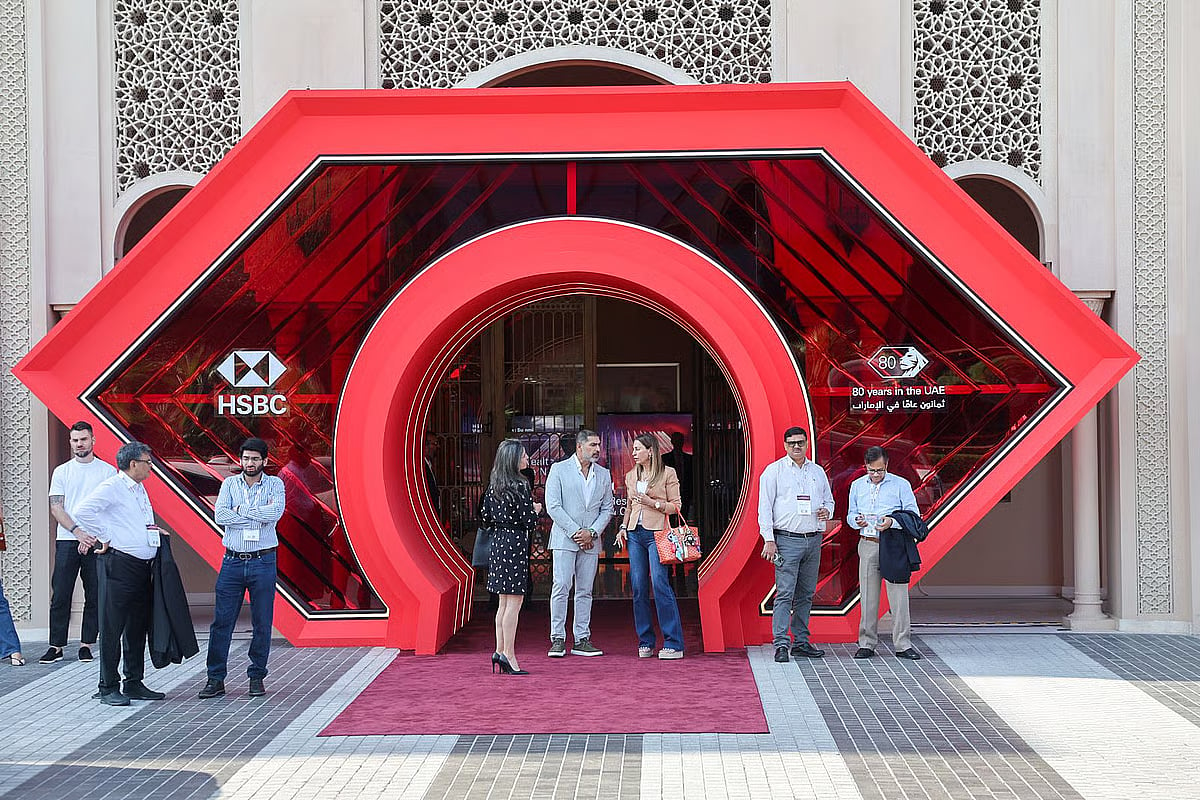
HSBC's Wealth Investment Summit closed with a clear message: wealth in the Middle East is maturing, and clients want more than returns. Speakers pointed to deepening links between Asia and the Middle East, and to HSBC's growing UAE presence as a sign of that shift. Family offices and personal investment companies now make up most private bank clients, bringing longer investment horizons and tighter risk management. Across the sessions, one theme held: global capital keeps flowing to the region, and clients expect more sophisticated solutions.
What to expect today
We open with the keynote from Surendra Rosha, Co-Chief Executive, Asia and Middle East, HSBC Holdings, followed by HE Hadi Badri, CEO of Dubai Economic Development Corporation, on the UAE’s economic vision and what it means for investors.
Through the day, we will bring you short interviews, session summaries and key quotes, among others, on:
The future of advice and wealth in the UAE
Asia-Middle East investment flows and Shariah-compliant opportunities
AI, productivity and the future of work
Diversification, resilience and the macro-outlook
The India connection
HSBC's first Dubai wealth summit begins
Dubai is no longer a regional hub, but a global one
HSBC is deepening its wealth footprint in the UAE, with Co-Chief Executive Surendra Rosha saying Dubai has outgrown its regional role.
“It is no longer a regional hub; it is a global hub,” Rosha said today in a keynote opening the bank’s UAE Wealth Investment Summit at the Four Seasons Hotel in Dubai. He called the country “one of the world’s most important platforms for capital, for talent, and for enterprise.”
Whether clients are weighing wealth, corporate expansion or careers, “Dubai becomes a venue for conversation about globality and being able to execute globally from there,” said Rosha, who runs the bank’s Asia and Middle East business.
The UAE is one of HSBC’s four priority markets globally and a “critical connector” between Asia and the Middle East, and between the Middle East and the West. The UAE operation sent about 1 billion of incremental deposits to the wider group in the past year, he said.
HSBC opened its first wealth center in Jumeirah last year and will add one in Abu Dhabi by December. “As our customers continue to grow here, we continue to invest,” Rosha said. He called the summit the first of many HSBC expects to hold over “the next 80 years,” marking its eight decades in the country.
Rosha said the UAE sits at the centre of the technology shift reshaping capital flows. McKinsey estimates about $13 trillion of value will shift by 2030 as AI transforms industries, he said.
Client conversations are “no longer about reacting to the next headline” but about “resilience architecture,” Rosha added, including how to plan “across generations, not just years.” Volatility “is not an enemy,” he said, but requires long-term consistency and commitment to investment.
HSBC has operated in the UAE for 80 years and globally for 160, and Rosha said its standing rests on “the continued trust of our customers”.
HSBC targets global Indian wealth with cross-border expertise
Vivek Bal Pandohi, Global India Head for the UAE, HSBC Global Private Bank.
There is a growing appetite among next-generation Global Indian investors for alternative assets and the importance of integrated wealth management across jurisdictions, said Vivek Bal Pandohi, Global India Head for the UAE, HSBC Global Private Bank. He was speaking on the sidelines of the HSBC UAE Wealth Investment Summit in Dubai, today.
With Indian wealth increasingly spanning international markets, private banks must offer more than investment opportunities. Cross-border expertise, succession planning and access to local specialists are becoming essential to managing the complex financial needs of global Indian families, and HSBC is perfectly placed to offer all of this and more, he said, highlighting the bank’s longstanding presence across key financial centres as a differentiator in serving this segment.
HSBC has an illustrious legacy in India and the Middle East with more than 80 years in the UAE alone, he said, emphasising the importance of an international network in helping clients navigate regulatory requirements, establish family offices and plan succession.
Investment priorities are evolving, particularly among the next generation of wealth holders. “The next generation is looking at this very differently,” he said, pointing to growing interest in “private equity, venture capitalists, private credit, alternative assets in the form of hedge funds”.
These opportunities extend across India and overseas markets, he added.
Beyond the UAE, HSBC’s regional reach includes Oman, Bahrain and Qatar, while Saudi Arabia is covered through its UK and Geneva hubs.
Pandohi said the bank combines local relationship managers with investment, wealth planning and investment counselling specialists to deliver a comprehensive service to its clients. The objective, he said, is to remain accessible across jurisdictions while addressing the distinct wealth management needs of global Indian clients.
HSBC AM’s Daisy Ho bets on the Asia-Middle East wealth corridor
Daisy Ho, CEO Asset Management, Asia and Middle East
HSBC Asset Management is expanding in the Middle East as wealth links with Asia deepen, says Daisy Ho, CEO Asset Management, Asia and Middle East. At the HSBC Wealth Investment Summit in Dubai, she pointed to MENAT and ASEAN as the corridors opening new routes for investment, capital formation and cross-border collaboration.
“HSBC Asset Management is well placed to help clients understand and access opportunities across these interconnected wealth corridors,” she says.
The firm opened an onshore office in the UAE earlier this year.
Ho described the move as proof of its commitment to growing its presence and capabilities in the region. It also supports HSBC Group’s strategic focus on the Middle East. The office sits within International Wealth and Premier Banking (IWPB) with an aim to become the leading international wealth bank in the UAE.
According to Ho, the Middle East is one of the fastest-growing wealth markets in the world. Retail investors are getting more sophisticated. A new generation of customers wants professional investment solutions. She understands that clients' needs are shifting too.
Wealth creation, economic diversification and entrepreneurial activity are making financial lives more international. She noted that there is a “rising demand for scalable solutions that match each investor’s objectives and risk preferences.”
The firm is learning from local insights, global investment expertise and its long-standing regional presence. “Our mission is simple,” Ho says. HSBC AM wants regional investors to have access to world-class strategies tailored to local needs.
HSBC sees family offices reshaping UAE private banking
Feras Zaid Aljaramani, Head of UAE, HSBC Global Private Banking
Institutional wealth now makes up most of the client base at UAE private banks, according to Feras Zaid Aljaramani, Head of UAE, HSBC Global Private Banking.
Aljaramani spoke to Gulf News on the sidelines of the HSBC Wealth Investment Summit, where he spoke of how family offices and personal investment companies now account for 60 to 70 per cent of private bank clients. A decade ago, wealthy individuals made up 80 to 90 per cent.
Institutional money brings longer investment horizons, wider diversification and tighter risk management, he explains.
The past seven months tested the region, including the UAE. Aljaramani says that despite all the roadblocks the country continues to generate wealth and is witnessing relocation into the region by ultra-high-net-worth individuals, family offices and funds. He calls the country “anti-fragile” and says that even though flows dipped at one point, it saw the recovery as “investors watched the UAE hold steady”.
Families formalizing an office raise four core concerns: succession planning, risk management, diversification and returns. Legal, tax and political exposure follow. HSBC begins with wealth structuring and succession planning, he adds. The bank keeps portfolios within each client’s stated risk profile.
But what makes HSBC’s private banking arm stand out? Aljaramani points to the bank’s reach as its edge. “HSBC runs seven main booking centres, including Hong Kong, Singapore, Geneva, London, the Channel Islands and New York.
Clients can access opportunities across markets 24x7”. The group also spans corporate, investment and retail banking alongside its global private bank.
He credits the bank’s history, and its brand recognition and equity for being strong enough to win client trust.
Dubai still growing despite turbulence
Hadi Badri (left), CEO, Dubai Economic Development Corporation, Dubai Department of Economy and Tourism and Mohamed Al Marzooqi, Chief Executive Officer, UAE, HSBC Bank Middle East Limited during a session.
Dubai kept growing through a turbulent year because its strength lies as much in mindset as in numbers, said Hadi Badri, Chief Executive Officer of the Dubai Economic Development Corporation, Dubai Department of Economy and Tourism.
Badri spoke at HSBC’s UAE Wealth Investment Summit at the Four Seasons Hotel in Dubai, in a fireside chat on “UAE Economic Vision: What’s Next on the Growth Agenda?” with Mohamed Al Marzooqi, Chief Executive Officer, UAE, HSBC Bank Middle East Limited.
“Dubai and UAE are a mindset. We’re as ambitious as ever,” Badri said. Dubai has added more than 200,000 residents this year, the DIFC’s pool of businesses has grown 30 per cent in 12 months, and financial services expanded 9 per cent in the first half, he said.
Badri, who plays a key role in advancing Dubai’s 10-year D33 economic agenda, launched just over three years ago, said its destination is unchanged but the route will keep shifting. “The point of arrival hasn’t changed. How we get there will change all the time because turbulence is the new normal.”
Dubai’s airport operations remained largely uninterrupted despite the conflict that broke out on 28 February, he said, and Emirates kept flying. “Judge Dubai by the streets,” he said. “If you look at the streets these days, they’re pretty busy.”
Families are still arriving, too. School enrollment reached record numbers in September, he said. “People are coming, kids are in school at record numbers,” Badri said.
The emirate’s finances give it room to manoeuvre, he said. Debt is about 11.5 per cent of gross domestic product, down 85 per cent from its pandemic peak. “For every $100 we spend, we collect $115.”
Dubai ranks seventh among global financial centres, having been outside the top 20 in 2023, and has led the world in foreign direct investment for five consecutive years, Badri said. Its population grew 7 per cent last year, against 2 per cent for the next-fastest in the top 20. “Dubai is a choice,” he said.
Investors have been rewarded for backing the city, Badri said. Over the past four years Dubai has been “the city of value creation” against Singapore, Hong Kong and London, across real estate, equities and business ownership. There has been no gating on withdrawals, he said, and deposits are higher than ever.
Capacity for the next phase is already in place, he said. Dubai has significant land available for future development, Emirates airline's order book is almost 1.5 times its current fleet, and the new Al Maktoum airport will handle three times the traffic of Dubai International. With supply and demand both accounted for, Badri said he hoped the numbers would leave everyone in the room “excited about investing more".
AI’s real value lies beyond productivity gains
Sami Abouzahr
Head of International, Wealth & Premier Banking, UAE and Middle East, HSBC.
Artificial intelligence may be transforming businesses at unprecedented speed, but how can organisations harness its potential without compromising trust, and where will the technology deliver genuine economic value? These were among the questions Sami Abouzahr, HSBC’s Head of International Wealth & Premier Banking, UAE & Middle East, explored during a panel discussion on AI’s Next Chapter: Impact, Opportunity and the Future of Work, at the HSBC UAE Wealth Investment Summit in Dubai, today.
Abouzahr, who is responsible for HSBC’s offering across discretionary investments, alternatives, funds and ETFs, ESG and ultra-high-net-worth solutions, has held executive roles across HSBC in London, Hong Kong and Shanghai, spanning wealth management, asset management, technology platforms and wholesale banking. This breadth enables him to connect the operational, investment and client implications of AI.
Bringing together David Rice, Chief Artificial Intelligence Officer at HSBC; Hanif Khalak, CTO of Mango Sciences; and Emme Kozloff, Partner and Portfolio Manager at Capital Group, Abouzahr steered the conversation towards practical implementation, investment opportunities and the challenges of scaling AI responsibly.
“From a corporate perspective, I don't think there are any organizations saying we're not going to deploy AI. So the real question is, how do they do it responsibly, safely, at scale?” he asked, setting the tone for a discussion that moved beyond the hype surrounding the technology.
On governance and accountability, Rice argued that speed and trust need not be competing priorities. He cited HSBC’s experience to illustrate the potential for measurable gains, revealing that the bank has 600 AI use cases in production.
While productivity improvements are significant, Rice identified two further areas where AI could create competitive advantage: generating insights from proprietary data and transforming how businesses interact with customers.
The company, however small the team is, have to be able to manage AI. “AI is an employee. AI is employed around orchestration,” said Hanif Khalak, even as he cautioned that “with AI, it's like you're handing off tasks to technology. You're not just using technology”.
Abouzahr challenged the panellists to look beyond pilot projects and examine how businesses could translate AI investments into tangible economic value.
From an investor’s perspective, Kozloff said governance, transparency and financial discipline were essential when assessing companies deploying AI.
The conversation also examined how AI could reshape workplaces. Rice argued that rather than simply automating existing tasks, businesses should reconsider how work is organised, eliminating unnecessary processes and allowing employees to concentrate on activities that deliver greater value.
Offering investors a final caution, Kozloff described AI as “an amazing supercharged toolkit”, adding that it could not transform a fundamentally bad business into a good one.
Succession is the blind spot for MENA’s wealthy families
Aladdin Hangari, Head of HSBC Private Bank MENA.
Dubai: Most large families in the Middle East and North Africa have no succession plan, says Aladdin Hangari, Head of Global Private Bank, MENA at HSBC. He cites the surveys covering large families undertaken by the bank. Claiming that “the majority have nothing in place.”
“It’s a very difficult topic to address,” he notes. Many families avoid it. HSBC now raises the issue proactively with clients. And the problem is not restricted to any particular region, but global. Hangari, however, observes that the MENA region specifically trails the rest of the world, and he sees room to improve.
Succession sits inside a wider package of family office work. Hangari outlines governance, investment guidelines and portfolio risk management as the other core areas. HSBC handles these daily for many of its larger families.
He then turned focus to how the UAE remains a key hub for family offices. Government initiatives draw them from the region and beyond, he confirmed. Family offices are a growing segment, and HSBC Private Bank is concentrating on it.
Global turmoil has not dented the region’s momentum, Hangari argues. He describes MENA as growing and resilient. His advice to clients starts with diversification.
“Stay invested, stay diversified,” he tells them. Returns and risk management follow from that, he adds.
Diversification is about upside, not just safety
Craig Worobec, HSBC Head of Wealth and Premier Solutions for UAE & Middle East.
Diversification means widening a client’s exposure to gains, not only guarding against losses, says Craig Worobec, Head of Wealth & Premier Solutions, UAE & Middle East, HSBC. He borrowed a line from an earlier panelist at the HSBC Wealth Investment Summit who argued that "diversification needed a rebrand".
Worobec spoke of how in a traditional portfolio building exercise, equities tend to lead in bull markets. Fixed income plays defence and pays investors steady income. Then one looks at tail-risk assets such as gold to cover shocks, though gold disappointed over the past year, he observes. So holding only cash and property does not count as diversification.
He explained the HSBC way. The bank starts with the person and not the product. Relationship managers map a client’s family, worries, long-term goals, risk tolerance, knowledge and sector preferences, including exclusions. The bank then builds a portfolio and monitors it over time.
But clients demands are shifting. Families in the region have long prioritized legacy planning. They now want more sophisticated products and a sharper focus on income and yield.
Worobec sees strong appetite for portfolio-based advisory, where the bank proposes moves and talks to the client before any transaction. He also pointed out the supply lags, particularly among mass affluent and lower-end high-net-worth clients in accessing such advice. He confirmed that HSBC had new propositions coming in this direction.
Managed solutions such as mutual funds remain the most accessible route. Alternatives, including hedge funds and private markets, are at an early stage in the region. HSBC favours the liquid end of that space, as one part of a wider portfolio.
The bank is also hiring and training more relationship managers so that they can deliver what clients are looking for. “We want to train them as clients have trust in the establishment of HSBC and we make sure that they have all of the right tools and knowledge in order to support those plans,” Worobec said.
UAE “the most dynamic economy in the region”, says HSBC Global Strategist
Joe Little, Global Chief Strategist, HSBC Asset Management.
The UAE's economic resilience, expanding investment themes and low correlation with other markets make it an increasingly attractive destination for global investors, said Joe Little, Global Chief Strategist at HSBC Asset Management.
The UAE and the Gulf Cooperation Council (GCC) are emerging as compelling investment destinations for global investors seeking diversification amid a challenging global economic environment.
Little highlighted the region's resilience amid geopolitical tensions, inflationary pressures and shifting global trade patterns, arguing that its investment appeal extends well beyond the traditional energy narrative.
“One theme comes through crystal clear - which is the resilience of the UAE, the resilience of the region, the resilience of frontier markets in the context of an economic environment which has remained very challenging for the global system,” he said.
“Many global investors are looking at the UAE and the region, and seeing a market that is undervalued, under-owned by global investors can offer real diversification.” He added that improving economic trends and returning momentum could sustain the region's growth story.
A key opportunity lies in broadening perceptions of the UAE and the GCC beyond their traditional association with commodities and energy exports. Little identified real estate, infrastructure, tourism and consumption as significant investment themes that could drive the region's next phase of economic growth.
“There's a whole variety of mega trends, mega themes, which are really interesting for investors, for global investors, to focus on at this juncture,” he said. “It's not just about energy; that's a really important idea for us.”
He described the UAE as “clearly the most dynamic economy in the region”.
A reduction in geopolitical tensions could provide a significant catalyst for growth, helping restore confidence, revive trade flows and rebuild supply chains. Such developments, he suggested, could trigger a near-term cyclical upturn, creating fresh opportunities for investors.
Perhaps the UAE's most distinctive investment advantage is its relatively low correlation with other emerging and global markets, offering international investors an opportunity to diversify portfolios when conventional diversification options are increasingly limited.
He added that allocations to the UAE and other GCC markets could provide portfolios with a different source of returns.
UAE emerges as a global wealth hub as HSBC charts the future of investment
At its first UAE Wealth Investment Summit, HSBC brought together global banking leaders, economists and industry experts to examine shifting capital flows, geopolitical uncertainty and the opportunities shaping the future of wealth.
Dubai’s evolution from a regional financial centre into a global hub for wealth creation and investment was the defining theme of the HSBC UAE Wealth Investment Summit.
The summit brought together Government officials, senior banking executives, investment specialists and business leaders to explore the forces reshaping global markets, the changing priorities of wealthy investors, and the UAE’s growing influence in international finance.
The discussions at the event also highlighted the changing profile of private banking clients, even as the summit looked ahead to how wealth management itself must evolve.
A discussion on The Future of Wealth Management examined the changing demands of investors and the importance of adapting wealth solutions to an increasingly complex financial landscape.
Geopolitics took centre stage in a panel that explored how shifting international alliances, diplomatic developments and economic uncertainty are influencing markets and investment decisions.
The UAE’s entrepreneurial success was another focus. Experts discussed the opportunities offered by the country's business environment.
Investment strategy and market volatility were examined in The Outlook Conversation: Navigating the Market with speakers examining the forces shaping the investment outlook and the importance of navigating uncertainty with a clear, long-term perspective.
The intersection of healthcare, technology and investment came under scrutiny in Healthcare’s Next Chapter: Demographics, AI, and Data Privacy where the role of demographic shifts, artificial intelligence and data privacy reshaping healthcare and creating new opportunities and challenges for investors were explored in detail.
Finally, a fireside chat with former England football captain Rio Ferdinand OBE brought a different perspective to the programme, exploring lessons from elite sport and their relevance to leadership, ambition and success.
As the UAE strengthens its position as a destination for global capital, HSBC is betting on the country's ability to attract wealth, talent and investment while helping clients navigate an increasingly interconnected world.
Sign up for the Daily Briefing
Get the latest news and updates straight to your inbox
Network Links
GN StoreAbout Gulf NewsTerms & ConditionsReach by GNSitemapContact usPrivacy PolicyGN FocusHave your sayWork with usAdvertise with usGulf News epaperPrinting Services
Download our app
© Al Nisr Publishing LLC 2026. All rights reserved.