Hooking up with compulsive Japanese gamers
They need to be interested within first 5 minutes of play time to make it happen
The most striking feature of the Granblue Fantasy booth at the Tokyo Game Show was not the Valkyries and bikinied elves, the mocked-up castle wall or the dragon-headed airship suspended above, but the fact that all these pyrotechnics were for something played on a tiny screen.
To many, the decision by the game’s creator, Cygames, to rent the largest stand at Japan’s biggest ever international video games event seemed recklessly ambitious.
Granblue Fantasy is a complicated, smartphone-focused game that has already stewed in the market for two years. Almost nobody outside Japan has played it.
But behind that decision by Cygames are fundamental changes in the way Japan consumes, produces and advertises its games. Titles such as Granblue justify the marketing because, over time, they stand to make far more money than many hit console games.
The shift is well under way. Three years ago, Japan surged to become by far the world’s most valuable market for smartphone games. In 2012, it was worth $4.1 billion — almost twice the US market at the time — and estimates by Deutsche Securities suggest it will be nearly $8 billion by the end of this year.
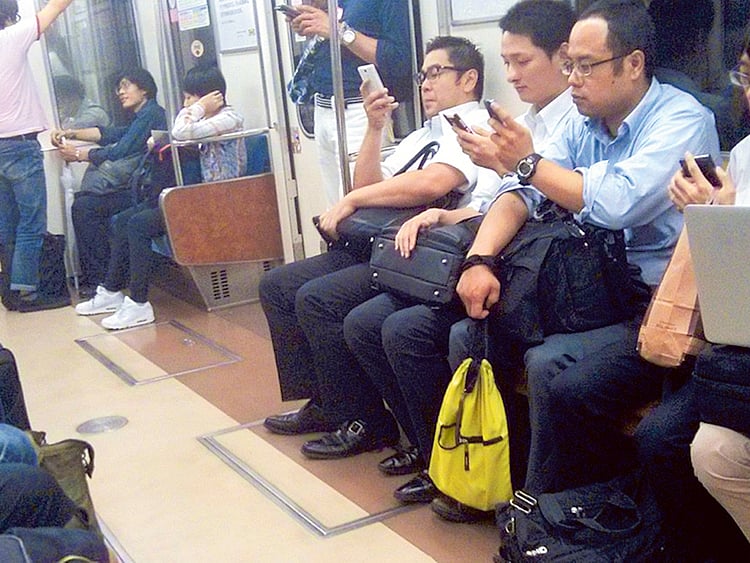
Every morning and evening, in commuter train carriages across Japan, a ferocious marketing war is being waged on smartphone screens as titles fight: first for eyeballs, then for the critical first five minutes of entertainment, then for long-term addiction.
The Tokyo Game Show last month testified to the growth of the market: some 40 per cent of the titles showcased were for smartphones and the increasing presence of Korean and Chinese mobile game developers contributed to the show’s record number of exhibitors.
Jay Defibaugh, an analyst at CLSA in Tokyo, says Japanese mobile gaming companies are tapping a growing market “accustomed to paying for content, and that suggests the opportunities to monetise are also growing quickly”.
But they do not see their products as competing merely with other games. The battle for attention is broader. “The rivals for our smartphone games are not other smartphone games,” says one senior executive at games group Bandai Namco, “but social media, books, newspapers and magazines.”
It is a claim easily tested on the Tokyo Metro. Just four or five years ago, say commuters on the busiest lines, Japanese train carriages were a glorious endorsement of the printed word.
Even at rush hour, and on the most packed trains, everyone seemed to find space to hold a book, a comic or a judiciously folded broadsheet newspaper.
Today, the scene is entirely different: almost everyone spends the journey looking at a smartphone screen, and the rustle of turning pages is gone.
Recent research on the media consumption of Tokyo residents over the past five years has shown steady decline in magazine reading, television watching and PC use, but sharp gains in time spent looking at smartphone screens.
In 2014, according to analysis by CLSA, Tokyoites spent an average of 74 minutes per day on their smartphones — up from 40 minutes in 2012. As analysts have pointed out, games are not the only beneficiaries: the stage is also set for a major shift in advertising budgets towards mobile.
The pivotal question is how that screen time is divided up, says Haruki Satomi, president and chief executive of Sega, a veteran Japanese games maker pushing aggressively into mobile games. On a typical one-hour commute, he suggests, a large proportion of the time will be spent on messaging and browsing online news, leaving games makers to battle each other — and other content providers — for the minutes that remain.
It is at this point that some of Japan’s game companies, most of them with experience that dates back to the country’s first games arcades in the mid-1980s, suspect they have an advantage.
The potential casual gamer — the demographic so spectacularly captured by Nintendo’s Wii console in 2006 — spends more time at the screen of a smartphone than they would ever imagine spending on a dedicated games machine. Hooking them to the point where they will spend money is an art, according to industry experts at the Tokyo Game Show.
“The first-time experience is so important. In the old console market, you bought a complete product. You had paid your money and you would give the game a chance.
“In the smartphone era, the game has to be a balance of something that is easy to understand and that will really excite the player within the first five minutes,” says Sega’s Satomi.
Those qualities are very close to the ones perfected by Japan when it became globally dominant in arcade games, and continued to be honed when the Gameboy-led era of hand-held games began around the start of the 1990s.
But the country has a further advantage at the other end of the spectrum: with the vastly more complicated role-playing games, like Granblue Fantasy, that have always been the preserve of the Japanese hard-core gamer.
As well as catering to the short-term arcade customer, Japanese developers have honed over many years a style of game that demands devotion, obsession and time. If that type of customer can be convinced that the smartphone is a legitimate platform, says Satomi, there is cash to be made.
In this case, the sector of the market with the most potential to spend money is made up of a generation (it is mostly men in this category) who grew up with consoles but now find themselves without as much time.
“Those gamers have grown up and have gone through a change of lifestyle. If they have time in the evening, their wish to play games competes with restaurants, a movie or the gym,” Satomi says.
These players see the smartphone as an opportunity to dip repeatedly into a complicated game in stolen moments throughout the day, he adds.
For these titles, the marketing challenge is greater than in the past, hence the Granblue extravaganza. Console games demanded only a huge push on marketing spending before the launch.
Smartphone games, which may have cash-generating lifespans of several years, require a steady drip of expenditure as each new update is introduced. Expect more promotional pyrotechnics at next year’s Tokyo Game Show.
Financial Times
Sign up for the Daily Briefing
Get the latest news and updates straight to your inbox
Network Links
GN StoreDownload our app
© Al Nisr Publishing LLC 2026. All rights reserved.