An aerial view of the Tesla Fremont Factory on January 29, 2026 in San Rafael, California.
Oil car era may have already ended: Year to be remembered as 'peak' of the combustion engine is not 2026
While the world closely watches oil, EVs are quietly rewriting transport history
Last updated:
5 MIN READ
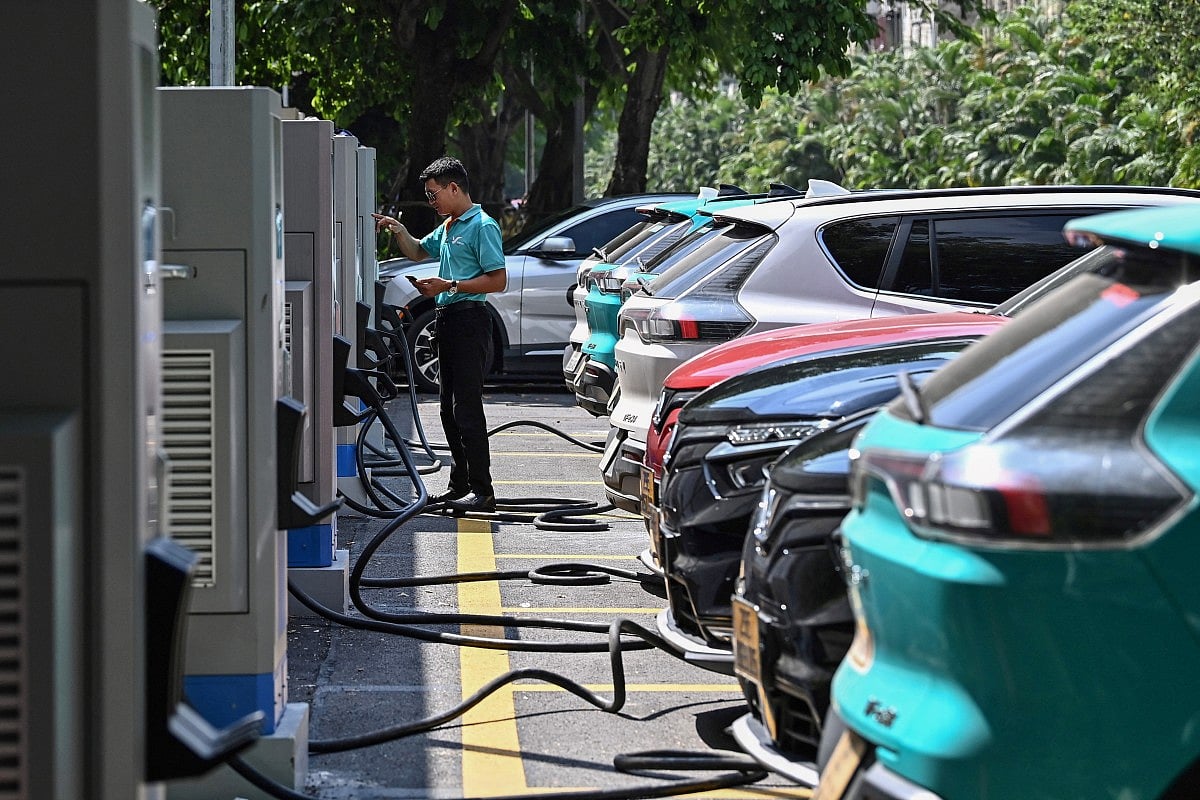
This picture taken on October 5, 2023 shows a driver charging a VinFast electric car at a charging station in Hanoi.
AFP
For more than a century, the internal combustion engine (ICE) powered the world. They powered economic growth, the transformation of cities and geopolitics.
Yet according to data from the International Energy Agency (IEA), a pivotal moment in automotive history may have already passed largely unnoticed.
'Quiet collapse'
It's dubbed a "quiet collapse" of the petrol car: EVs have captured nearly all growth since 2017, according to latest industry data.
Turns out the internal combustion engine (ICE) isn't dead — but its growth story may be over.
And the current oil crisis may be helping strengthen the EV revolution.
Global sales of petrol and diesel-powered vehicles peaked in 2017. Despite population growth, rising incomes and increasing demand for personal mobility, sales of conventional vehicles have never returned to that level. Nearly all growth in the global passenger vehicle market since then has been captured by electric vehicles (EVs).
The shift suggests the transition away from oil-powered transport is no longer a distant possibility but an ongoing reality.
'Tipping point': Hidden in plain sight
Technology transitions rarely unfold smoothly.
And it's a tipping point nobody really noticed: the global combustion-car sales already peaked nine years back.
The internet, smartphones and solar power all spent years appearing niche before reaching tipping points where growth accelerated and incumbent technologies struggled to recover.
Many analysts now argue that road transport may be experiencing a similar transition.
The significance is not simply that EV sales continue to rise. Rather, it is that sales of conventional vehicles appear to have stopped growing altogether.
Chinese carmaker BYD saw a surge in revenue last year, a stock filing showed Monday, surpassing the $100 billion mark and beating rival Tesla as the electric vehicle giant accelerates its overseas expansion.
Historically, temporary declines in demand were often followed by recoveries to new highs. Since 2017, however, petrol and diesel vehicle sales have remained below their previous peak despite broader recovery in vehicle demand following the COVID-19 pandemic.
That pattern has led some researchers and industry observers to conclude that future growth in personal transportation is increasingly electric.
Economics are changing
One of the most common assumptions surrounding EV adoption is that growth depends primarily on government mandates or subsidies.
While public support helped establish the industry, market forces are playing an increasingly important role.
A Volvo EV parked next to a BYD Seal outside a house in the Philippines.
Electric vehicles generally contain far fewer moving parts than conventional vehicles. They do not require oil changes, spark plugs, exhaust systems, fuel injectors or complex multi-speed transmissions.
As a result, maintenance costs are often lower and reliability can be higher.
Fuel costs also differ significantly. Electricity is frequently cheaper per kilometre travelled than petrol or diesel, particularly in markets with abundant renewable energy.
Convenience
Perhaps most important is convenience.
Traditional motorists have long accepted regular trips to filling stations because there was no alternative.
EV owners with access to home charging can begin each day with a fully charged vehicle without making a separate journey for fuel.
Industry surveys in multiple countries have found high satisfaction rates among EV owners, many of whom report little desire to return to internal combustion vehicles.
Vinfast EV cars are seen during a car shipment to the U.S. in Haiphong city, Vietnam, November 25, 2022.
Oil still matters — but its role is changing
Oil remains critical to the global economy.
According to the IEA, road transport continues to account for a substantial share of worldwide oil consumption. Hundreds of millions of petrol and diesel vehicles remain on roads globally, and they will continue to do so for many years.
However, growth trends increasingly favour electricity.
This has important implications for energy security.
For decades, transportation relied on petroleum extracted in relatively few regions and transported through vulnerable chokepoints such as the Strait of Hormuz, through which roughly one-fifth of globally traded oil passes.
Disruptions in those supply chains can quickly affect fuel prices worldwide.
Global oil demand growth is on track to slow to a halt by the end of this decade amid surging EV sales and changes in China's economic structure, according to the International Energy Agency (IeA). As EV China's oil demand is set to reach a peak in 2027.
Electrification of transport creates new dynamics
EVS offer a different model.
Rather than relying on imported petroleum, they can be powered by domestically produced electricity generated from solar, wind, hydroelectric, geothermal or nuclear sources.
For many governments, particularly in Europe and parts of Asia, electrification is increasingly viewed not only as a climate policy but also as a strategy to reduce exposure to geopolitical risks.
A BYD car ship with capacity for up to 5,000 vehicles on board. China's auto industry is emebraching a new era of exports. According to China's General Administration of Customs, China's auto exports surged to 5.22 million vehicles in 2023, up 57.4 percent year on year.
Accelerating electrification
Recent tensions involving Iran and concerns about shipping through the Strait of Hormuz have once again highlighted the vulnerability of global oil markets.
Whenever conflict threatens major oil-producing regions or transport routes, crude prices tend to rise, increasing fuel costs for consumers and businesses.
Historically, oil shocks have often influenced transportation trends.
The 1973 Arab oil embargo and the 1979 Iranian Revolution contributed to demand for more fuel-efficient vehicles. More recently, periods of high oil prices have boosted interest in hybrid and electric vehicles.
As fuel prices rise, the economic advantages of EV ownership become more visible. Geopolitical instability also strengthens the appeal of locally generated electricity compared with imported petroleum.
In that sense, every oil disruption reinforces one of the core arguments for electrification: reducing dependence on volatile global fuel markets.
Global EV surge
The growth of electric vehicles has been dramatic.
According to the IEA's annual Global EV Outlook reports, EV sales rose from roughly 1 million units in 2017 to more than 17 million globally by 2024, with China, Europe and the United States accounting for most purchases. EVs now represent a significant and growing share of new vehicle sales in many major markets.
Battery prices have also fallen sharply over the past decade, helping narrow the cost gap between electric and conventional vehicles.
At the same time, governments and private companies have invested heavily in charging infrastructure, reducing concerns about range and accessibility.
Not the end of the engine — but the end of growth?
Internal combustion engines will remain a dominant presence on roads for decades. Existing vehicle fleets are vast, and many regions still lack the infrastructure, purchasing power or policy support needed for rapid electrification.
Yet growth trends increasingly suggest that the era of expanding petrol and diesel vehicle sales may already be over.
The key question is no longer whether electric vehicles will continue gaining market share. Instead, analysts are increasingly asking whether conventional vehicles have any realistic path back to sustained growth.
So far, the evidence points in one direction.
Patterns
Several major energy transitions followed similar patterns:
The horse-drawn carriage did not disappear overnight after the arrival of automobiles, but its growth era ended long before it vanished from roads.
Coal remained widely used for decades after oil became dominant in transportation.
Landline telephones persisted for years after mobile phones became the primary source of subscriber growth.
Solar and wind power continued expanding even while fossil fuels remained major sources of electricity generation.
In each case, the decisive moment was not when the old technology disappeared, but when it stopped growing.
For the internal combustion engine, many analysts believe that moment may have arrived in 2017.
If future historians identify a turning point in the transition away from oil-powered mobility, it may not be a future government ban, corporate announcement or technological breakthrough.
It may simply be remembered as the year global sales of petrol and diesel vehicles reached their highest point—and never returned.
Sign up for the Daily Briefing
Get the latest news and updates straight to your inbox
Network Links
GN StoreAbout Gulf NewsTerms & ConditionsReach by GNSitemapContact usPrivacy PolicyGN FocusHave your sayWork with usAdvertise with usGulf News epaperPrinting Services
Download our app
© Al Nisr Publishing LLC 2026. All rights reserved.