Echoes of Europe crisis heard in US Congressional deadlock
Procrastination and political paralysis plague both regions
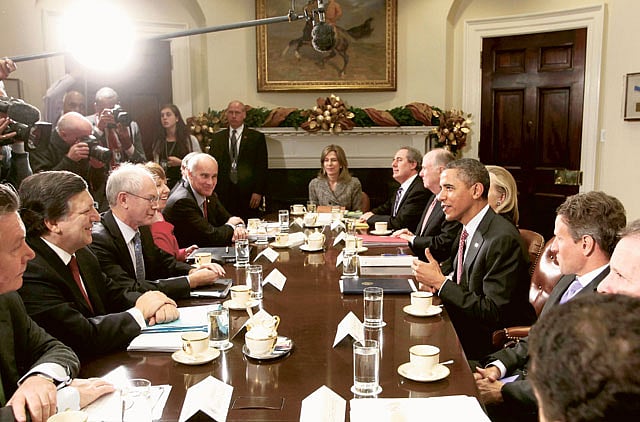
Washington: Europe's deepening debt crisis is echoed in the United States by the inability of President Barack Obama and Congress to strike a bipartisan deficit deal.
On both sides of the Atlantic, leaders are having a hard time making tough, unpopular decisions. And things come together only at the very last minute, if at all, while the global economy hangs in the balance.
What happens in Europe is important to Americans. It has already taken an economic toll on US exporters — from reduced consumer demand in Europe for their products and from a rising dollar against the euro. And US stock markets have been battered for months as the crisis spread from Greece to other more-solvent economies, including Italy and Spain, and even taking a toll on Germany's ability to sell its bonds.
On Monday, the Dow industrials rose nearly 300 points, both on robust post-Thanksgiving holiday spending in the US and on new, radical proposals for solving Europe's debt crisis.
Contagion
The worse things get in Europe, the more likely the contagion could spread to the United States.
Right now, the situation looks much graver overseas, with Europe teetering on the brink of a new recession.
With their backs against the wall, and with some economists warning of an imminent collapse of the euro, European leaders are racing to find a grand bargain to keep their monetary union from fracturing. But time is running out.
The US isn't quite that close to the edge of the cliff. Last week's failure of the so-called congressional supercommittee to strike a deficit-cutting deal to lower future government borrowing underscored that Congress is bogged down in inter-party strife, likely meaning that no deal on jobs, spending and taxes is likely until after next November's presidential election.
The two parties were blaming each other for the deadlock. Republicans slammed Democrat Obama for not doing more to prod an agreement.
And one top Democratic lawmaker even suggested "the public cannot be totally absolved of responsibility."
"They elected us," Representative Barney Frank, senior Democrat on the House Financial Services Committee said.
There are multiple parallels between the crisis here and the one in Europe, and with procrastination and political paralysis playing a role in both.
"It has to do with the fact that politicians in both areas have taken what is an inherently manageable problem and turned it into a crisis by their actions or lack of actions," said Nariman Behravesh, chief economist with IHS Global.
A worsening crisis in Europe could undercut recent slightly improved economic news in the US so closely tied are the two economies.
The US and the 27-nation European Union are the world's top two economies, accounting for roughly half of all global economic output and one-third of total world trade.
The closeness of links between the two economies was driven home at a Monday meeting at the White House between Obama and European Union officials that dealt in large part with the European crisis.
"I communicated to them that the United States stands ready to do our part to help them resolve this issue," Obama said. "This is of huge importance to our own economy."
He did not specify what that would entail, White House spokesman Jay Carney earlier said US taxpayers shouldn't be put at further risk, including by paying more into International Monetary Fund coffers to help support various proposals that the IMF do more to help rescue troubled European economies.
European Council President Herman Van Rompuy said Eurozone nations have already done a lot to tackle the crisis with measures that "would have been unthinkable" a year ago. "But we have to do more."
A recession in Europe would first hurt US exports to Europe. European countries would likely buy fewer American goods and services. A moderate to deep European recession would also likely drive up the dollar with respect to the euro, making American products more expensive in Europe, and striking a double blow to US exporters.
Also, many US companies earn a lot of their profits in Europe. Those profits would decline, likely forcing the US companies to reduce their investment in Europe and perhaps cut hiring in the US.
Some economists have even suggested US labour markets are beginning to look more like those in Europe, with unemployment remaining stuck at nine per cent and nearly six million Americans out of work for more than six months. Europe has long been plagued with chronic long-term joblessness and high levels of youth unemployment.
In a report Monday, the Paris-based Organisation for Economic Cooperation and Development (OECD) said the euro crisis poses "a key risk to the world economy."
It suggested European decision-makers had moved too slowly in preventing the crisis from spreading.
The US also has some safeguards not enjoyed by Europeans. Despite stubborn unemployment, its economy is still growing, with recent signs of improvement in manufacturing and consumer spending.
In the US the federal government is a central authority over taxing and spending. Not so in Europe.
And the 17 countries that use the euro can't print their own money, whereas the US Federal Reserve has shown itself willing and able to print money to help ease pressures on US banks and to stimulate parts of the economy, including the stock market.
Sign up for the Daily Briefing
Get the latest news and updates straight to your inbox
Network Links
GN StoreDownload our app
© Al Nisr Publishing LLC 2026. All rights reserved.