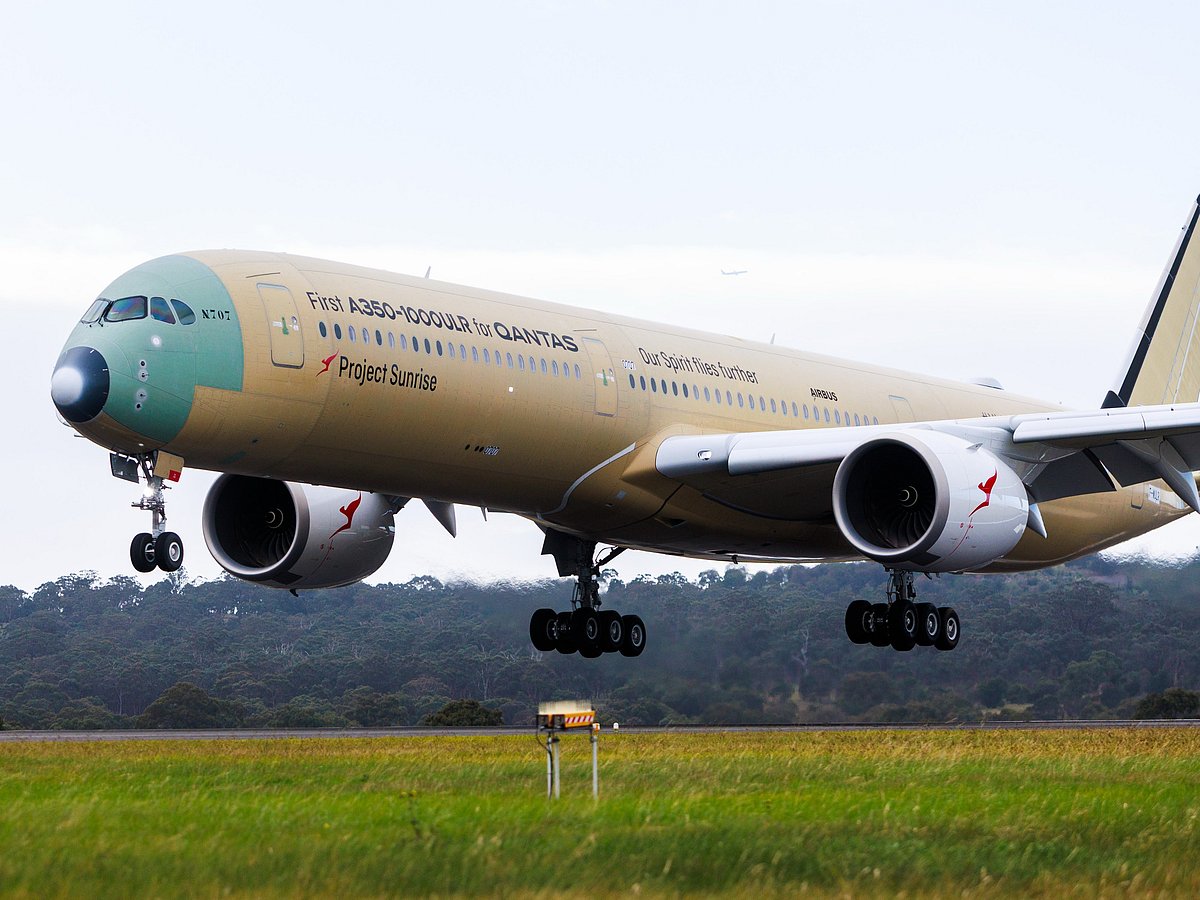
The Airbus A350-1000ULR lifted off from Toulouse with no passengers on board. No holidaymakers. No business travellers settling in for the long haul.
Instead, the cabin was occupied by Airbus test pilots and flight-test engineers. Their mission was straightforward on paper but more demanding in practice: stay airborne for nearly 19 hours and help prove that one of aviation's most ambitious projects is nearing reality.
Get updated faster and for FREE: Download the Gulf News app now - simply click here.
When the aircraft touched down in Melbourne after flying almost 17,000 kilometres nonstop, it marked a major milestone for Qantas' long-running Project Sunrise. It wasn't the first nonstop flight between Europe and Australia—that title belongs to the airline's Paris-Perth service. This was different: a certification flight for the aircraft Qantas plans to use on future nonstop Sydney-London services.
The journey quickly drew attention beyond the aviation industry. As it crossed Europe, the Middle East, and the Indian Ocean, the aircraft briefly became the most-tracked flight on Flightradar24, with thousands following its progress in real time. For an aircraft yet to carry a paying passenger, that interest reflected the significance of its testing.
For now, though, the aircraft still belongs to Airbus.
This is a development aircraft, flown by four Airbus test pilots and supported by five flight-test engineers as part of the manufacturer's certification programme. Much focus is on what passengers will never see: an additional 20,000-litre rear centre fuel tank that gives the A350-1000ULR enough range to stay airborne for up to 22 hours. After work in Australia, the aircraft will return to Toulouse for further testing.
For Qantas, however, the destination isn't Melbourne. It's 2027.
The airline expects to receive its first Project Sunrise aircraft, Vega, in April next year. Ticket sales are planned for February 2027, with daily nonstop Sydney-London flights starting in October. Sydney-New York services are expected to follow as more aircraft join the fleet.
The cabin has been designed around a simple idea: if people are going to spend close to 20 hours in the air, the aircraft has to feel different.
Each A350-1000ULR will carry just 238 passengers across four cabins—far fewer than many aircraft of similar size. The lighter load allows extra fuel and gives travellers more personal space. A dedicated Wellbeing Zone lets passengers stretch, walk, and move during the flight, reflecting years of research into fatigue, sleep, and jet lag on ultra-long-haul journeys.
That research began years before this aircraft ever left the factory.
In 2019, Qantas operated experimental Boeing 787 flights from New York and London to Sydney. Those missions focused less on proving the routes were possible and more on understanding what nearly 20 hours in the air does to pilots and passengers. Researchers monitored sleep patterns, alertness, meal timing, movement, and cabin lighting, with findings later influencing the new A350 fleet design.
The programme hasn't followed a straight path.
Certification was delayed after regulators required changes to the aircraft's additional fuel tank, pushing deliveries back over a year. Airbus redesigned the system before flight testing resumed. This week's mission marks the programme's return to a crucial certification stage before customer deliveries.
Project Sunrise will not replace the traditional Kangaroo Route overnight. Qantas will continue operating its nonstop Perth-London service while adding something that has remained beyond reach for decades: a direct connection between Sydney and London.
For travellers, the change sounds deceptively simple. One flight. No transit airport. No race to make a connection.
For the engineers and pilots who spent 19 hours crossing half the world this week, it was another step toward making that routine.
Network Links
GN StoreDownload our app
© Al Nisr Publishing LLC 2026. All rights reserved.