Management consulting firm Bain & Company projected global airline revenue for the whole of 2022 to reach $432 billion — in the “baseline recovery” scenario.
Air passenger traffic soars 381% in Europe: IATA
Cargo surges to a 32-year high as demand for flying shows resilience
Last updated:
3 MIN READ
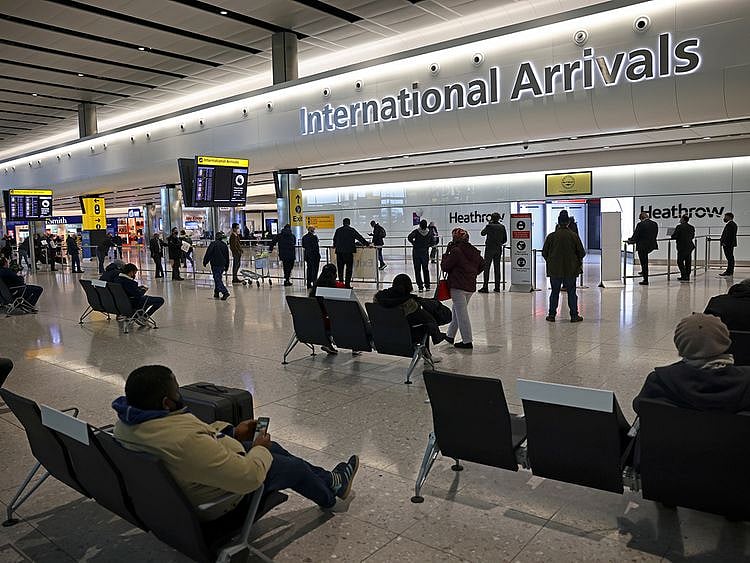
The International Air Travel Association reported a 381 per cent jump in passenger traffic in Europe in February 2022 vs February 2021. File photo shows a scene at London's Heathrow Airport.
AP
Highlights
- With more borders being reopened, IATA sees travel industry en route to recovery.
- All markets — Africa, Europe, Latin America, Middle East and North America — showed “very strong performance” in February 2022 versus February of 2021.
- 200+% rise in ME passenger traffic noted.
As more countries open their borders, the travel industry is soaring towards recovery, according to an industry report.
It cited a massive 381 per cent jump in passenger traffic in Europe in February 2022 vs February 2021.
“The good news…is that demand for passenger flying continues to be resilient,” Willie Walsh, director general of the International Air Transport Association (IATA), said in a recent press briefing, the transcript of which was released on April 7, 2022.
“And we can see the international sales continuing to pick up despite all of the issues, particularly associated with the war in Ukraine,” added Walsh, who took over the IATA leadership in April 2021.
AIR TRAVEL DEMAND:
Global airline revenue for the whole of 2022 could reach $432 billion in the “baseline recovery” scenario, based on projections by management consulting Bain & Company. This represents 65% of 2019’s revenue. In the same “baseline” scenario, by end-2022, global air travel demand could recover to 84% of 2019 levels. The surge in Omicron sub-variants surge in some countries continues to stall recovery.
Following are the highlights of IATA director general Willie Walsh's briefing:
IATA’s Welsh said: “We would expect to see a number of countries starting to relax their restrictions as we go through the rest of this month.”
Globally, air cargo has posted a record February, the best February performance on record since 1990, according to IATA.
Cargo: at 32-year high
Globally, air cargo has posted a record February, the best February performance on record since 1990, according to IATA.
Walsh said: "December (2021) was the record month." However, he cited that the softening in global demand, given the purchasing managers' index (PMI) below 50 globally, may affect affect the air cargo industry's performance in the coming months.
“Based on this and based on the ongoing disruption to supply chains that we're witnessing, we would expect to see the growth and very strong performance of cargo just begin to ease as we go through the next couple of months,” Walsh said.
The price of fuel, too, has been a major challenge for airlines. “And given that fuel represents the single biggest cost base of the industry, it averaged 27% over the 10 years up to 2019," he said.
"It's inevitable that these high oil prices will be reflected in higher fares, and I've heard a number of CEOs indicate that in recent weeks.”
Sign up for the Daily Briefing
Get the latest news and updates straight to your inbox
Network Links
GN StoreAbout Gulf NewsTerms & ConditionsReach by GNSitemapContact usPrivacy PolicyGN FocusHave your sayWork with usAdvertise with usGulf News epaperPrinting Services
Download our app
© Al Nisr Publishing LLC 2026. All rights reserved.