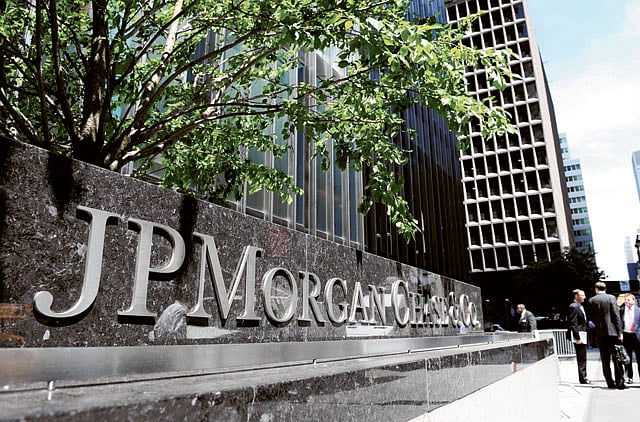
About two-thirds the way through JPMorgan Chase & Co chief executive officer Jamie Dimon's stunning May 10 conference call, in which he announced that the hedging strategy originating in the firm's vaunted chief investment office had cost the firm $2 billion (Dh7.34 billion), he seemed to hit his stride. "It is very unfortunate," he said, "this plays right into the hands of pundits out there. But we have to deal with it."
Well, Jamie, as a former JPMorgan Chase managing director turned Wall Street pundit, here you go: The problem with the unexpected loss and its hasty announcement was not so much the sheer magnitude of the losses — a firm with a trillion-dollar balance sheet can withstand them — but that for weeks you and your fellow senior executives have been pooh-poohing the risks posed by the huge proprietary bets being made by your bank's Bruno Michel Iksil (aka the London Whale).
After Bloomberg News revealed the extent of the gambling that was going on in JPMorgan's London office on April 5, Dimon called it a "complete tempest in a teapot" and heaped scorn on the journalists who revealed the extent of the bet and how it was roiling debt markets throughout the world.
The firm's chief financial officer, Doug Braunstein told the press on April 13 that the chief investment office "balances our risks. They hedge against downside risk, that's the nature of protecting that balance sheet." Braunstein added that he was "very comfortable with the positions we have" and that all of the positions are "very long term in nature."
What's worse, in February, during the company's annual investor day, Dimon further belittled the journalists in attendance by mocking their questions about Wall Street's inordinately high compensation structure, whereby — generally speaking — 40 per cent to 50 per cent of every dollar of revenue generated goes to the employees who work there. At JPMorganChase, the compensation expense ratio in 2011 was around 35 per cent, while at Goldman Sachs Group and Morgan Stanley it was higher — in the 50 per cent range — and at Lazard Ltd., it was 63 per cent.
Question of the moment
Why Wall Street feels the need to pay the people who work there so much money is the question of the moment. Whom do these firms serve? The shareholders who own them, or the employees who work there? For far too long, the answer has been — sadly — the bankers. Why don't Dimon and his fellow industry leaders understand that the less that gets paid out to employees, the more that goes to the bottom line?
But Dimon would have none of it, at least during the investor day conference on February 29. He even thought it would be funny to dig out a comparable statistic from a newspaper company and found one that showed that journalists' compensation had eaten up 42 per cent of the paper's revenue. That's "damned outrageous," he said. "Worse than that, you don't even make any money! We pay 35 per cent. We make a lot of money."
He's right about that. In 2011, JPMorgan made $19 billion in profit. Dimon got compensation of $23 million.
Dimon at least had the good sense to sound a note of contrition on Thursday. He said the firm's new "value-at-risk" model had proved inadequate and the company was going back to using an older model. He said the money-losing trade was "flawed, complex, poorly reviewed, poorly executed and poorly monitored." He said it was "sloppy" and that "all appropriate" measures would be taken. He said there were "egregious mistakes" made and that the wound "was self-inflicted." Before he answered questions, he said, "We will admit it, we will learn from it, we will fix it and move on."
Until this moment, Jamie Dimon has been Teflon. He has boasted about his firm's "fortress balance sheet" and about how his skills as a risk-manager were far superior to those at other Wall Street firms.
Dimon has been proven right about one thing: He has given the pundits (and politicians) a gift. "The enormous loss JPMorgan announced... is just the latest evidence that what banks call ‘hedges' are often risky bets that so-called too-big- to-fail banks have no business making," Senator Carl Levin said.
"Today's announcement is a stark reminder of the need for regulators to establish tough, effective standards."
Not a moment too soon.
— Bloomberg
Sign up for the Daily Briefing
Get the latest news and updates straight to your inbox
Network Links
GN StoreDownload our app
© Al Nisr Publishing LLC 2026. All rights reserved.