Why some sneakers bounce and others feel flat: foam and drop
How midsole foam and heel to toe drop shape cushioning, bounce and your run
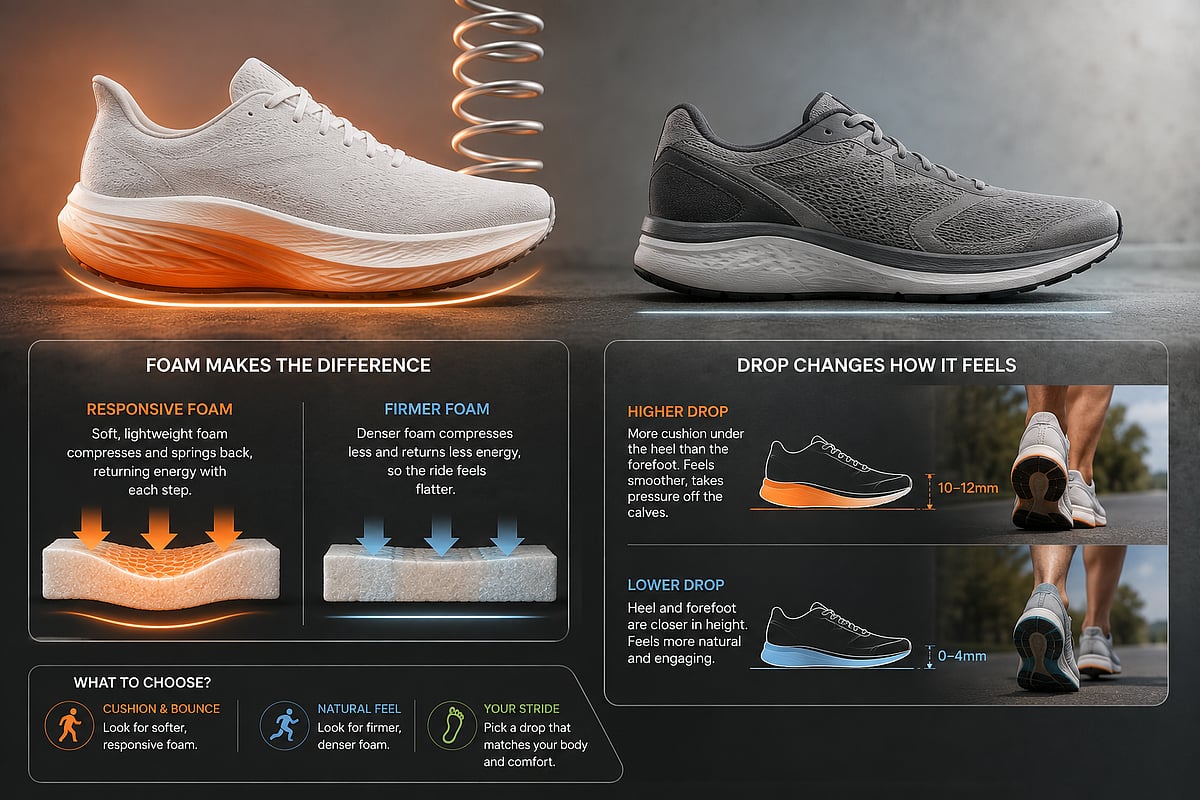
A carbon plate gets much of the attention in modern running shoes, but it cannot explain the ride by itself. A 2025 systematic review and meta analysis found that the performance effect of advanced running footwear appears to come from an interaction between bending stiffness and midsole energy return, rather than either property working alone. That helps explain why one thick shoe can feel lively while another feels soft but strangely flat. Beneath your foot, foam is being compressed, losing some energy and returning some as it rebounds. Add the shoe's geometry, including heel to toe drop, and two apparently similar sneakers can behave very differently.
Midsole foam sits between your foot and the outsole. When loaded, it deforms, then rebounds as the load comes off. Mechanical testing of running shoes shows that some of the energy put into the foam is dissipated while some is returned as it recoils. Material, thickness and construction all affect that behaviour, which is why “more cushioning” does not automatically mean more bounce.
Heel to toe drop is simpler to define. It is the difference in height between the heel and forefoot. A higher drop shoe places the heel farther above the forefoot, while zero drop footwear keeps them level. Changing that geometry can alter running mechanics, so switching abruptly between very different drops may feel more significant than the numbers suggest.
For UAE runners doing regular kilometres on paved routes, treadmills or tracks, these characteristics are often more useful shopping clues than whether a shoe resembles an elite racing model.
Start with purpose. For easy runs and long walks, cushioning that feels comfortable and controlled is generally more relevant than maximum stiffness. For a livelier running feel, look for a midsole described with a specific responsive foam technology rather than relying on stack height alone.
Check drop too, particularly if your current shoes work well. A radically different geometry is not automatically an upgrade. Avoid the idea that softness alone equals better cushioning. Research suggests shoe performance comes from several interacting design properties.
This is the clearest max cushion option in the group. Skechers identifies Max Cushioning as one of its established footwear technologies, while product specific information for this model describes a lightweight cushioned construction and slip in design. The substantial sole makes it useful for understanding an important distinction: stack height gives the midsole space to deform, but height alone does not tell you precisely how efficiently it rebounds. It is the strongest fit here for readers prioritising a generously cushioned feel for everyday running and walking rather than minimalist ground feel.
The D 2008 takes a more conventional approach. Available product specifications identify an EVA sole, memory foam insole, knitted upper, pull on construction and an approximate weight of 299g. EVA is a familiar running shoe midsole material, although its behaviour varies considerably with formulation and construction. The memory foam here is primarily an underfoot comfort feature, so it should not be confused with the highly resilient performance foams used in modern racing shoes. This makes more sense as a cushioned general purpose shoe for walking, gym use and lighter running than as an example of racing shoe rebound.
This shoe is the useful counterpoint to all that cushioning. The product information identifies a zero drop design, wide toe box and minimalist construction. Zero drop means the heel and forefoot sit at the same height, removing the raised heel geometry found in many conventional running shoes. It also illustrates why “low drop” and “cushioned” should never be treated as synonyms. A shoe can change foot position without supplying a thick, springy midsole. Runners accustomed to conventional cushioned shoes should treat a major change in footwear geometry as a different setup rather than simply another version of the same ride.
FitVille's running range is built around wider toe boxes and cushioned constructions, with current models using EVA or rebound midsoles depending on the design. That wider platform is relevant because ride quality is not only about vertical softness. The width and geometry of the sole also influence how planted a tall cushioned shoe feels. For runners who need more forefoot room, this is the option to go for.
The useful lesson from the carbon plate era is not that every runner needs a plate. Modern research increasingly points to the whole shoe: foam resilience, stiffness, geometry and the runner interact to create the result. For straightforward cushioning, the Skechers Slip ins Max Cushioning Advantageous is our top pick from these four because cushioning is central to its design rather than an incidental comfort feature. The AIRHAS sits at the opposite end of the spectrum and neatly demonstrates how dramatically geometry can change without adding more foam.
Gulf News earns a commission on purchases made through links in this article, at no extra cost to you. Our editorial team selects products independently.
Sign up for the Daily Briefing
Get the latest news and updates straight to your inbox
Network Links
GN StoreDownload our app
© Al Nisr Publishing LLC 2026. All rights reserved.