Why your power bank charges some devices faster than others
Your power bank's mAh rating tells only half the story. Here's what matters more
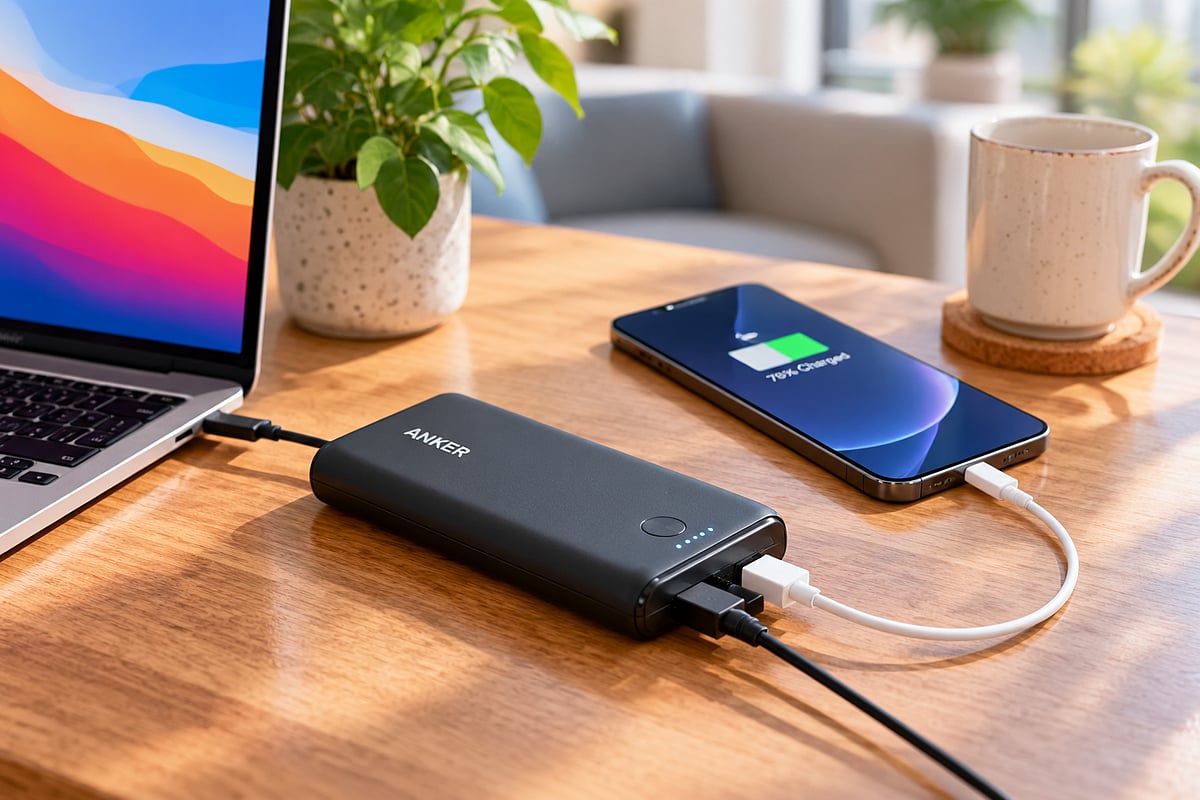
A 20,000mAh power bank does not necessarily deliver twice as many phone charges as a 10,000mAh model. Nor does a larger battery guarantee faster charging. The explanation lies in how electricity is stored and transferred. According to Anker's technical guidance, a typical 20,000mAh battery operating at 3.7 volts stores around 74 watt-hours of energy, but some of that energy is lost before it reaches your phone. Meanwhile, USB-C charging technology determines how quickly the remaining power can be delivered. Understanding these differences makes choosing a portable charger considerably easier, particularly when the same battery needs to serve several devices.
Milliampere-hours, abbreviated mAh, measure electrical charge capacity. Watts measure the rate at which power is delivered. Watt-hours, or Wh, measure stored energy, accounting for voltage as well as capacity.
These distinctions explain why two similarly sized power banks can behave differently. One might charge a smartphone relatively slowly, while another can supply enough power to charge a compatible laptop.
According to the USB Implementers Forum, USB Power Delivery (PD) allows a charger and connected device to negotiate suitable power levels. A power bank capable of supplying 100W does not automatically send 100W to every device. The connected device requests power according to its supported charging specifications.
For UAE residents carrying phones, tablets and laptops between meetings or during travel, the relevant question is how much power each device can actually accept.
Start with maximum USB-C output wattage and supported charging protocols, particularly USB Power Delivery. A laptop may require 45W, 65W or more for effective charging, while a phone with a lower charging limit gains little from additional wattage.
Check individual port ratings rather than relying on the advertised combined output. Power may be shared when several devices are connected.
Capacity still matters, but compare watt-hours where available. Battery conversion losses mean the advertised mAh figure cannot be treated as the amount transferred directly into your phone.
UGREEN's Nexode demonstrates why output power matters as much as battery capacity. Its 20,000mAh battery stores 72Wh, while its primary USB-C port delivers up to 100W.
A second USB-C port supports up to 30W, alongside a USB-A port rated at 22.5W. The power bank also supports USB PD and PPS charging protocols, making it suitable for a range of compatible devices.
This combination makes sense for professionals carrying a laptop and smartphone between meetings. The 100W output provides flexibility for more demanding devices, while the additional ports accommodate smaller accessories. Actual charging speeds depend on device compatibility and how the available power is distributed.
Anker's 25,000mAh model is designed for people who regularly charge multiple devices. Its maximum combined output reaches 165W, with individual USB-C connections supporting up to 100W.
The manufacturer specifies 90Wh of stored energy, two integrated USB-C cables, a USB-A connection and a display showing charging information. It also supports USB PD, PPS and several other protocols.
The advantage becomes apparent when working away from a desk. A laptop and phone can share the power bank without requiring separate chargers or multiple loose cables.
Its higher combined output is particularly relevant to laptop users, although connecting additional devices changes the available power allocation.
The INIU offers a different balance, combining a 20,000mAh capacity with a maximum advertised output of 22.5W.
The listed model includes two USB-C connections and one USB-A port, with advertised PD 3.0 and QC 4.0 support.
Its appeal lies in everyday phone charging rather than high-powered laptop use. Someone who mainly needs additional battery life during commutes, shopping trips or long days outside can benefit from the larger capacity without requiring a 100W output.
It also illustrates an important distinction: two 20,000mAh power banks can store similar amounts of energy while offering substantially different charging speeds.
Belkin's BoostCharge offers a smaller-capacity alternative for readers whose charging needs centre on a smartphone and everyday accessories.
The 10,000mAh model is listed with one USB-C port, two USB-A ports and up to 15W output.
For a regular office commute, this arrangement may be sufficient when the priority is carrying reserve energy rather than supplying a laptop.
The lower output rating also helps explain why a phone supporting faster charging might replenish more slowly with this model than with a higher-powered USB-C PD bank.
Choosing it is primarily a decision about portability, charging requirements and how frequently additional power is needed.
The UGREEN Nexode 20,000mAh 100W offers the strongest all-round balance for readers charging both phones and compatible laptops. Anker's 165W model suits heavier multi-device requirements, while INIU and Belkin address more straightforward smartphone charging needs.
Before buying, check your device's charging limit, the power bank's USB-C output and whether its supported protocols match. For international flights, also check the airline's current power bank rules and the battery's watt-hour rating.
The best specification is the one your devices can actually use.
Gulf News earns a commission on purchases made through links in this article, at no extra cost to you. Our editorial team selects products independently.
Sign up for the Daily Briefing
Get the latest news and updates straight to your inbox
Network Links
GN StoreDownload our app
© Al Nisr Publishing LLC 2026. All rights reserved.