A GAC Montx concept car is displayed on the opening day of the Beijing Auto Show in Beijing on April 24, 2026.
Chinese automaker GAC eyes Dubai R&D hub by 2028 to build cars for Gulf drivers
Chinese automaker says UAE will be a test market for premium EVs and local design
Last updated:
7 MIN READ
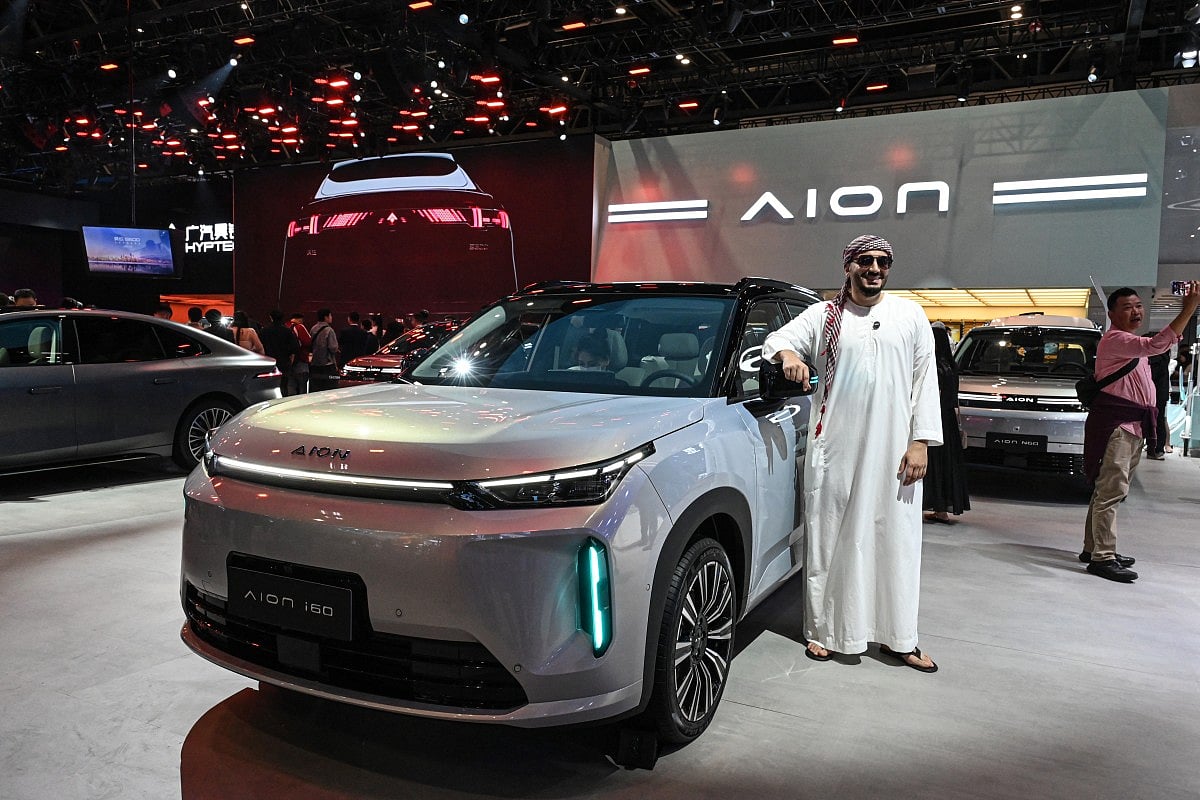
A man poses for photographs beside Aion’s i60 car at the Beijing Auto Show in Beijing on April 24, 2026.
AFP-JADE GAO
Dubai: GAC Group is considering setting up a research and development centre in Dubai by 2028, a move that would bring the Chinese automaker closer to Gulf buyers at a time when electric vehicles, premium SUVs and high-performance models are gaining ground across the UAE.
In an exclusive interview with Gulf News at the Beijing Auto Show 2026, James Wang, Vice President of GAC International, said the company is studying a Dubai R&D base to better understand local drivers, climate conditions, road habits and premium-car expectations. The plan would build on GAC’s existing operation centre in Dubai, which already covers sales, branding, service workshops and warehousing for the wider MENA region.
Get updated faster and for FREE: Download the Gulf News app now - simply click here.
I think we are considering to have the R&D center in Dubai,” Wang said. “Now we already have our own operation center in Dubai, including the sales activities, branding team, and also the service workshop, and also the warehouse used to cover all the regions MENA.”
Pressed on when such a centre could be established, Wang pointed to 2028. “I think maybe, let's say, two years later. Two years later, in 2028 will be possible for us to set up this,” he said.
UAE becomes a test market for premium EVs
The possible Dubai R&D centre signals a more serious bet on the UAE, which GAC sees as one of the region’s most premium and diverse car markets. Wang said the UAE’s buyer base stretches from luxury customers to more affordable segments, making it an important market for testing how Chinese brands can move up the value chain.
GAC’s next phase in the Gulf will lean heavily on premium electric vehicles and technology-led models, with its Hyptec brand expected to play a bigger role. Wang said the company wants local customers to understand that GAC is not limited to affordable cars and can compete in higher-end segments.
“For our EV segment in the future, first we want to promote our Hyptec. This is our premium brands,” Wang said. “We want the local customer can understand that GAC is not only for the affordable segment. We also have a premium brand like Hyptec in the markets.”
That matters because the UAE’s roads are already seeing a stronger mix of electric SUVs, Chinese EVs and high-performance models. Buyers are becoming more open to new brands, but they are also demanding more from them, especially in service quality, cooling performance, driving range, technology and after-sales support.
Wang said the UAE could become one of GAC’s key trial markets for premium brands in the Gulf over the next five years.
Why GAC is not rushing its flagship models
GAC has drawn attention with models such as the Hyptec SSR, its high-performance electric sports car, and the S9, which has performed strongly in China. Wang said the company is aware of regional interest in such vehicles, but it will not rush broader sales until the full ownership ecosystem is ready.
Two workers walk past the venue of this year's Beijing Auto Show on the eve of the event at the China International Exhibition Center in Beijing on April 23, 2026.
The reason is that premium-car buyers in the Gulf expect more than a striking design or strong acceleration figures. They expect test-drive access, fast service, trained workshop teams, clear maintenance processes and direct feedback loops between customers, dealers, engineers and the brand.
“So far, the product itself is quite nice model, and why we're not enlarged to sell them in the market, because we need to make everything ready,” Wang said. “We need to have a lot of connection between our company, our R&D team, our sales team and our service team, to understand very well for their demand.”
That mirrors the larger test facing Chinese carmakers in the Gulf. Winning attention is easier than winning loyalty. A premium EV customer in Dubai or Abu Dhabi will compare a new Chinese model with established luxury brands, electric specialists, and high-spec SUVs already available in the market.
Wang said GAC wants to ensure sales activity, test drives, customer feedback, and workshop services are aligned before scaling premium models in the region.
Gulf drivers want cars with character
GAC’s reading of Middle East demand is not limited to EV range or price points. Wang said buyers in the region, especially in the medium- and premium-segments, want vehicles with a stronger sense of identity.
“They have a lot of diversified demand,” he said. “But on the common side for this kind of premium or medium range clients, they love the cars with some unique DNA.”
That includes off-road capability, a strong driving feel and models that feel engaging to own. In the Gulf, cars are often tied to lifestyle, family movement, long-distance weekend travel and desert or mountain driving. This makes the region different from markets where compact city EVs dominate the electric transition.
James Wang, Vice President of GAC International
GAC’s product planning for the Gulf is therefore expected to cover several powertrain routes, including petrol, hybrid, plug-in hybrid, battery electric and range-extended electric models. The company has said its global portfolio now covers ICE, HEV, PHEV, BEV, and REEV products, giving it the flexibility to match vehicles to infrastructure maturity and customer usage patterns.
In the UAE, this makes a big difference because charging infrastructure is expanding, but many consumers still want range security and strong performance. Saudi Arabia’s large distances and growing EV infrastructure plans also make the Gulf a market where a single technology route may not be enough.
Comfort, range and service will decide trust
Wang said GAC sees the UAE and the broader GCC as strategically important growth regions, supported by strong purchasing power, rising demand for intelligent vehicles, and government support for green mobility.
A practical understanding of the Gulf needs is central to the company’s regional approach. Drivers value space, comfort, cooling performance, long-distance usability and premium technology, especially in markets where SUVs are used for both city commutes and intercity family travel.
“We have always believed that a product only creates real value when it truly fits the local market, meets local regulations, and addresses local user needs,” GAC executives said in its Beijing Auto Show briefing.
Localisation becomes the next test
GAC’s regional ambitions will depend on more than product launches. The company said it is shifting from simple vehicle exports to what it calls ecological overseas expansion under its One GAC 2.0 framework and the principle of “In Local, For Local.”
That means a stronger focus on regional sales networks, after-sales service, spare parts supply, digital ownership tools and local partnerships.
“Whether in the Middle East or Africa, the ownership and service experience after purchase is crucial, and this is also an area where we are committed to long-term investment,” Wang said.
The company is already using local distributors to build visibility and customer access. The Deira showroom gives GAC a larger retail platform in Dubai, while its wider Middle East strategy is expected to cover physical retail, test drives, brand events, digital campaigns and stronger service capability.
GAC said overseas competition is now about “supply chains, service capabilities, and organisational strength,” not only the product itself. That is especially relevant in the GCC, where new Chinese brands are entering showrooms at a rapid pace, often competing on features, pricing, warranties, and EV technology.
A bigger battle among Chinese car brands
GAC is entering a Gulf market where Chinese automakers are becoming more visible across showrooms, malls and roads. Many are competing on technology, long feature lists, aggressive pricing, warranties and EV credentials.
That makes brand trust the next major battleground. Gulf buyers may be willing to try new carmakers, but they will still judge them on service response, parts supply, warranty execution and the ability to hold value over time.
GAC’s possible Dubai R&D centre would give the company a stronger local feedback loop. It could help engineers study Gulf heat, driving patterns, charging behaviour, customer preferences, and service pain points from the region itself, rather than relying solely on product planning from China.
Details of the four new vehicles released by GAC Group at the 2026 Beijing Auto Show
1. GAC Trumpchi Xiangwang E8 PHEV
• Positioning: New-generation family plug-in hybrid MPV, flagship of GAC Trumpchi's MPV product line
• Core Powertrain: Adopts GAC's latest plug-in hybrid technology
• Key Performance: Achieves a global record-low fuel consumption of 3.98L per 100km; delivers a maximum pure electric cruising range of 281km, the longest among medium-sized MPVs
• Highlights: Focuses on family-oriented comfort, safety and practicality, optimizing interior space layout and intelligent human-computer interaction experience
2. GAC Trumpchi Yue 7
• Positioning: GAC Trumpchi's first all-scenario intelligent hardcore off-road SUV
• Product Features: Combines tough off-road capability with urban daily driving comfort, equipped with professional off-road chassis and all-terrain adaptive system
• Market Plan: Scheduled to be officially launched in Q3 2026, targeting family users pursuing both off-road fun and daily commuting scenarios
3. AION N60
• Positioning: Intelligent aesthetic urban SUV, a new benchmark for intelligent driving in the 100,000-yuan-level new energy vehicle market
• Core Technology: Equipped with L4-level Robotaxi homologous intelligent driving technology, lowering the threshold for popularizing high-level intelligent driving
• Market Performance: Pre-orders exceeded expectations after release, priced starting from 115,800 RMB, focusing on young urban commuter users
4. Hyper S600
• Positioning: Premium pure electric flagship sedan under GAC Hyper brand
• Core Advantages: Integrates top-tier intelligent driving, luxury interior configuration and high-performance electric drive system
• Highlights: Adopts avant-garde luxury design language, equipped with advanced intelligent perception hardware and personalised intelligent cockpit, targeting high-end luxury new energy sedan market
Nivetha Dayanand is Assistant Business Editor at Gulf News, covering aviation, financial markets and commodities. A business and financial journalist with a strong interest in multimedia storytelling, she regularly takes complex financial and economic subjects beyond the written word, producing explainer videos that make them easier for a wider audience to understand. Nivetha has interviewed senior policymakers, business leaders and global financial figures both on and off camera. Her past guests include UAE Minister of Economy and Tourism Abdulla bin Touq Al Marri, Khaled bin Alwaleed Al Saud, a member of the House of Saud and the founder and CEO of KBW Ventures, Jihad Azour, Director of the Middle East and Central Asia Department at the International Monetary Fund and Indian ministers Hardeep Singh Puri and N. Chandrababu Naidu. She has also hosted and moderated panels, conferences and awards shows, bringing her newsroom experience to live conversations on business, finance and the economy. An Erasmus Mundus journalism alum, Nivetha is drawn to stories that affect people directly and to reporting that gives a platform to voices that might otherwise go unheard. She was among the first journalists to speak to Petrofac employees in the UAE about unpaid salaries, broke the news of the planned demolition of Dubai’s well-known “Toyota Building”, and helped set the record straight on widely circulated claims that a giant replica of the Moon was coming to Dubai. More recently, her exclusive interview with EDGE Group CEO Hamad Al Marar revealed how the UAE-based defence group deployed its systems along the country’s shore border and established a geofence around the UAE within 48 hours of the February 28 escalation. Prior to joining Gulf News, Nivetha worked at ITP Media, where she helped launch Finance Middle East, a new publication covering the region’s financial sector. Her role spanned reporting and editing, video production, interviews and events. Across print, digital, and video, she focuses on finding the people behind business stories and explaining why those stories matter to the audience reading or watching them.
Sign up for the Daily Briefing
Get the latest news and updates straight to your inbox
Network Links
GN StoreAbout Gulf NewsTerms & ConditionsReach by GNSitemapContact usPrivacy PolicyGN FocusHave your sayWork with usAdvertise with usGulf News epaperPrinting Services
Download our app
© Al Nisr Publishing LLC 2026. All rights reserved.