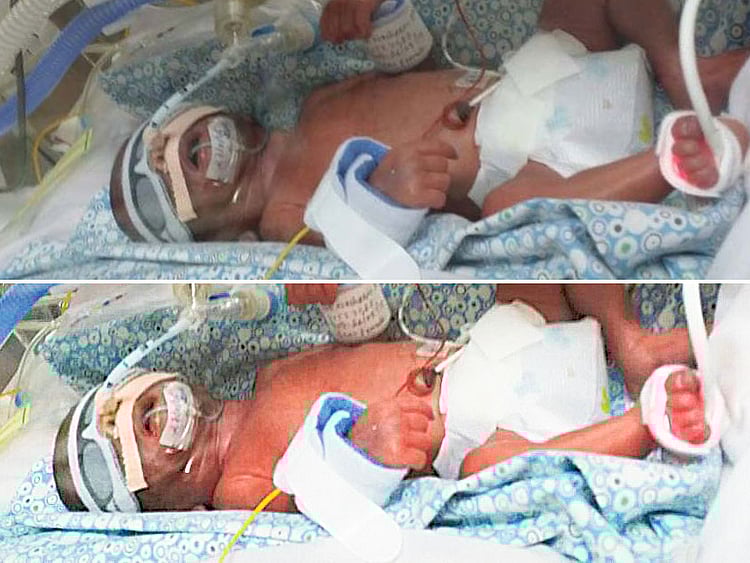
All infants born preterm require immediate and significant medical care posing unexpected challenges — emotional and financial — to their parents and family system.
Also In This Package
Dubai: Each year, there are about 15 million babies around the world be born prematurely — or before 37 weeks of gestation each year.
Out of that number, about 1 million do not survive, despite the advancement in medical care. Prematurity remains the leading cause of death in children under five years.
The World Health Organisation (WHO), points to a study suggesting the number of premature babies is rising globally, although the reason is unclear.
So premature babies are better known as " the few and the brave, the small and mighty, the one in 10, the survivor."
What are the risk factors for premature birth?
Multiple pregnancies, infections and chronic health conditions such as diabetes and high blood pressure can all be factors, although clear cause is seldom identified, say experts.
What is the survival rate?
The World Health Organisation (WHO) points to a study suggesting that the number of premature babies is still rising worldwide.
In an article written by Dr. Maria Theresa B. Reyes, Consultant Neonatologist at Kings College Hospital London Dubai, at least 1 in 10 babies are born prematurely, amounting to 15 million babies per year.
About 1 million of these babies do not survive. Despite the advancement in medical care, prematurity remains the leading cause of death in children under five years.
“Premature babies are the few and the brave, the small and mighty, the one in 10, the survivor,” Dr. Reyes stated in the article.
What challenges do parents face when they have pre-term infants?
All infants born preterm require immediate and significant medical care posing unexpected challenges — emotional and financial — to their parents and family system.
When is the World Prematurity Day (WPD)?
In 2008, the European Foundation for the Care of Newborn Infants and partnering European parent organisations have initiated World prematurity Day to be celebrated every 17th of November.
It is a global movement to raise awareness on the impact of premature birth and the challenges faced by their families.
Definitions of Levels of Hospital Care
First-level hospital (50 to 250 beds): Few specialities—mainly internal medicine, obstetrics and gynecology, pediatrics, and general surgery. Often only one general practice physician or a nonphysician clinician Limited laboratory services available for general analysis but not for specialized pathological analysis Second-level hospital (200–800 beds): More differentiated by function, with as many as 5 to 10 clinical specialties Third-level hospital (300–1,500 beds): Highly specialized staff and technical equipment—for example, cardiology, intensive care unit, and specialized imaging units; Clinical services highly differentiated by function; Teaching activities in some facilities
What is the theme for 2019?
This year’s theme focuses on providing the right care, at the right time, in the right place for all premature babies.
Rightfully said, according to Dr. Reyes, the availability of expertise and resources and being born, albeit too soon, in a place competent and confident to handle these fragile babies can lead to favourable outcomes with minimal morbidity and higher survival rates.
Aliya Parveen and husband Syed Muhammad Ali and their baby
Why is it important to look at Level 3 facility/hospital?
Dr. Reyes further reiterates that researches looking at intended hospitals of birth confirmed that babies born in a Level 3 facility had reduced mortality without an increase in neonatal morbidity.
Large studies involving very low birth weight and extremely low birthweight babies less than 1000 grams demonstrated the same effect if born in Level 3 centres.
The risk of death for very low birth weight infants born with Level 1 and 2 facilities remains high, said Dr Reyes, not to mention the higher risk of complications of brain haemorrhages if babies are born outside and needed to be transferred to Level 3 centres.
All these studies led to the conclusion that high-risk patients should be in higher-level centres with the appropriate resources and personnel to address the required complexity of care.
What is the colour of World Prematurity Day?
Purple. It stands for sensitivity and exceptionality.
The socksline has become a symbol for World Prematurity Day. The small pair of purple socks – framed by nine full-size baby socks – symbolises: 1 in 10 babies is born preterm. Worldwide.
How can you raise awareness and support newborns and their families?
There are ways you can raise awareness and support newborns and their families:
Network Links
GN StoreAbout Gulf NewsTerms & ConditionsReach by GNSitemapContact usPrivacy PolicyGN FocusHave your sayWork with usAdvertise with usGulf News epaperPrinting Services
Download our app
© Al Nisr Publishing LLC 2026. All rights reserved.