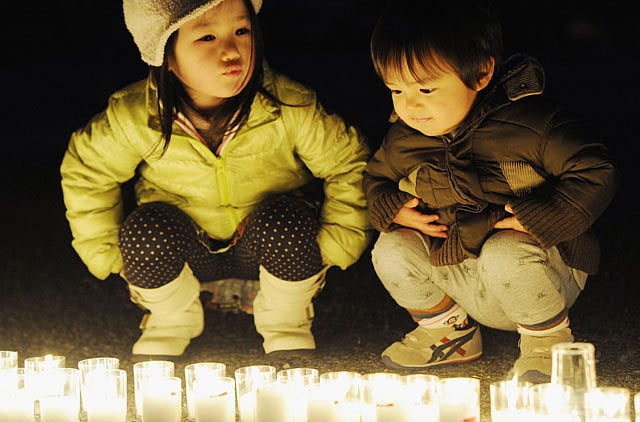
Ishinomaki: As the clock struck 2.46 pm, on March 11, 2011, it was a moment that will be etched in the minds of every individual Japanese.
The 9.0 magnitude earthquake — the world's fifth worst — and consequent tsunami, unleashed its fury across the north eastern parts of Japan, claiming many lives and reducing cities and provinces to a heap of ruins. But more devastatingly, the tsunami had torn apart families and communities.
It has been a year since that tragedy and on Sunday, Japan commemorated the first anniversary of that catastrophe — what is called here the disaster of the Great East Japan Earthquake.
This is an occasion that brings all Japanese together, binding them closer through a genuine feeling of solidarity and inclusiveness, regardless of where they were when the disaster struck, or how closely or remotely it had affected their lives.
In Ishinomaki, which is part of the Miyagi Prefecture (district) located in the north east of Japan, the city stood in silence on Sunday, at the very moment the clock struck 2.46pm. The sorrow in the heart of every Japanese gripped the air and made it heavy.
Relatives who had lost their loved ones last year, had come together for a moment of remembrance and a few seconds of collective solace. Heads bowed in silence, tears rolling down on their cheeks, hands clasped in a prayer.
An eerie moment passes over the minute of silence forcing one to imagine, what could have been the last thoughts at the moment, of a victim or a survivor.
Today is a day of remembrance, a time for solace, solidarity — and above all a time to overcome grief and the sense of isolation. The gymnasium hall in Ishinomaki was filled with almost 1,500 people — relatives of the victims and residents of the area. Men, women, old and young, children and even toddlers trickled in as groups of families.
Miyagi faced a great loss. Of all the 20,000 or so dead and missing last year, 11,000 were from the Miyagi Prefecture. A ten-year-old boy walked in carrying a bouquet of three roses — which would probably find its place on a beloved one's grave. Two young girls followed, dressed in their school uniform, just in time to join the ceremony.
The official ceremony began with a choir singing songs about the homeland and the beauty of mountains, rivers, and the thoughts of friends and loved ones.
The performance took place in front of a stage filled with white flowers and a centre staged wooden plank with an inscription that read: "Ishomiyaki City victims spirits". All eyes later were on the two screens placed at each end of the gymnasium hall as a live transmission from the National Theatre in Tokyo relayed the speeches of Emperor Akihito and Prime Minister Yoshihiko Noda.
The Emperor touched on the issue that is of greatest concern to the Japanese people today — ensuring safety following the nuclear accident and the tsunami.
Other speeches of local officials in Ishinomaki also were scheduled with Mayor of Ishinomaki Hiroshi Kameyama, and Miyagi Governor Yoshihiro Murai, both speaking of hope and the importance for the community to stay united and pass on the history of the tragedy to coming generations.
Sign up for the Daily Briefing
Get the latest news and updates straight to your inbox
Network Links
GN StoreDownload our app
© Al Nisr Publishing LLC 2026. All rights reserved.