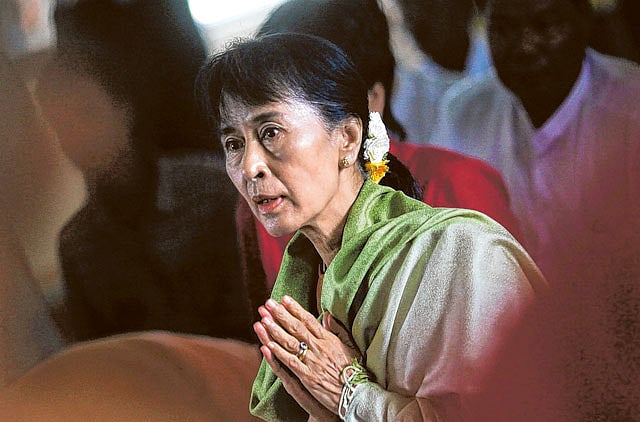
NAYPYITAW: Nobel Peace Prize winner Aung San Suu Kyi is making a career change, from icon of liberty opposing Myanmar’s junta to party boss in a fragile new quasi-democracy. The transition hasn’t been easy.
At a talk in London in June, a student from the Kachin ethnic minority asked why Suu Kyi (a majority Burman) seemed reluctant to condemn a bloody government military offensive against Kachin rebels.
The conflict has displaced some 75,000 people.
Suu Kyi’s answer was studiously neutral: “We want to know what’s happening more clearly before we condemn one party or the other.”
The Kachin community was livid. The Kachinland News website called her reply an “insult.” Kachin protesters gathered outside her next London event. An ‘open letter’ from 23 Kachin groups worldwide said Suu Kyi was “condoning state-sanctioned violence”.
That a woman so widely revered should arouse such hostility might have seemed unthinkable back in April. A landslide by-election victory propelled Suu Kyi and 42 other members of her National League for Democracy into Myanmar’s parliament.
Not anymore. Once idolised without question for her courageous two-decade stand against the old junta, Suu Kyi now faces a chorus of criticism even as she emerges as a powerful lawmaker here.
She has quickly become an influential voice in the country’s newly empowered parliament. Still, ethnic groups accuse her of condoning human-rights abuses by failing to speak out on behalf of long-suffering peoples in Myanmar’s restive border states. Economists worry that her bleak public appraisals of Myanmar’s business climate will scare foreign investors. Political analysts say her party has few real policies beyond the statements of its world-famous chairperson. She must also contend with conflict within the fractious democracy movement she helped found.
International critics have seized upon her ambiguous response to one of Myanmar’s most urgent humanitarian issues: the fate of 800,000 stateless Rohingya Muslims in the coutnry. There, clashes with ethnic Rakhine Buddhists have killed at least 77 people and left 90,000 homeless since June.
Rohingya violence
Spurned by both Myanmar and neighbouring Bangladesh, many Rohingya live in appalling conditions in Rakhine State. The UN has called the Muslim minority “virtually friendless” in Buddhist-dominated Myanmar. The violence erupted in June, days before Suu Kyi’s first trip to Europe in 24 years. “Are the Rohingya citizens of your country or are they not?” a journalist asked Suu Kyi in Norway, after she collected the Nobel Peace Prize she was awarded in 1991 while under house arrest.
“I do not know,” said Suu Kyi. Her rambling answer nettled both the Rohingya, who want recognition as Myanmar citizens, and the locals in Rakhine, who regard them as invaders. The reply contrasted with the moral clarity of her Nobel speech, in which she had spoken about “the uprooted of the earth ... forced to live out their lives among strangers who are not always welcoming.”
Suu Kyi’s moral clarity helped make the former junta a global pariah. Her new role as political party leader demands strategic ambiguity as well. She must retain her appeal to the majority Burmans and Buddhists, without alienating ethnic minorities or compatriots of other faiths.
Always a politician
“I don’t like to be referred to as an icon, because from my point of view, icons just sit there,” she said in a lecture last month at Harvard’s Kennedy School of Government in Cambridge, Massachusetts. “I have always seen myself as a politician. What do they think I have been doing for the past 24 years?”
Myanmar’s emergence from authoritarianism is often compared to the Arab Spring. Yet its historic reforms were ushered in not by destabilising street protests, but by former generals such as President Thein Sein.
Suu Kyi’s role was pivotal. A meeting she held with Thein Sein in Naypyitaw in August 2011 marked the start of her pragmatic engagement with a government run by ex-soldiers. She pronounced him “sincere” about reforming Myanmar, an endorsement that paved the way for US Secretary of State Hillary Clinton’s visit to Naypyitaw last November and the scrapping of most sanctions.
So can adulation, which generates expectations that not even Myanmar’s “human rights superstar”— as Amnesty International calls her —can fulfill.
Suu Kyi realizes this. “To be criticised and attacked is an occupational hazard for politicians. To be praised and idealized is also an occupational hazard and much the less desirable of the two.” She wrote that 14 years ago.
— Reuters
Sign up for the Daily Briefing
Get the latest news and updates straight to your inbox
Network Links
GN StoreDownload our app
© Al Nisr Publishing LLC 2026. All rights reserved.