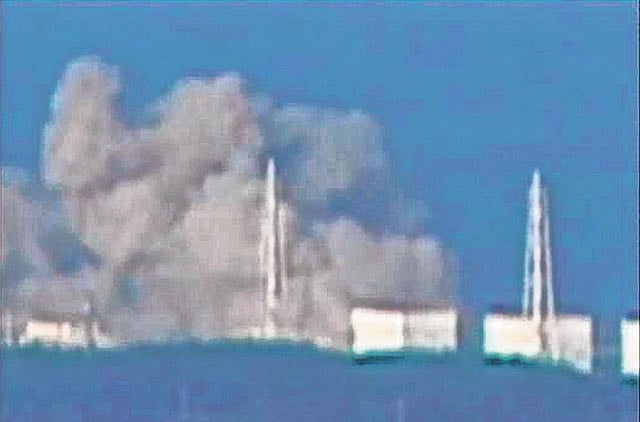
Fukushima: Radiation yesterday leaked from a damaged Japanese nuclear reactor north of Tokyo, the government said, after an explosion blew the roof off the facility in the wake of a massive earthquake.
The developments raised fears of a meltdown at the plant as officials scrambled to contain what could be the worst nuclear disaster since the Chernobyl explosion in 1986 that shocked the world.
The Japanese plant was damaged by Friday's 8.9-magnitude earthquake, which sent a 10-metre tsunami ripping through towns and cities across the northeast coast. Japanese media estimate that at least 1,700 people were killed.
"We are looking into the cause and the situation and we'll make that public when we have further information," Chief Cabinet Secretary Yukio Edano said after confirming the explosion and radiation leak at the plant.
Edano said an evacuation radius of 10km from the stricken 40-year-old Daiichi 1 reactor plant in Fukushima prefecture was adequate, but an hour later the boundary was extended to 20km. TV footage showed vapour rising from the plant, 240km north of Tokyo.
Along Japan's northeast coast, rescue workers searched through the rubble of destroyed buildings, cars and boats, looking for survivors in hardest-hit areas such as the city of Sendai, 300km northeast of Tokyo.
Dazed residents hoarded water and huddled in makeshift shelters in near-freezing temperatures. Aerial footage showed buildings and trains strewn over mudflats like toys.
"All the shops are closed, this is one of the few still open. I came to buy and stock up on diapers, drinking water and food," Kunio Iwatsuki, 68, told Reuters in Mito city, where residents queued outside a damaged supermarket for supplies.
Across the coastline, survivors clambered over nearly impassable roads. In Iwanuma, not far from Sendai, people spelled S.O.S. out on the roof of a hospital surrounded by water, one of many desperate scenes.
The earthquake and tsunami, and now the radiation leak, present Japan's government with its biggest challenge in a generation.
The blast at the Japanese nuclear facility came as plant operator Tokyo Electric Power Co (Tepco) worked desperately to reduce pressures in the core of the reactor. The company has had a rocky past in an industry plagued by scandal. In 2002, the president of the country's largest power utility was forced to resign along with four other senior executives, taking responsibility for suspected falsification of nuclear plant safety records.
NHK television and Jiji news agency said the outer structure of the reactor building that houses the reactor appeared to have blown off, but nuclear experts said this did not necessarily mean the nuclear reactor had been breached.
Sign up for the Daily Briefing
Get the latest news and updates straight to your inbox
Network Links
GN StoreDownload our app
© Al Nisr Publishing LLC 2026. All rights reserved.