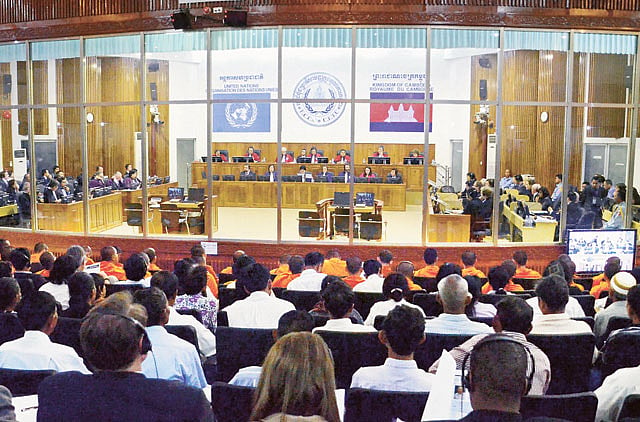
Phnom Penh: Three top Khmer Rouge leaders accused of orchestrating Cambodia's "killing fields" went on trial yesterday before a UN-backed tribunal more than three decades after some of the 20th century's worst atrocities.
Judge Nil Nonn declared the trial open yesterday and read the names of the three senior Khmer Rouge leaders who are defendants in the tribunal in the Cambodian capital, Phnom Penh.
The charges against the surviving inner circle of the communist movement — all now in their 80s — include crimes against humanity, genocide, religious persecution, homicide and torture stemming from their 1975-79 reign of terror.
An estimated 1.7 million people died of execution, starvation, exhaustion or lack of medical care as a result of the Khmer Rouge's radical policies, which essentially turned all of Cambodia into a forced labour camp as the movement attempted to create a pure agrarian socialist society. Intellectuals, entrepreneurs and anyone considered a threat were imprisoned, tortured and often executed.
Tribunal spokesman Huy Vannak called the proceedings "the most important trial in the world" because of the seniority of those involved.
"It sends a message that the trial, which survivors have been waiting more then three decades for, finally begins," he said.
Unfit to stand trial
The defendants, who sat side by side with their lawyers, are 85-year-old Nuon Chea, the Khmer Rouge's chief ideologist and the No 2 leader behind the late Pol Pot; 80-year-old Khieu Samphan, an ex-head of state; and 86-year-old Ieng Sary, the former foreign minister.
A fourth defendant, 79-year-old Ieng Thirith, was ruled unfit to stand trial last week because she has Alzheimer's disease. She is Ieng Sary's wife and served as the regime's minister for social affairs.
The Khmer Rouge's supreme leader, Pol Pot, died in 1998 in Cambodia's jungles while a prisoner of his own comrades, who after being toppled from power fought a guerrilla war that did not fully end until the late 1990s.
There is serious concern that justice may not be done if any of the ageing and infirm defendants dies before a trial is finished.
Forum for victims
In September, the tribunal announced it would split up the indictments according to charge into separate trials in order to expedite the proceedings.
"It's the first time the senior leadership of the Khmer Rouge is being tried by a court with international backing. It's the first time thousands of victims have had a forum to tell their stories, and demand reparations for their suffering," said Clair Duffy of the Open Society Justice Initiative, which has been monitoring the tribunal's work.
Sign up for the Daily Briefing
Get the latest news and updates straight to your inbox
Network Links
GN StoreDownload our app
© Al Nisr Publishing LLC 2026. All rights reserved.