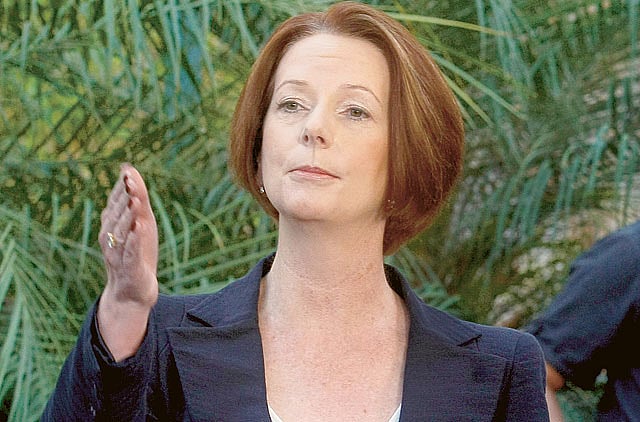
Canberra: Prime Minister Julia Gillard put her job on the line on Thursday, announcing a leadership ballot in hopes of quashing a comeback by Kevin Rudd, the colleague she ousted in a Labour Party coup nearly two years ago.
The vote by party lawmakers, scheduled for Monday, is an effort by Gillard to knock down a power struggle that has been percolating for weeks, and that spilled over onto the world stage on Wednesday when Rudd resigned as foreign minister during an official trip to the US. The fight could lead to the collapse of the government and early elections.
In Washington, Rudd would not say whether he will challenge Gillard in the leadership ballot, telling reporters on Wednesday night he would announce that decision when he returns to Australia on today. But he said he believes the Labour Party will lose national elections scheduled for next year if Gillard remains its leader.
Gillard said she will abandon her leadership ambitions if Labour lawmakers choose Rudd over her on Monday, and she called on Rudd to do the same if he loses. "We need a leadership ballot to settle this question once and for all," she told reporters in Canberra, the capital.
Analysts expect Gillard has enough support in the House of Representatives to remain in power for now, but she and her government are unpopular among voters. And Rudd supporters said even if he lost on Monday, he would simply build support and try again later.
A Rudd supporter, Senator Doug Cameron, said a Monday poll would be unfair because Rudd would not have time to canvass support.
"It's clear that some senior ministers are intent on putting a stake through Kevin Rudd's heart and I don't think that's justified," Cameron told Australian Broadcasting Corp television.
Disloyalty
For weeks, Rudd denied widespread rumours he was planning a run for Gillard's job. Before Rudd announced his resignation, Gillard had refused to comment on media reports that she intended to fire him as foreign minister for disloyalty. Rudd accused Gillard of showing disloyalty to him by failing to silence senior ministers who accused him of being dysfunctional and of secretly undermining the Australian government while he served as its top international envoy.
As Rudd turned from Cabinet member to rival, Gillard criticised his performance as prime minister, and her supporters have been warning about his notorious temper. Gillard supporters have been accused of leaking a video to media over the weekend in which Rudd, then prime minister, became enraged as he struggled with the words in a Chinese-language speech.
Nick Economou, a political scientist at Monarch University, said Rudd's resignation caught Gillard wrong-footed. "Everyone can figure out the thing to do is to jump before you're pushed. That way you've got the high moral ground instead of being sent to the back bench as the product of the prime minister's authority," Economou said.
He called Rudd's resignation "an absolute strategic disaster" for Gillard that made the Australian government appear dysfunctional in the capital city of the US, Australia's most important security partner.
Sign up for the Daily Briefing
Get the latest news and updates straight to your inbox
Network Links
GN StoreDownload our app
© Al Nisr Publishing LLC 2026. All rights reserved.