Wopke Hoekstra, EU climate commissioner, left, sits next to Darragh O'Brien, minister of climate, energy and the environment of Ireland, during a closing plenary session at the COP31 U.N. Climate Summit, Sunday, Nov. 22, 2026, in Antalya, Turkey.
Why did COP31 collapse, and what happens to global climate action now?
Deadlock over fossil fuels, carbon capture raises questions about future of climate talks
Last updated:
4 MIN READ
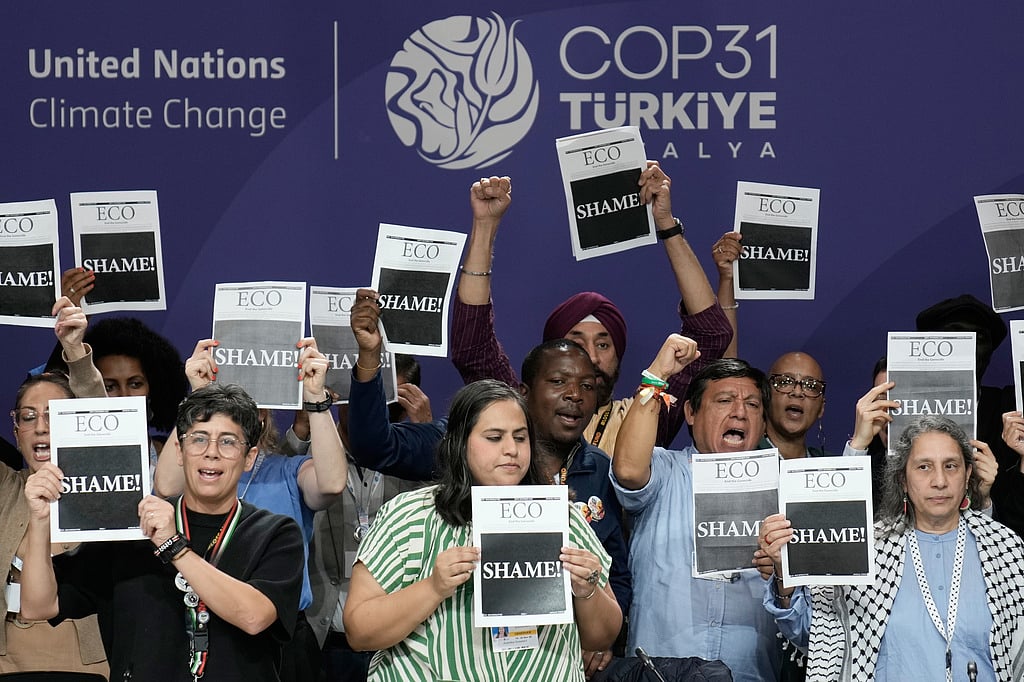
Attendees hold signs that say "SHAME!" as they take part in a session at the COP31 U.N. Climate Summit, Friday, Nov. 20, 2026, in Antalya, Turkey.
AP
The COP31 climate summit in Turkey ended in failure on Sunday after nearly 200 countries failed to agree on a common plan to confront global warming. The talks in Antalya ran more than 49 hours beyond their scheduled conclusion, making them the longest UN climate negotiations on record.
The breakdown exposed deep divisions between oil-producing nations and countries demanding stronger action against fossil fuels. Disagreements over climate finance, carbon capture technologies and scientific assessments further complicated negotiations.
UN Secretary-General Antonio Guterres expressed profound frustration at the outcome, while UN climate chief Simon Stiell warned: “The world cannot afford a repeat.”
Here is what went wrong, why it matters and what could happen next.
Why did COP31 fail?
The immediate cause was disagreement over whether the summit’s final political declaration, known as a “cover decision”, should explicitly address the phasing out of fossil fuels.
The European Union and several vulnerable nations refused to endorse an agreement that ignored coal, oil and gas, the principal drivers of global warming.
Saudi Arabia and other oil-producing countries opposed language calling for their phase-out.
Australian Climate Minister Chris Bowen, who chaired negotiations, acknowledged that the opposing positions had become “unbridgeable red lines”.
The proposed Antalya Pact consequently failed to secure the consensus needed for adoption.
Why were fossil fuels such a contentious issue?
Burning coal, oil and natural gas releases greenhouse gases that trap heat in the atmosphere, increasing global temperatures and intensifying extreme weather.
But replacing fossil fuels involves enormous economic and political challenges, particularly for countries dependent on oil revenues or coal-fired electricity.
The dispute was therefore about much more than wording. It concerned how quickly economies should move away from fossil fuels and who would bear the economic consequences.
Didn’t countries already agree to move away from fossil fuels?
Yes. At COP28 in Dubai in 2023, countries agreed to “transition away from fossil fuels” in energy systems, a landmark acknowledgement of their role in climate change.
However, fossil fuels were absent from the final agreements at COP29 and COP30.
At COP31, countries seeking stronger commitments refused to accept another declaration that avoided the issue.
Ireland’s Climate Minister Darragh O’Brien, representing the EU presidency, declared: “We will not endorse a cover decision... that does not even mention fossil fuels, which is the key driver of climate change.”
What other disputes contributed to the collapse?
Carbon capture technology became another major obstacle.
The proposed agreement encouraged expanding technologies that capture carbon dioxide and store it rather than allowing it to enter the atmosphere.
Oil-producing nations argue that these technologies should form part of the climate solution.
“We believe that climate change requires all solutions on the table,” said Saudi negotiator Mohammad Ayoub.
Critics counter that carbon capture remains expensive, energy-intensive and insufficiently developed to handle global emissions at scale. They fear excessive reliance on it could allow continued fossil fuel consumption instead of encouraging reductions.
Countries also disagreed over the timing of scientific work by the Intergovernmental Panel on Climate Change (IPCC).
What happened to climate finance?
Developing countries wanted stronger commitments from wealthier nations to finance clean energy transitions and protect communities against worsening climate disasters.
They pushed for a $120 billion climate finance target, but it disappeared from the failed agreement.
This reinforced longstanding grievances that poorer countries, despite contributing relatively little to historical emissions, face some of the worst consequences of climate change without adequate financial support.
Could a compromise have saved the summit?
Turkey and Australia attempted to bridge the divisions by proposing a global goal to electrify economies, potentially reducing emissions while improving energy security.
But the proposed pact offered only an indirect reference to fossil fuels while retaining provisions supporting carbon capture.
The compromise failed to satisfy opposing camps, and the broader agreement was rejected.
Does the collapse mean the Paris Agreement is dead?
No. The 2015 Paris Agreement remains in force, along with existing international climate commitments.
Its central goal is to keep global warming well below 2°C above pre-industrial levels while pursuing efforts to limit the increase to 1.5°C.
However, the failure to agree on stronger measures makes achieving that ambition increasingly difficult.
Scientists expect the 1.5°C threshold to be breached in the coming years as global emissions remain too high.
Why couldn’t the majority simply approve the agreement?
UN climate negotiations operate through consensus rather than ordinary majority voting.
Consequently, a small group of countries can prevent an agreement even when most participants support it.
“Decision-making that requires every country to agree on every comma is not fit for a climate emergency,” said Nikki Reisch of the Center for International Environmental Law.
Bowen acknowledged the problem but highlighted another obstacle: “you also need consensus to change consensus”.
Has a climate summit failed like this before?
Yes. The outcome revived memories of COP15 in Copenhagen in 2009, widely regarded as a major diplomatic failure.
COP31’s collapse is particularly significant because countries that previously accepted weak compromises to preserve the negotiating process were no longer prepared to do so.
It raises fundamental questions about whether the existing system can deliver meaningful action quickly enough.
What happens now? Could countries act outside COP?
Yes. Some governments are increasingly pursuing agreements among like-minded countries rather than waiting for universal consensus.
One example is the Santa Marta initiative, which brings together countries committed to phasing out fossil fuels.
Legal action may also gain momentum following an International Court of Justice advisory opinion confirming that states have binding obligations to combat climate change.
China, meanwhile, expressed disappointment but insisted that the global green transition remained “irreversible”.
What is next for global climate diplomacy?
The next summit, COP32, is scheduled for Ethiopia in 2027. COP33 in 2028 is expected to review global progress on emissions reductions through the next global stocktake, although its host has yet to be confirmed.
The immediate challenge is restoring confidence in a negotiating process increasingly strained by geopolitical tensions, economic interests and competing national priorities.
As Guterres warned: “Temperatures keep shattering records. Climate extremes keep intensifying. Emissions remain far too high.”
With inputs from AFP and AP

Alex has been on the frontline of global headlines for nearly 30 years. A Senior Associate Editor, he’s part newsroom veteran and part globe-trotting correspondent. His credentials? He was part of the select group of journalists who covered Pope Francis’ historic visit to the UAE - flying with the pontiff himself. With 27 years on the ground in the Middle East, Alex is one of the most trusted voices in the region when it comes to decoding politics and power plays. He breaks down global affairs into slick, 60-second news - his morning reels are practically a daily ritual for audiences across the UAE. Sharp. Grounded. Fast. Insightful. That’s Alex at his best, bringing a steady editorial hand to every story he tells.
Sign up for the Daily Briefing
Get the latest news and updates straight to your inbox
Network Links
GN StoreAbout Gulf NewsTerms & ConditionsReach by GNSitemapContact usPrivacy PolicyGN FocusHave your sayWork with usAdvertise with usGulf News epaperPrinting Services
Download our app
© Al Nisr Publishing LLC 2026. All rights reserved.