The Suez Canal is rarely blocked — but when it is, the effects are global and immediate. Even short disruptions can ripple across oil prices, supply chains, and shipping routes worldwide. The 400-meter, 224,000-tonne Ever Given container ship, leased by Taiwan's Evergreen Marine Corp, is seen blocking the Suez Canal in this European Space Agency Copernicus Sentinel-2 satellite Image distributed courtesy of Maxar Technologies taken March 24, 2021.
When the world’s arteries close: From Suez’s 8-year shutdown to the shadow blockade of Hormuz
What happened when the Suez Canal was blocked — and why it matters now
Last updated:
5 MIN READ
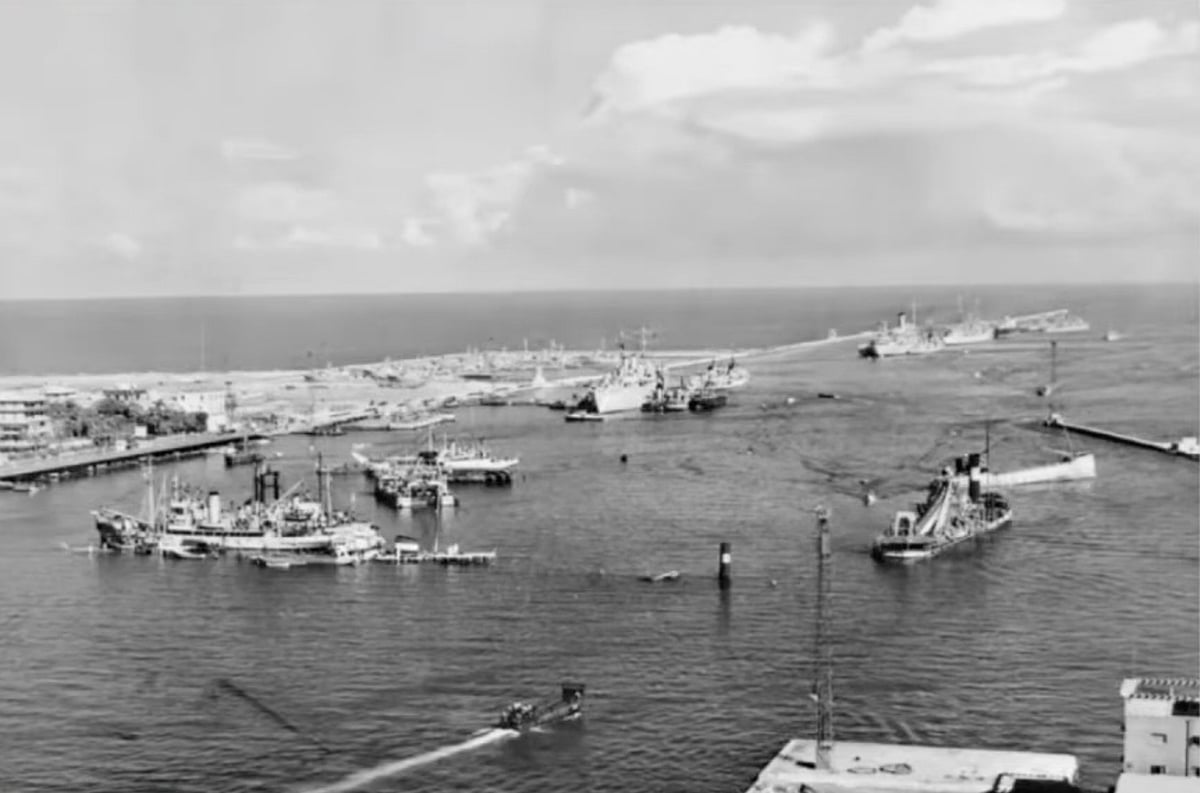
An overview of the Suez Canal at Port Said showing a number of the blocking ships sunk to prevent use of the canal during the Arab-Israeli War. Egypt closed it from June 5, 1967, to June 5, 1975. The 1967 closure lasted eight years, with the canal acting as a frontline between Egypt and Israeli-occupied Sinai.
The Suez Canal — one of the most critical trade routes on Earth — was effectively shut down for eight years, from 1967 to 1975.
It wasn’t an accident. It was war.
At the outbreak of the 1967 Arab–Israeli War, Egypt deliberately blocked the canal by sinking ships and laying mines, turning the waterway into a militarised frontline between Egyptian and Israeli forces.
What had once been a global shipping artery became a “no-man’s-land.”
Fifteen ships — the so-called “Yellow Fleet” — were stranded in the Great Bitter Lake for the entire duration, becoming a floating symbol of how geopolitics can freeze global trade overnight.
Why would a country block such a vital global route?
Because chokepoints are power.
Egypt’s move was strategic: deny Israel access, assert control, and weaponise geography.
The canal became less about commerce and more about leverage — an echo of earlier tensions during the Suez Crisis, when control over the canal triggered a global confrontation involving Britain, France, Israel, and the United States.
The lesson was clear then — and remains true today: whoever controls the chokepoint controls the flow of energy, goods, and influence.
The Suez Canal opened in 1869, financed by the French and Egyptian governments. The canal was operated by the Suez Company, an Egyptian-chartered company.
President Gamal Abdel Nasser in Port Said after the nationalisation of the Panama Canal.
What finally led to the canal reopening in 1975?
It wasn’t a single event. It was a chain reaction.
1. War changed the calculus
The "October War" reshaped the battlefield and forced both sides toward negotiation.
2. Diplomacy created space
UN-backed ceasefires and disengagement agreements led to Israeli withdrawal from key positions along the canal’s west bank.
3. Superpower involvement mattered
The United States led a massive demining and clearing operation in 1974, removing wreckage and explosives that made the canal impassable.
4. Economic reality took over
Egypt, under President Anwar Sadat, needed to revive its economy and re-engage with global trade and Western partners.
On June 5, 1975 — exactly eight years after its closure — the canal reopened.
Satellite image from ship tracker shows the flow of ships from Suez Canal (top left), the Red Sea marine traffic, and Bab Al Mandab on the lower right.
What changed during those eight years?
The world adapted.
With the canal closed, oil tankers were forced to take the much longer route around Africa’s Cape of Good Hope.
That inefficiency triggered a major innovation cycle: the rise of supertankers large enough (very large crude carrier, VLCC) to make long-haul shipping economically viable.
In other words, disruption didn’t just pause the system — it reshaped it.
How does this connect to today’s tensions in the Strait of Hormuz?
The parallel is striking. The Strait of Hormuz is the modern equivalent of Suez — a natural, narrow passage through which a significant portion of the world’s oil supply flows.
Unlike Suez in 1967, Hormuz has not been physically sealed for years.
But in recent conflicts, Iran has demonstrated something arguably more powerful: the ability to “virtually” block it.
Through drone strikes, tanker attacks, and military threats, shipping through Hormuz can become too risky or expensive to sustain. Insurance costs spike.
Traffic slows. Some vessels reroute entirely. The chokepoint doesn’t need to be closed.
It just needs to "feel" closed.
This handout photo taken on March 11, 2026 shows smoke rising from the Thai bulk carrier 'Mayuree Naree' near the Strait of Hormuz after an attack.
What would reopening Hormuz require if it were fully disrupted?
History suggests three familiar ingredients:
1. Military stabilisation
Just as in the 1970s, naval coalitions — often led by the United States and allies — would be needed to secure safe passage.
2. Diplomatic breakthrough
A ceasefire or broader regional de-escalation would be essential. Without political agreement, no amount of clearing operations can guarantee safety.
3. Physical and operational clearing
Mines, threats, and damaged infrastructure would need to be addressed—echoing the massive 1974 effort that reopened Suez.
What’s the deeper lesson across both Suez and Hormuz?
Energy systems built on chokepoints are inherently fragile.
Whether it’s Suez in 1967 or Hormuz today, the pattern is the same:
A geopolitical flashpoint emerges
A critical route becomes contested
Global supply chains seize or reroute
The world is forced to adapt
And in that adaptation lies the real story.
How does this tie into today’s energy transition?
Every disruption accelerates the search for alternatives.
The eight-year closure of Suez helped reshape global shipping. Today’s instability around Hormuz is doing something similar—but on a broader scale.
It is pushing nations, industries, and consumers to rethink dependence on fuels that must pass through vulnerable chokepoints.
In that sense, the “virtual blockade” of Hormuz is not just a geopolitical strategy. It is a signal.
A reminder that systems built on continuous flow can be interrupted — and that when they are, the world doesn’t just wait.
It evolves.
From Suez to Hormuz, the story is not just about waterways. It is about control, vulnerability, and transformation.
Because when the world’s arteries close — even briefly — the global system doesn’t simply pause. It begins to change.
File photo: The MV Ever Given container ship being pushed by tugboats in the Suez Canal.
Suez Canal Blockage: Timeline
1956 – The Suez Crisis (Full Closure)
Trigger: Nationalization by Gamal Abdel Nasser
Conflict: Invasion by the UK, France, and Israel
Impact: Canal shut down for ~5 months
Significance: First major geopolitical shutdown of the canal
1967–1975 – Longest closure in history
Trigger: 1967 Arab–Israeli War
Impact: Canal closed for 8 years
Notable: “Yellow Fleet” of trapped ships stranded in the canal
Reopened in 1975 after clearing mines and wreckage
2004–2016 – Minor Groundings & Disruptions
Several ships ran aground or experienced mechanical failures
Typically resolved within hours to a day
Highlighted narrowness and vulnerability of the canal
March 2021 – 'Ever Given' Crisis
Vessel: Ever Given
Cause: High winds + navigational issues
Impact: Canal blocked for 6 days
Effect: ~12% of global trade disrupted, hundreds of ships delayed
Became one of the most costly shipping incidents in history
2023–2024 – Red Sea Crisis spillover
Trigger: Attacks on shipping in the Red Sea linked to regional conflict
Impact: Not physically blocked, but traffic plunged
Many ships rerouted around Africa, avoiding the canal
2025–2026 – Ongoing regional tensions
Linked to instability involving Iran and Gulf conflicts
Impact: No full blockage, but heightened risk and insurance costs
Strategic chokepoints like Suez and Hormuz increasingly interconnected
Sign up for the Daily Briefing
Get the latest news and updates straight to your inbox
Network Links
GN StoreAbout Gulf NewsTerms & ConditionsReach by GNSitemapContact usPrivacy PolicyGN FocusHave your sayWork with usAdvertise with usGulf News epaperPrinting Services
Download our app
© Al Nisr Publishing LLC 2026. All rights reserved.