US forces strike the Iranian tanker M/T Stark 1 off Jask in the Gulf of Oman.
US-Iran ship attacks open dangerous new phase in battle for Strait of Hormuz
Tit-for-tat strikes threaten fragile oil flow recovery as both sides signal more attacks
Last updated:
5 MIN READ
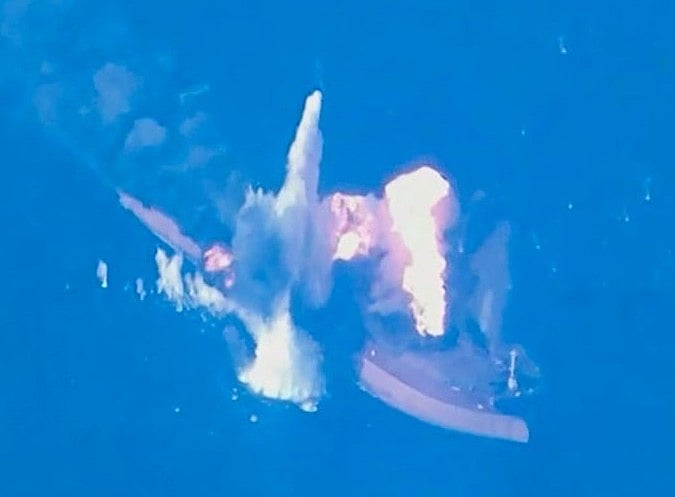
A screen grab from US Central Command footage shows a strike on an oil tanker linked to Iran’s Revolutionary Guards, as attacks on shipping open a dangerous new phase in the battle over the Strait of Hormuz.
AFP
Dubai: The US attack on three Iranian oil tankers has opened a more dangerous phase in the battle for the Strait of Hormuz, with Tehran claiming retaliatory attacks on six vessels as Washington tries to sustain the recovery in oil flows through the vital waterway.
The confrontation is rapidly becoming a cycle of ship-for-ship retaliation: Iran is seeking to prevent vessels from passing through Hormuz without its consent, while Washington has warned that attacks on its navy will cost Tehran more of the oil fleet it depends on for revenue.
Hours after the US strikes, Iran’s Revolutionary Guards said they had targeted six vessels — three oil tankers using what Tehran called an “unauthorised route” through the Strait of Hormuz and three vessels it said were affiliated with the United States elsewhere.
The Guards warned other ships against using routes not approved by Tehran, underscoring the central struggle over who controls passage through Hormuz. There was no immediate independent confirmation of the Iranian claims.
Iran’s military separately warned that attacks on US naval vessels could become “more severe” and expand if Washington continued what Tehran calls harassment of Iranian shipping and a naval blockade.
The latest cycle began after Iran launched ballistic missiles towards a US aircraft carrier and guided-missile destroyer. US Central Command said both warships evaded the attacks before American forces retaliated against three Iranian crude carriers.
Two — the Downy off Kharg Island and Stark 1 near Jask — were “permanently disabled”, while the unladen Kylo was “completely destroyed” outside the Arabian Gulf, according to CENTCOM.
“If you shoot at two of our ships, we will impose an even higher economic cost — taking out three of yours,” CENTCOM commander Adm. Brad Cooper said.
A fragile recovery at risk
The escalation comes at a sensitive moment for Hormuz.
Oil flows through the strait have recovered significantly from the severe disruption earlier in the six-month conflict as the United States escorts commercial vessels and attacks Iranian capabilities used to threaten shipping.
Flows are now estimated at around two-thirds of pre-war levels, although Washington has reported much higher volumes on some days.
That recovery remains vulnerable.
Iran is still seeking to dictate which vessels can use Hormuz, and its latest claim of attacks on three tankers travelling on an “unauthorised route” suggests Tehran is trying to enforce that position even as US-protected traffic increases.
If Tehran follows through on its threat to intensify attacks on US naval escorts, the consequences could extend well beyond the military confrontation.
Repeated missile or drone attacks could again increase the risks facing commercial shipping, unsettle shipowners and insurers and slow the recovery in oil traffic — even if Iran fails to hit an American warship.
The contest over Hormuz, in other words, is not simply about physically closing or opening the strait. It is increasingly about whether Washington can make commercial shipping confident enough to keep using it.
Iran faces a difficult choice
That presents Tehran with a dilemma.
Hormuz has been one of Iran’s most important sources of leverage during the war. If increasing numbers of vessels can pass through under US protection, that leverage diminishes.
But trying to reassert it by attacking American warships now carries a clearly stated price.
US Defence Secretary Pete Hegseth warned on Saturday that Washington would “destroy (and sink)” Iranian oil tankers if Tehran continued firing on US Navy vessels.
The threat potentially exposes one of Iran’s remaining economic lifelines.
More than 50 Iranian tankers are in the Arabian Gulf and nearby Gulf of Oman, according to ship-tracking services cited by CNN, including nearly 20 anchored near Kharg Island.
Many of those near Kharg are believed to be laden with crude but unable to leave the Gulf because of US pressure.
A satellite image shows an oil terminal at Kharg Island, Iran
Pressure moves closer to Kharg
Saturday’s strike on the Downy is particularly significant because it brought US military action close to the heart of Iran’s oil-export system.
Kharg Island, about 16 miles off Iran’s coast in the northern Arabian Gulf, handled roughly 90 per cent of the country’s crude exports before the war.
US forces have previously struck military targets there while leaving its principal oil facilities untouched, despite President Donald Trump’s repeated threats involving the island.
Saturday’s attack targeted a tanker rather than Kharg’s terminals, storage tanks or pipelines.
But it demonstrated how easily further retaliation could move closer to infrastructure that is crucial to Iran’s ability to earn oil revenue.
Warning before the strike
Washington also appeared intent on separating its attack on the tankers from an attack on their crews.
Audio confirmed by CNN captured a US military aircraft warning the crew of the Stark 1 before the strike.
“I am preparing to fire at your stern,” an American-accented voice said, giving the crew 10 minutes to clear that part of the vessel.
A later warning told them to get into lifeboats and abandon the ship.
Iranian media said there were no casualties in the attack near Kharg Island.
How far will Iran escalate?
The biggest uncertainty is how far the retaliation now goes.
Iran's claimed attacks on six vessels suggest Tehran is prepared to challenge both commercial traffic using routes it has not approved and US military power protecting shipping through the region.
Iran does not have to sink an American aircraft carrier to disrupt Washington’s strategy in Hormuz. Sustained attacks on naval escorts could force US ships into repeated defensive operations and make commercial operators more wary of the route.
But a successful Iranian strike would carry much greater risks.
An attack that seriously damaged a US warship — particularly one that killed American personnel — could trigger a much larger response and put more of Iran’s military and oil assets at risk.
Tehran therefore needs to demonstrate that it can still impose costs in Hormuz without provoking retaliation that further damages its own ability to fight and finance the conflict.
Washington faces the opposite challenge: keeping more ships moving through Hormuz without allowing its effort to protect the waterway to turn into an escalating ship-for-ship war.
Oil is flowing again through the strait. But with Washington now targeting Iran's oil fleet and Tehran claiming attacks on ships using routes it has not approved, the battle over who controls Hormuz has entered a more dangerous phase.

A Senior Associate Editor with more than 30 years in the media, Stephen N.R. curates, edits and publishes impactful stories for Gulf News — both in print and online — focusing on Middle East politics, student issues and explainers on global topics. Stephen has spent most of his career in journalism, working behind the scenes — shaping headlines, editing copy and putting together newspaper pages with precision. For the past many years, he has brought that same dedication to the Gulf News digital team, where he curates stories, crafts explainers and helps keep both the web and print editions sharp and engaging.
Sign up for the Daily Briefing
Get the latest news and updates straight to your inbox
Network Links
GN StoreAbout Gulf NewsTerms & ConditionsReach by GNSitemapContact usPrivacy PolicyGN FocusHave your sayWork with usAdvertise with usGulf News epaperPrinting Services
Download our app
© Al Nisr Publishing LLC 2026. All rights reserved.