FILE - President Donald Trump, right, meets with NATO Secretary General Mark Rutte on the sidelines of the Annual Meeting of the World Economic Forum in Davos, Switzerland, Jan. 21, 2026.
Trump’s Nato threat rattles alliance as global economy reels from Iran's choking of Hormuz
Alliance strains as Article 5 collective defence ideal collides with geopolitical reality
Last updated:
4 MIN READ
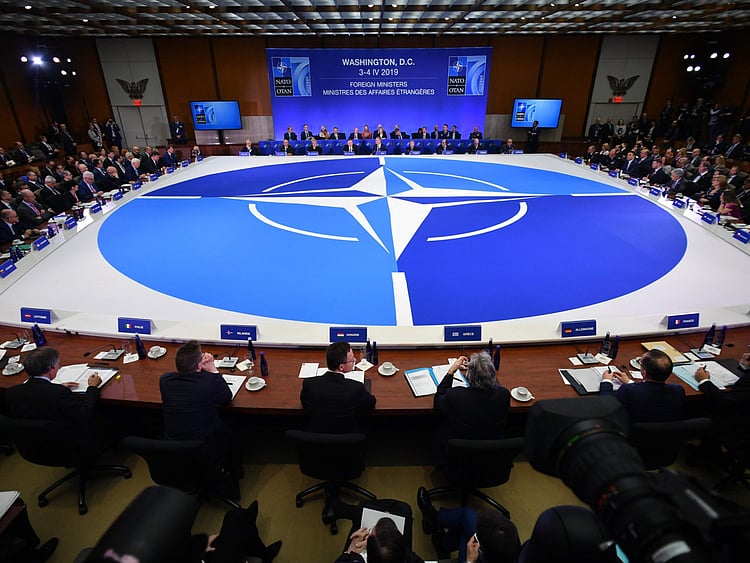
A Nato alliance meeting. US President Donald Trump's frustration centres on allies refusing to automatically join US military operations — alongside Israel — against Iran.
AFP
Of all the pressure tactics in Donald Trump’s playbook, threatening to pull the United States out of the North Atlantic Treaty Organisation (Nato) has always been one of the most powerful — and destabilising.
Asked by The Telegraph whether he was reconsidering US membership in the Western military alliance, Trump didn’t hesitate: “Oh yes… I would say [it’s] beyond reconsideration.”
His frustration this time centres on allies refusing to automatically join US military operations — alongside Israel — against Iran.
“I just think it should be automatic,” he added.
That expectation cuts to the heart of a long-running misunderstanding. Nato is built on collective defence, but not automatic war participation.
Under Article 5, an attack on one member is considered an attack on all —but action requires consensus among all 32 members.
And the original 1949 treaty was designed primarily around threats in Europe and North America.
That nuance is now colliding with reality.
Several Nato allies have held back from joining the Iran conflict—largely because they were not consulted beforehand and remain unclear about Washington’s objectives amid mixed messaging from the administration.
Historically, Article 5 has only been invoked once: after the September 11 attacks.
Trump, however, suggested a broader interpretation. Referring to Ukraine, he said: “We’ve been there automatically, including Ukraine.”
But Ukraine is not a Nato member.
After Vladimir Putin launched a full-scale invasion in 2022, the US — under Joe Biden — did take a leading role in coordinating Western support.
Still, Nato as an alliance deliberately avoided becoming a direct combatant, wary of escalating the conflict into a wider war.
Nato: 'Paper tiger', 'obsolete'
Trump’s skepticism toward Nato is nothing new. Even before taking office in 2017, he dismissed the alliance as a “paper tiger,” called it “obsolete,” and argued it was “costing a fortune” for the United States.
At one point during his first term, the threat became very real.
Former Nato Secretary General Jens Stoltenberg revealed in his memoir On My Watch that “we saw clear signs that Trump was preparing to act on his threat” to withdraw in 2019. Stoltenberg said he intervened publicly, crediting Trump with pushing allies to boost defense spending — a move that Trump quickly amplified on social media, backing away from a planned withdrawal speech.
At the center of Trump’s grievances has long been burden-sharing.
Defence spending
Nato members agreed in 2014 to aim for defence spending of 2% of GDP—a target that was initially more guideline than obligation. Since then, military budgets across Europe and Canada have surged, driven partly by Trump’s pressure and partly by rising concerns over Russia.
Still, one fact remains unchanged: the United States dominates the alliance militarily.
Washington accounts for roughly 62% of NATO’s total defence spending, with capabilities—from intelligence to logistics—that few allies can match.
That imbalance is now feeding a deeper fracture.
Trump’s Secretary of State, Marco Rubio, has echoed the criticism, warning that the alliance may need rethinking after the Iran conflict.
“I think there’s no doubt, unfortunately, after this conflict is concluded we are going to have to re-examine that relationship,” Rubio said.
Nato a 'one-way street'?
Pointing to US bases in Europe, he added: “Not using them ‘to defend America’s interests’ meant ‘Nato is a one-way street.’”
The strain is already visible on the ground.
The UK initially refused to allow US warplanes to use its bases for strikes, later softening its stance to permit “defensive operations.”
That hesitation drew sharp criticism from Trump and Defense Secretary Pete Hegseth, who mocked Prime Minister Keir Starmer as “no Churchill.”
Other allies have gone further. Italy denied US aircraft permission to land en route to the Middle East, while Spain closed its airspace to planes involved in operations against Iran.
Yet even as Trump escalates his rhetoric, his power to act is constrained.
In 2023, the US Congress passed legislation preventing any president from unilaterally withdrawing from Nato without either a two-thirds Senate majority or an act of Congress.
That leaves Nato’s current chief, Mark Rutte, facing a familiar challenge: keeping Trump engaged.
President Donald Trump, right, meets with Nato Secretary General Mark Rutte during a meeting on the sidelines of the Annual Meeting of the World Economic Forum in Davos, Switzerland, Wednesday, Jan. 21, 2026.
Like his predecessor, Rutte has earned a reputation as a “Trump whisperer,” using a mix of diplomacy and public praise to manage the volatile relationship. He is widely seen as having helped defuse tensions earlier this year when Trump floated the idea of “taking” Greenland—a territory belonging to NATO member Denmark.
But Rutte’s balancing act is becoming harder.
His strong backing of US actions against Iran — saying Trump was acting “to make the whole world safe” — has drawn criticism from other NATO members who fear the alliance is being pulled too far into a conflict they did not choose.
For Rutte, the priority is clear: hold the alliance together.
Because Nato is now facing pressure on multiple fronts — from the war in Ukraine, instability in the Middle East, and increasingly, from within the White House itself.
Sign up for the Daily Briefing
Get the latest news and updates straight to your inbox
Network Links
GN StoreAbout Gulf NewsTerms & ConditionsReach by GNSitemapContact usPrivacy PolicyGN FocusHave your sayWork with usAdvertise with usGulf News epaperPrinting Services
Download our app
© Al Nisr Publishing LLC 2026. All rights reserved.