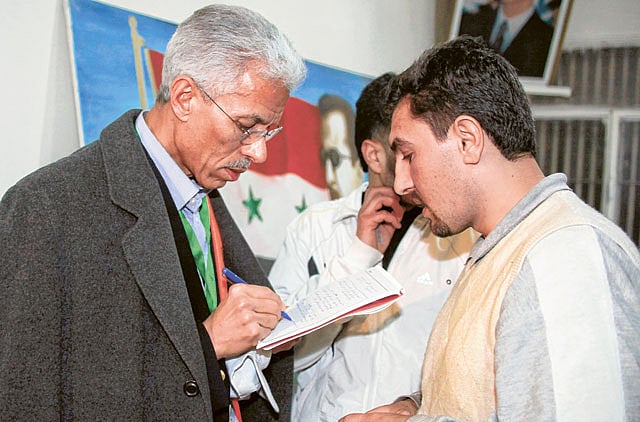
Zabadani, Syria: When observers from the Arab League drove into this mountain town in southwestern Syria, a hotbed of dissent against President Bashar Al Assad, they received a hero's welcome. Residents mobbed the observers' car, clamoured to tell of their plight, and carried one of them away on their shoulders in celebration. But just hours later, the five League representatives sped away under a hail of bullets. It was impossible to determine who was doing the shooting.
The episode on Sunday was a rare glimpse into the conflict that is threatening to plunge Syria into civil war, and the challenges faced by about 160 monitors who are trying to verify wildly divergent versions of events under dangerous conditions.
Opposition activists and some monitors have declared the mission a failure, saying it was not given the time, the resources or the independence to determine whether the government is fulfilling its pledge to end a military crackdown.
Town under siege
In better times, Zabadani was famous for its cherry, apricot and apple orchards, and for the gracious summer homes built by members of the Syrian elite and wealthy visitors from the Gulf. Residents said that on Friday, security forces surrounded the town and began pummelling them with tank rounds and gunfire. "Kids are dying here and we can't take them to the hospital," one man said on Sunday. "We've been three days without electricity or water."
The five monitors, including representatives from the UAE, Kuwait and Qatar, were dispatched to investigate what was happening. Syrian officials, who are responsible for the mission's security, informed the team that explosive devices had been found on the road to Zabadani and urged them not to go. If the observers insisted, they said, their security escort could not accompany them into the town, which residents acknowledge is defended by military defectors fighting under the banner of the Free Syrian Army.
It was not the first time they were presented with such a choice, the observers said. In some cases, they decided against a visit. This time, they said they would see how far they could get on their own.
"With these things, we never know if it's a real threat or they are just trying to keep us away," one said.
They set off from Damascus in a convoy full of armed security force members. Less than half an hour from the capital, they entered an area that looked and felt like a front line in a war. The road emptied of traffic and checkpoints dotted the way. Outside Zabadani, the security escort peeled off.
Fleeing families
As they got closer, the monitors came across families fleeing on foot and in cars. Asked whether there was trouble ahead, a woman in a black coat snapped back, "If there weren't trouble, we wouldn't be escaping."
The town appeared eerily deserted until the observers turned down a narrow street dubbed ‘Free Syria' in bold black graffiti on a wall. Young men raced into the road to clear away an improvised checkpoint and lead the vehicles to a small square where hundreds of people were waiting for them. The crowd erupted in cheers and chants. Frantic men and women surrounded the vehicles, eager to tell their stories.
Residents said security forces had killed 14 people, injured 350 and detained 568 in a town of about 30,000 people since March. "Till now, they are around Zabadani," a 67-year-old man said.
"They only left because of you and after an hour, they will be back."
Leading the monitors to the edge of the town, they pointed down a road where six armoured vehicles could be seen in the distance. Go and look, they said, the security forces are hiding tanks in the bushes. When the observers demurred and said they needed to leave, elements of the crowd started kicking and stoning their vehicle.
Afraid their car was about to be overturned, the observers sped off into the no man's land between the town and the government checkpoint. They approached carefully, waving their orange vests in the air before getting too close to the government forces.
After several anxious moments, they were waved forward, but then told there were suspicious wires in the road ahead and they could go no farther. Some raised their guns and chanted, "Bashar, we sacrifice our souls and blood for you."
Eruption of gunfire
When they were finally led away by an armoured carrier, there was an eruption of gunfire. Bullets zinged past the car, but it was not clear where they were coming from or who was the intended target. Another tank rolled by, headed to Zabadani.
By the time the members of the team reached their hotel, residents were calling their cellphones to report that the town was being shelled. One observer said it felt as though the whole episode had been staged, but he could not say by whom. Did the townspeople push them forward to provide cover for an attack by the Free Syrian Army? Or, were the security forces using them as an excuse to send in the army?
— Los Angeles Times
Sign up for the Daily Briefing
Get the latest news and updates straight to your inbox
Network Links
GN StoreDownload our app
© Al Nisr Publishing LLC 2026. All rights reserved.