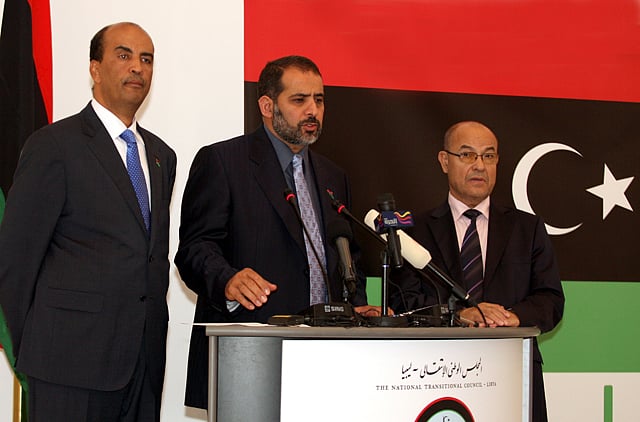
Dubai: Libya's revolutionary government has moved from "liberation stage" to a "stabalisation stage", said an official of the Libyan Transition National Council (TNC) in Dubai on Tuesday.
In a briefing to journalists on progress made by the TNC in its attempt to control the capital Tripoli, officials of the revolutionary government stressed that the TNC was already moving towards bringing stability to the country, and was competent to do so.
Read more:
Dr Aref Nayed, spokesperson of the TNC's Stabalisation Team and Libya's ambassador to the UAE, said that the TNC had started operating from Tripoli and that five senior members had already moved to the capital.
Infrastructure minister Dr Ahmad Al Jehani said that some Libyan funds frozen in Western countries were expected to be released soon, and oil production was expected to reach its 1.5 million barrels per day capacity within a year.
Funds worth $1.5 billion (Dh5.52 billion) were expected to be released by the United States, and an unspecified amount of Libyan dinars would be released from the United Kingdom soon under humanitarian provisions, he said.
For the release of other frozen funds and assets, the United Nations would be required to lift its sanctions on Libya and recognise the TNC as the sole representative government of the Libyan people, he added.
"We are going to intensify efforts [to obtain recognition] from the General Assembly in September," he said.
Dr Nayed said work had already started to repair the minor damage inflicted on oil facilities in the fighting that took place between the rebel forces and those loyal to Muammar Gaddafi.
"We have succeeded in restoring the GSM [mobile] networks in the country and have been sendng messages of comfort by text messages to the local population in Tripoli" he said.
Asked about the whereabouts of Gaddafi and his son, Dr Nayed said "he has left our hearts and minds".
On the controversial issue of handing over former regime officials wanted by the International Criminal Court Dr Al Jehani said it was "too early" to discuss the matter and that it was "in the hands of the Libyan people".
He said that a committee to draft a constitution is expected to be announced soon, but did not give details on a time frame.
Sign up for the Daily Briefing
Get the latest news and updates straight to your inbox
Network Links
GN StoreDownload our app
© Al Nisr Publishing LLC 2026. All rights reserved.