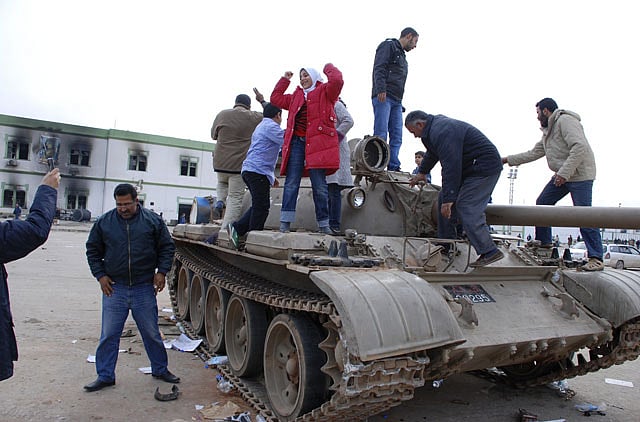
Cairo: When the uprising against Libyan strongman Muammar Gaddafi erupted, Suhail Al Mabrouki, a Libyan studying at Cairo University, was on a visit to his paternal relatives in Benghazi, Libya’s second largest city.
“It was the mid-year vacation and I thought it would be good to visit my uncles in Libya,” said Al Mabrouki, whose mother is an Egyptian.
“The mood in Benghazi was festive after the Tunisians and Egyptians toppled their long-serving rulers, and soon the Libyans thought it was high time for them to remove Gaddafi and his cronies,” he told Gulf News after his arrival in Cairo along with many others who fled Gaddafi’s violent crackdown.
“As the anti-Gaddafi revolution spread, the regime unleashed African mercenaries against the revolutionaries. Any moving object in Benghazi became a legal target for those hitmen and warplanes,” he recalled.
“Even though, the revolutionaries have taken control of Benghazi and it became safe for me to return to Egypt through the border crossing of Sallum.”
Over the past three days, Egypt has intensified the airlifting of an estimated 1.5 million Egyptian expatriates from Libya. Many others survived the violent unrest by travelling by land to Sallum. One of them is Mahrous Abdul Wahab.
“When demonstrations started in Benghazi on February 17, I and my roommates decided to stock up on food for fear that the protests would expand,” said Abdul Wahab, an Egyptian wallpainter, after reunion with his family in Cairo.
“Horrified by heavy gunfire, we did not dare go outdoors. But I could see through the door viewer Libyan soldiers shooting randomly at demonstrators,” a frail Abdul Wahab told this newspaper.
He added that when Saif Al Islam, Gaddafi’s son, accused the Egyptians of involvement in the revolt, he and his compatriots expected the worst. “We decided to flee and arranged a journey with a Libyan driver who took us from Benghazi to Sallum. I am happy that I am back home, but I feel sad because I left behind all my property and savings.”
Safwat, Abdul Wahab’s brother, recalls how they saw dozens of bodies lying scattered in Benghazi. “With the help of my colleagues, we buried more than 50 bodies, mostly belonging to Libyans, before we left. The Gaddafi regime has lost its mind and is waging a war of genocide against its people,” added Safwat, who has worked as a plumber for the past five years in Benghazi.
In a rambling speech on Tuesday, a defiant Gaddafi vowed to fight “until the last drop of blood” to crush the revolt of what he termed as rats and drug-takers. Following Gaddafi’s threats, the Egyptian authorities stopped Egyptians from entering the Libyan territory to bring back their relatives. Media people were barred too. Only medical teams are allowed into Libya, according to Egyptian officials.
“It proved extremely difficult for Egyptians and other nationals to leave Tripoli by air. The African mercenaries, hired by Gaddafi, controlled the road to the airport and fired at whoever they suspected of being his antagonist,” said Mahmoud Faraj, an Egyptian engineer.
“I had no other option but to flee with many others through the Ras Jadeer border crossing between Libya and Tunisia. This crossing is located 200 km from Tripoli,” added Faraj, who returned to Cairo by air from Tunisia on Wednesday.
Sign up for the Daily Briefing
Get the latest news and updates straight to your inbox
Network Links
GN StoreDownload our app
© Al Nisr Publishing LLC 2026. All rights reserved.