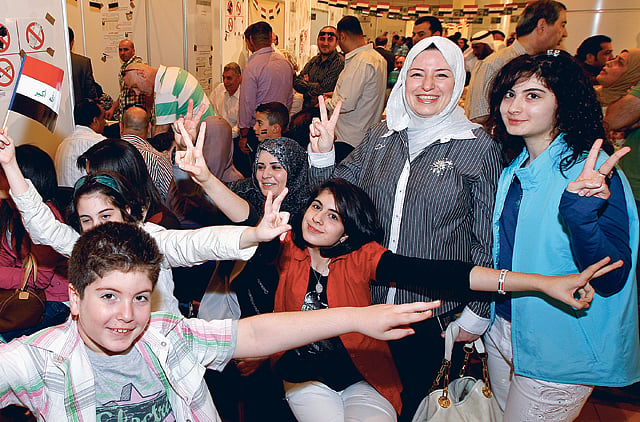
Baghdad: Polls have closed in Iraq's parliamentary elections after a spate of attacks that marred the vote left 31 people dead.
Despite tight security, insurgents intent on intimidating voters still managed to set off a spate of bombs, rockets and mortar attacks.
The Sunday vote, coming as US troops prepare to leave Iraq, will determine whether the country can overcome the sectarian divisions that have plagued it since the 2003 US-led invasion.
At least 14 people died in northeastern Baghdad after an explosion leveled a building, and mortar attacks in western Baghdad killed seven people in two different neighbourhoods, police and hospital officials said.
Blog: The long march to democracy in Iraq
In pictures: Crucial Iraq poll
Interactive map: Seats in the Iraq elections
In Baghdad's northeast Hurriyah neighbourhood, where mosque loudspeakers exhorted people to vote as "arrows to the enemies' chest," three people were killed when someone threw a hand grenade at a crowd heading to the polls, said police and hospital officials.
In the city of Mahmoudiya, south of Baghdad, a bomb inside a polling centre killed a policeman, said Iraqi Army Col. Abdul Hussain. There were also explosions elsewhere in the country, but no further reports of fatalities.
Witnesses at the scene of a collapsed building in Baghdad's northeastern Ur neighbourhood described rescuers pulling bodies from the rubble.
Insurgents also launched mortars toward the Green Zone, home to the US Embassy and the prime minister's office, and in the Sunni stronghold of Azamiyah police reported at least 20 mortar attacks in the neighboyrhood since day break.
"These acts will not undermine the will of the Iraqi people," Prime Minister Nuri Al Maliki said on Sunday morning, speaking to reporters after casting his ballot.
Security tightened
Security was tight across the capital. The borders have been sealed, the airport closed and hundreds of thousands of Iraqi military and police have flooded the streets.
Extra checkpoints were set up across the city, and in some parts of central Baghdad, people could not go 50 metres without hitting another checkpoint.
A ban on small vehicles was lifted around the country, except in northern Ninevah province, to facilitate access to the polls, Maj. Gen. Ayden Khalid Qader said on state-run Iraqiya television.
Most decisive election
Widely considered the most decisive Iraqi election since the US invaded the country exactly seven years ago, Sunday's national polls are expected to reshape the political landscape and may pave the way to permanent stability. Voting is due to end at 5pm (1400 GMT).
Nearly 20 million voters are eligible to vote in the elections, in which more than 6,000 candidates are competing for the 325 seats in the National Assembly.
Prime Minister Nuri Al Maliki is bidding to become the first Iraqi voted back into office. His rivals include Iyad Allawi, a Shiite former prime minister who heads the Iraqiya list.
Also seeking the top job are Ahmed Chalabi, a former deputy premierAdel Abdel Mahdi, the country's Shiite vice president; and Baqer Jaber Solagh, the finance minister.
Under the Iraqi electoral system no one party will emerge with the 163 seats needed to form a government on their own.
The vote is seen as a pivotal test of democracy less than six months before US combat troops quit the country ahead of a complete withdrawal from Iraq by the end of 2011.
With input from agencies and Duraid Al Baik, Associate Editor
Sign up for the Daily Briefing
Get the latest news and updates straight to your inbox
Network Links
GN StoreDownload our app
© Al Nisr Publishing LLC 2026. All rights reserved.