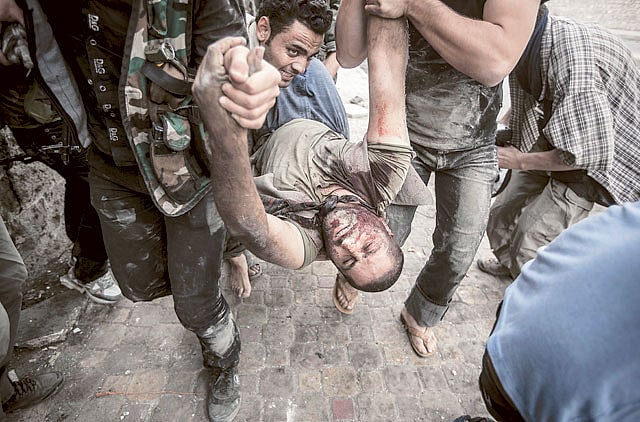
Baghdad: Scores of Iraqi Shiites are fighting in Syria, often alongside President Bashar Al Assad’s troops, and pledging loyalty to Iran’s supreme leader, according to militia fighters and politicians in Iraq.
The conflict has already drawn in a stream of Sunni fighters from across the region attracted to the rebel cause, while on the other side Syrian rebels accuse Lebanon’s Shiite Hezbollah of supporting Al Assad’s troops on the ground.
For Iraqi Shi’tes who follow Iran’s Ayatollah Ali Khamenei, the uprising in Syria threatens Shiite influence and Iraqis fighting there say they see a duty to help Al Assad because of their loyalty to the Islamic Republic’s highest authority.
Among them are defectors and former fighters from anti-US Iraqi cleric Moqtada Al Sadr’s Mehdi Army, the Iran-backed Badr group and Asaib Al Haq and Kata’ib Hezbollah, group who once waged a war on American troops, Shiite fighters and Iraqi politicians say.
Shiite politicians say militants fighting in Syria have no official sanction from their leadership or from Iraq’s Shiite-led government which is caught in a delicate balancing act between its ally Tehran, and Western and Middle East powers calling for Al Assad to go.
Some of the Iraqi militants are former Mehdi Army fighters who took refugee in Syria after 2007 when their group was crushed by Iraqi forces. Others, loyal to Khamenei as a religious authority, crossed over recently, fighters and Iraqi politicians say.
“We formed the Abu Al Fadhal Al Abbas brigade which includes 500 Iraqi, Syrian and some other nationalities,” an Iraqi defector from the Mehdi Army who goes by the name of Abu Hajar told Reuters by satellite telephone from Syria.
“When the fighting erupted in our areas, we carried out some joint military operations side by side with the Syrian army to clean up areas seized by rebels,” said Abu Hajar, who like others was a refugee in Syria before the conflict.
Another Mehdi Army defector, Abu Mujahid, who recently returned from Syria to visit his family in the Iraqi city of Najaf said his group’s mission in Syria was restricted to securing the famed Sayyida Zeinab Shiite holy place and its nearby Shiite neighbourhoods.
But sometimes, he said, they carry out pre-emptive raids on Free Syrian Army rebel fighters, whenever they get information rebels will attack the shrine, offices of Shiite religious leaders, known as Marjaiya, and Shiite neighbourhoods.
“Our mission is securing the shrine, the Shiite areas and the Marjaiya offices,” Abu Mujahid said. “We have no clear battlefield, but, from time to time, we carry out raids with the army on the sites of the Free Syrian Army.”
Syrian rebels consider the Shiite militants a pro-Assad militia. Some have been captured and killed in combat, militants and local families in Iraq said.
In Baghdad’s Ameen Shiite neighbourhood, a large recently erected billboard shows the photograph of a bearded Mehdi Army militant who the poster proclaims became a “matyr” in February. Neighbourhood families say he was killed in fighting in Syria.
A video posted on YouTube last month by Syrian rebels showed a young man named as Ahmsd Al Maksosi whose face appeared to be swollen with signs of beating and torture as he confessed that he was a Mehdi Army fighter.
Iraqi Shiite militants said Maksosi was one of their comrades fighting with them in one of the Sayyida Zeinab neighbourhoods. They said he was kidnapped and tortured by the FSA before he was killed.
Abu Mujahid, Abu Hajar and Iraqi Shiite politicians with knowledge of the militias said those who went to Syria were individual volunteers travelling with their own passports through regular routes.
They said there were contacts responsible for receiving and organizing volunteers, arming them and directing them to tasks, but all were facing the problem of funding, much of which they said came from some Iraqi merchants in Syria.
The Badr organisation, Asaib Al Haq and Mehdi Army leaders told Reuters they had not sent fighters to Syria because they believe the upheaval was an internal affair. Sending fighters would be an intervention in the Syrian affairs.
“We have not sent any people to Syria... some people think fighting in Syria is legitimate, so maybe individuals went there without coordinating with their leaders,” said a senior Badr organization leader, who spoke on condition of anonymity.
Sign up for the Daily Briefing
Get the latest news and updates straight to your inbox
Network Links
GN StoreDownload our app
© Al Nisr Publishing LLC 2026. All rights reserved.