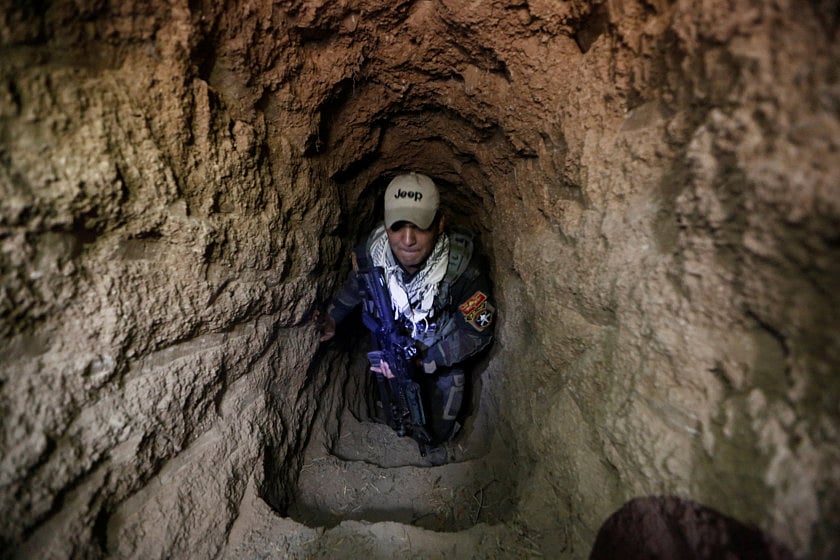
Karemlash, Iraq: “They’re everywhere,” said the Iraqi intelligence officer, sweeping his arm from this ancient Christian village toward the horizon. The Iraqi captain was searching for tunnels dug by Daesh fighters.
The officer stomped on the ground. “Here. We found one, then three, now six. Right here.” And over there? “More,” he said. “And more.”
Villages recaptured from Daesh over the past three weeks by the Kurdish peshmerga and Iraqi army forces on the road to Mosul have been honeycombed with tunnels, many of them booby-trapped.
Commanders say Iraqi forces have faced the hardest fighting of the offensive as they entered Mosul, made worse by extensive tunnels that are allowing Daesh terrorists to appear seemingly out of nowhere, attack, then retreat to the hidden bunkers.
“The clashes have been very, very violent,” especially on Friday and Saturday, as troops advanced deeper into the city held by Daesh for the past two years, said Brig. Gen. Yahya Rasoul, a spokesman for the Iraqi military
“It’s house-to-house fighting now,” said Rasoul, who declined to give casualty figures.
With Iraqi special forces now battling for the eastern districts of Mosul, commanders say the omnipresent tunnels, alongside holes smashed between the walls of buildings, are allowing hidden Daesh terrorists to move quickly into position to ambush advancing troops and then pivot to concealed locations.
An Iraqi armoured commander who drove his Abrams tank into eastern Mosul recalled seeing dozens of fighters scrambling on the street in front of his guns.
“Then they disappeared,” he said. Into the ground.
“It’s like we are fighting two wars in two cities,” said Col. Falah Al-Obaidi of the Iraqi counterterror forces. “There’s the war on the streets and there is a whole city underground where they are hiding.”
The colonel complained, “Now it’s hard to consider an area liberated, because though we control the surface, Daesh will appear from under the ground, like rats.”
Obaidi and other commanders said that they knew urban warfare among civilians and human shields in Mosul would be difficult, but the tunnels are making it worse. The officers described the battlefield as more of a sphere than a plane — with threats coming from side to side, above and below.
Journalists embedded with Iraqi special forces reported Daesh terrorists popping out of tunnels after areas were secured, to fire at the troops.
The number of tunnels is unknown. Daesh terrorists dug extensive tunnels under Fallujah, which was recaptured by Iraqi forces in June.
Daesh didn’t invent the tactic. Tunnels have been used in warfare for thousands of years, especially valued in asymmetric guerrilla war. Jewish rebels used tunnels against Roman legions; the Viet Cong did the same against US troops in Southeast Asia.
Here in Karemlash, Iraqi Christian militias uncovered cramped earthen burrows used by Daesh fighters to hide from surveillance drones, artillery shells and US-led air strikes.
The tunnels were dug into a hill that covers an archaeological site for an ancient Assyrian city. The Daesh also commandeered the Saint Barbara convent and dug deep tunnels through the floor of the chapel. The village marks the site where Alexander the Great fought the Persian emperor Darius in 331BC.
Some tunnels go for hundreds of yards. The earth is hard-packed and laced with rocks, and the passageways illuminated with electric lights.
In one set of tunnels in the village of Shaqouli there were subterranean dormitories, still littered with mattresses and blankets. Someone had decorated the rooms with flowered wallpaper and Daesh posters.
Iraqi troops have found weapons caches, small kitchens, food pantries and rooms stacked with explosives.
The floor of one tunnel was littered with onions, eggplants and spilt sugar. There were unwashed pots and pans with a residue of dried beans.
To conceal their digging from drones and satellites, Daesh usually hid the dirt. In the houses near tunnel entrances, rooms are filled from floor to ceiling with soil.
The longest tunnel discovered so far stretched for six miles at the edge of Mosul, according to Iraqi commanders, dug by Daesh cadres with help from civilians probably forced to shovel.
The tunnellers employed drills originally designed for mining operations or the oilfields, the Iraqis said.
One large drill mounted on half-tracks was discovered in a tunnel outside of Judayda al Mufti at the edge of Mosul.
The Iraqi intelligence officer, who serves in the Iraqi 9th Armored Division but declined to have his name used because of his position, complained that because of booby traps, his men haven’t found all the entrances and exits of tunnels.
When they do find a suspicious hole, the troops toss grenades into the darkness, followed by flaming tyres. They said they cannot be too sure that Daesh terrorists don’t return to surprise them.
Sign up for the Daily Briefing
Get the latest news and updates straight to your inbox
Network Links
GN StoreDownload our app
© Al Nisr Publishing LLC 2026. All rights reserved.