This handout picture released by the office of Iran's Supreme Leader Ayatollah Ali Khamenei shows him (L) and Iran's President Masoud Pezeshkian attending a meeting with Iranian goverment officials in Tehran on March 8, 2025.
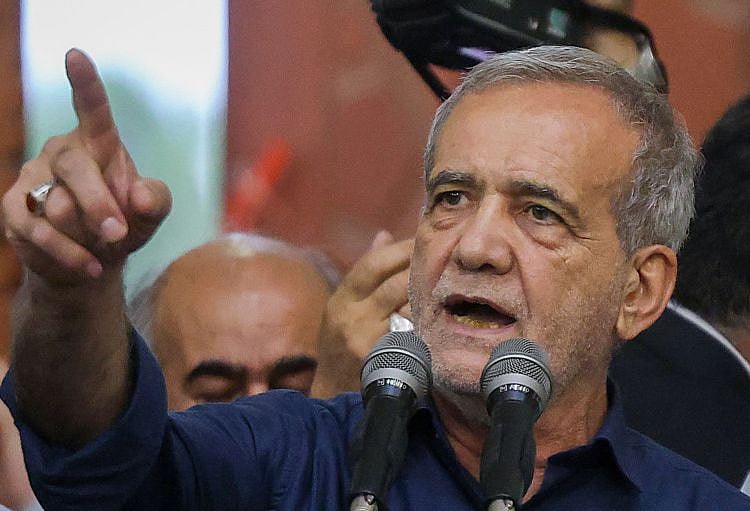
Reports indicate that Iranian President Masoud Pezeshkian has formally submitted a resignation letter to the office of Supreme Leader Mojtaba Khamenei, according to Iran International.
The report, which cites a source familiar with the matter, says Pezeshkian argued that Iran’s elected government has been increasingly sidelined as hardline factions within the Islamic Revolutionary Guard Corps (IRGC) expand their influence over key state decisions.
According to the reported contents of the letter, Pezeshkian stated that the presidency and civilian government have effectively been excluded from major decision-making processes, leaving him unable to carry out his constitutional responsibilities.
The report describes the situation as evidence of a widening power struggle between civilian institutions and military-security centers within the Islamic Republic.
If confirmed, the development would be significant not because it reveals a new reality, but because it would represent a rare acknowledgment from within Iran’s own leadership structure.
Critics and many analysts have long argued that the country’s elected institutions operate with limited authority, while ultimate power rests with the Supreme Leader, the IRGC, and the broader security establishment.
Pezeshkian himself, like all Iranian presidential candidates, was vetted and approved by the regime before being permitted to run for office.
The reported resignation therefore underscores a deeper issue: even the restricted authority traditionally granted to Iran’s civilian government may be shrinking further as military-security factions consolidate influence.
What we don't know
Whether the resignation is accepted — or whether the report is officially confirmed — remains unclear.
Notably, Iranian officials have previously denied or disputed some reports circulated by Iran International, and no public confirmation has yet been issued by Iran’s leadership.
On May 7, 2026 President Pezeshkian said he had met Mojtaba Khamenei in person and spoken with him for two and a half hours, in the first public confirmation that the Islamic Republic's new ayatollah has been seen by a senior official since his appointment more than two months ago.
Pezeshkian, speaking at a meeting with trade unions and market representatives, gave no details of when or where the meeting took place, what was discussed, or who else was present.
He said the exchange was "completely unmediated".
"What stood out to me more than anything else in this meeting was (Mojtaba Khamenei's) manner, perspective, and deeply sincere and humble behaviour, an approach that transformed the atmosphere into one based on trust, calmness, empathy, and direct dialogue," Pezeshkian said.
Mojtaba Khamenei was appointed by the Assembly of Experts following the death of his father Ayatollah Ali Khamenei, who was killed in US and Israeli strikes in the opening salvo of the war on 28 February.
Sign up for the Daily Briefing
Get the latest news and updates straight to your inbox
Network Links
GN StoreAbout Gulf NewsTerms & ConditionsReach by GNSitemapContact usPrivacy PolicyGN FocusHave your sayWork with usAdvertise with usGulf News epaperPrinting Services
Download our app
© Al Nisr Publishing LLC 2026. All rights reserved.