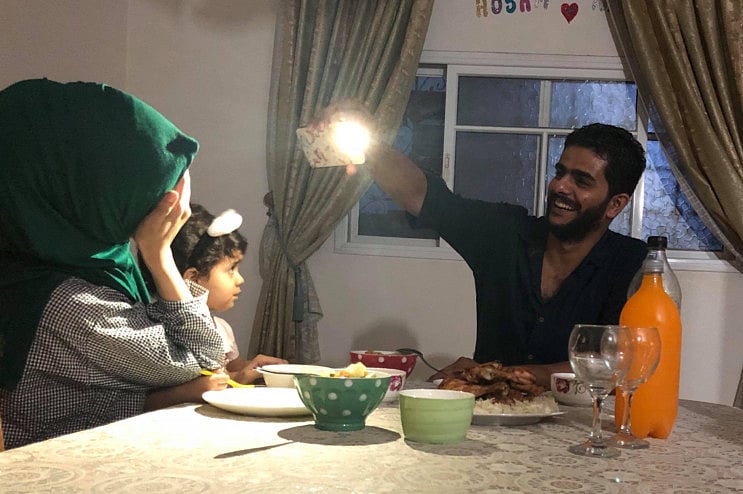
Gaza: After fasting for more than 15 hours, Nisma, 28, along with her husband Hussam, 32, start preparing the dining table.
Today they are having grilled chicken and salad for Iftar, but it will most probably be by candlelight as electricity comes only a few hours a day--if at all.
Gaza suffers from extreme poverty as it has been under Israeli and Egyptian siege since 2007, goods are hard to come by, unemployment is sky high and it has been through two gruelling Israeli wars.
More than two million Palestinians in Gaza suffer a blackout crisis since 2007 when Israel damaged the main electricity plant. Since then, houses there typically have two shifts of electricity which vary between four to eight hours.
“Since the beginning of Ramadan, we had electricity during Iftar only once,” Nisma tells Gulf News while carrying her two-year-old daughter Zain.
To prepare the food and the dinner table, Nisma has to carry her phone light back and forth from the kitchen to the dining area.
It is the third time Nisma and Hussam observe Ramadan together as a married couple and they say each year has gotten worse.
For Hussam, Ramadan is an especially painful time as he remembers losing two relatives during Ramadan in 2014 during an Israeli offensive.
This time around the wounds are fresh from a two-month long protest along the Gaza border with Israel which resulted in more than 100 Palestinian casualties—killed by Israeli snipers.
Hussam said that it’s not only the grief that is making Ramadan hard, but also the deteriorating financial situation of the people living in the besieged coastal enclave.
“I just came back from the market. Even though goods are cheap people still cannot afford them. The market was literally empty,” he says.
Hussam considers himself lucky as he has a decent job and source of income working as an administrative employee at a local NGO.
However more than 40 per cent of people in Gaza are unemployed and 70 per cent rely on humanitarian handouts.
Hot weather and high level of humidity is also a major problem in Gaza as people don’t have any source for cooling their houses except than leaving their doors open.
Nisma needs to strategize how to cool the drinks for Iftar on less than five hours of electricity a day.
“I usually put drinks in the freezer, and then put them back in the fridge an hour before Iftar time so they won’t be icy.”
But despite the hardships, Hussam and Nisma feel blessed for what they have and are able to provide for their young daughter.
“Nisma usually does all the work for Iftar so I try to help her to prepare the Suhoor meal,” Hussam says.
“It feels good we are sharing all the work we need to do, this is the good thing about Ramadan.”
-Abeer is a freelance journalist based in Gaza
Sign up for the Daily Briefing
Get the latest news and updates straight to your inbox
Network Links
GN StoreDownload our app
© Al Nisr Publishing LLC 2026. All rights reserved.