Ismail Al Thawabta, head of Hamas' government media office, addresses a press conference at the Al Aqsa Hospital in Deir Al Balah, central Gaza Strip on July 6, 2026.
Hamas steps aside from governing Gaza. What does it really mean?
Technocratic committee may take charge, but the group’s military wing remains intact
Last updated:
4 MIN READ
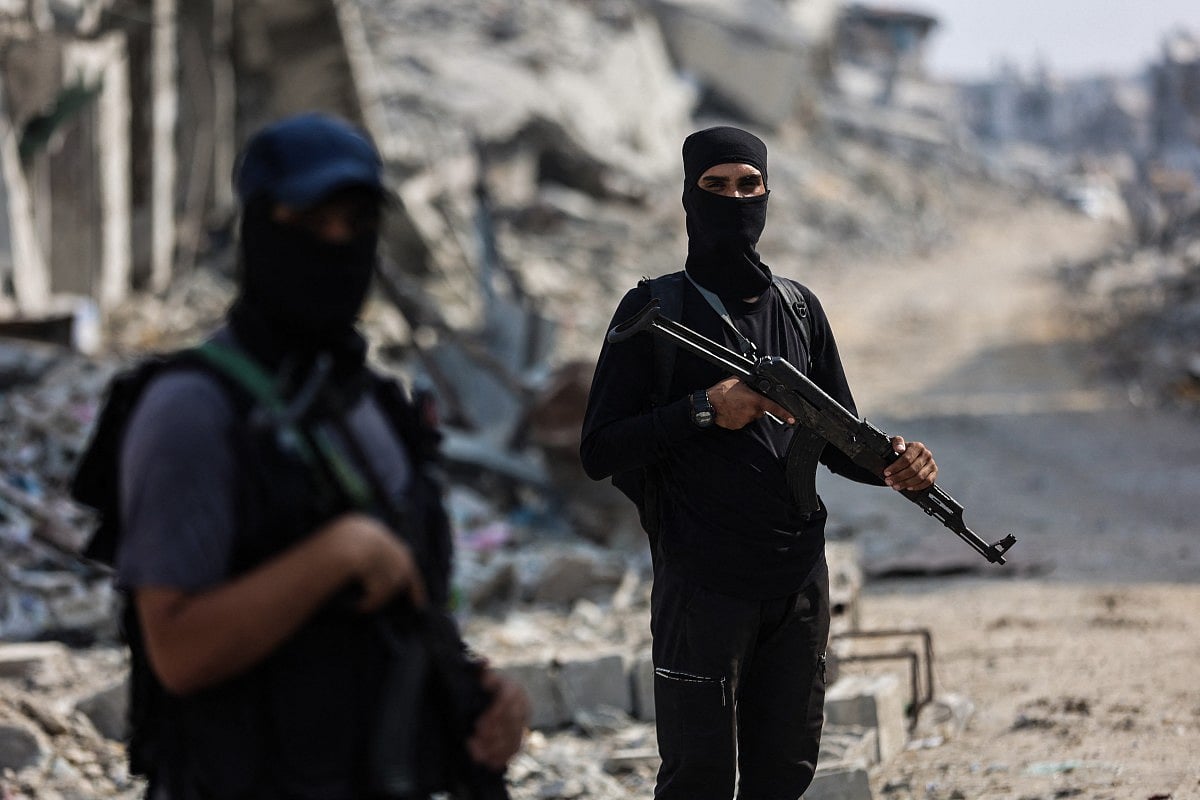
Hamas militants guard an area where they are searching for the bodies of hostages with the help of the International Committee of the Red Cross (ICRC) in Gaza City on November 3, 2025.
AFP
Dubai: Hamas has announced its biggest political concession since seizing control of Gaza in 2007, dissolving the body that has governed the territory for nearly two decades and paving the way for a technocratic administration to take over civilian affairs.
At first glance, the move appears to mark a breakthrough in efforts to implement the next phase of the Gaza ceasefire. But analysts say it changes little unless two much larger issues are resolved: Hamas agreeing to disarm and Israel allowing the new administration to function inside Gaza.
Why has Hamas made this move?
According to AFP, Hamas says it dissolved its emergency governing committee to facilitate the transfer of civilian administration to the National Committee for the Administration of Gaza (NCAG), a technocratic body established under the US-brokered ceasefire plan.
“Hamas has taken a new step in that it will no longer be in charge of the Gaza Strip, in order to remove any pretexts for the occupation,” Hamas spokesman Hazem Qassem told AFP.
The announcement also comes as US President Donald Trump pushes for implementation of the next phase of the ceasefire, which has stalled for months.
What still stands in the way?
Hamas has not agreed to disarm
Israel controls about 70% of Gaza
NCAG remains based in Cairo
Israel has yet to allow the committee into Gaza
International security arrangements have not been implemented
Both sides accuse each other of violating the ceasefire
Phase two of the US-brokered agreement remains stalled
What is the NCAG?
The NCAG was created to administer Gaza after the war under the ceasefire framework. According to AFP, it is based in Cairo and says it is ready to assume responsibility once conditions permit.
But CNN notes that the committee has never entered Gaza because of Israeli objections and has therefore exercised no authority on the ground. It was intended to oversee “pilot areas” as part of the peace plan, but implementation has stalled.
Does Hamas really lose control?
Not yet.
While Hamas says it is stepping away from governing Gaza, the announcement changes little because Hamas and its security forces continue to control the parts of Gaza not occupied by the Israeli military.
The group has also said its roughly 60,000 government employees would continue working under the technocratic administration during any transition.
Why do experts call it largely symbolic?
Because the main dispute has never been about who runs Gaza’s ministries.
According to AFP, political analyst Mkhaimar Abusada says the real obstacle remains Hamas’ weapons.
“The problem is not with dissolving their governmental committee, but with agreeing to disarmament.”
The Board of Peace echoed that position, saying it had taken note of Hamas’ announcement but wanted “actions, not promises.”
It reiterated that the ceasefire is based on “one authority, one law and one weapon,” meaning all weapons must eventually come under the authority of the NCAG.
Can Hamas still remain powerful?
Yes.
Even if the NCAG eventually takes charge of civilian administration, Hamas is expected to remain Gaza’s dominant political and security force unless it agrees to surrender its arsenal.
The group retains an extensive political organisation, security networks and influence across much of the territory. Analysts say the proposed technocratic administration would initially oversee civilian services, while Hamas would continue to wield significant influence unless the disarmament issue is resolved.
What does Israel want?
Israel has repeatedly ruled out allowing Hamas to remain in power after the war, but it has also rejected an immediate takeover by the Palestinian Authority.
According to AFP, Israeli forces now control nearly 70 per cent of Gaza despite the ceasefire. The second phase of the agreement was meant to include Hamas’ disarmament and a gradual Israeli withdrawal, but neither has happened.
What happens next?
Analysts believe Hamas is trying to convince Washington and mediators that it is serious about implementing the ceasefire while shifting pressure onto Israel.
A diplomatic source who attended Cairo talks told AFP the announcement allows Hamas to demonstrate progress while highlighting what it sees as Israel’s failure to fulfil its commitments.
CNN quoted Michael Milshtein of Tel Aviv University as saying mediators hope the move will encourage the Trump administration to increase pressure on Israel to implement the next phase of the agreement.
The bottom line
Hamas has made its clearest political concession since taking power in Gaza by agreeing to step away from formal governance. But it has not agreed to disarm, and that remains the key obstacle to implementing the ceasefire.
Until Hamas’ military future and Israel’s role in post-war Gaza are resolved, the announcement is likely to remain more significant politically than practically. For ordinary Gazans, analysts say, it is unlikely to produce immediate changes on the ground.

A Senior Associate Editor with more than 30 years in the media, Stephen N.R. curates, edits and publishes impactful stories for Gulf News — both in print and online — focusing on Middle East politics, student issues and explainers on global topics. Stephen has spent most of his career in journalism, working behind the scenes — shaping headlines, editing copy and putting together newspaper pages with precision. For the past many years, he has brought that same dedication to the Gulf News digital team, where he curates stories, crafts explainers and helps keep both the web and print editions sharp and engaging.
Sign up for the Daily Briefing
Get the latest news and updates straight to your inbox
Network Links
GN StoreAbout Gulf NewsTerms & ConditionsReach by GNSitemapContact usPrivacy PolicyGN FocusHave your sayWork with usAdvertise with usGulf News epaperPrinting Services
Download our app
© Al Nisr Publishing LLC 2026. All rights reserved.