Khartoum: A few weeks ago, a leading opposition activist sat down in a downtown Khartoum office to talk to a journalist. The young man immediately removed the battery from his mobile phone.
"It's so they can't trace you," he said, placing the battery and the phone on the table. "Any one of the security agencies spread throughout the country can arrest you."
Despite that danger, the activist, from an underground group called Change Now, said he was convinced Sudan is on the brink of its own Arab Spring uprising.
Hard times and growing frustration with the two-decades-old government of President Omar Hassan Al Bashir have sparked small protests in Khartoum and other university cities in the Arab-African state.
The demonstrations are still tiny compared with those that shook Egypt and Libya. Sometimes about 30 people show up, hold banners denouncing the government for a couple of minutes, and then melt away before security agents arrive. But the demonstrations have become more frequent in the past few months and the question is, could they lead to something bigger?
The main economic challenge is plain. When South Sudan seceded from the north last year, Khartoum lost about three-quarters of its oil, the main source of state revenues and hard currency. The Sudanese pound has slumped by as much as 70 per cent below the official rate. Annual inflation is at 18 per cent as the cost of food imports has shot up. Wars against insurgencies in different parts of the still-vast country have also soaked up government funds.
In 1985, protests against food inflation toppled President Jaafar Numeiri in some ten days. But the government in Khartoum today says the economy is not nearly as bad as it was in the 1980s, when people had to queue for days to get rationed petrol or food. Sudan, it says, will not follow Egypt or Tunisia.
Rabie Abdelati, a senior official in the information ministry and Al Bashir's National Congress Party (NCP), said the economy was much better than in 1989 when Al Bashir came to power.
"The situation at that time was very terrible," he said. "The government has the ability to overcome all obstacles."
A relaxed-looking Al Bashir, who is wanted by the International Criminal Court for war crimes, spoke on state television for almost two hours last week to assure the population that the economic situation was under control.
"We have a three-year economic programme [but] this year will be the most difficult," the president said.
On the surface, life in the capital looks normal. Construction cranes loom on the banks of the Nile, working on new buildings and roads. The city bustles with foreign workers, maids and hotel staff.
‘Anger erupted'
But there are sporadic signs public anger is rising.
In the last week of December, authorities temporarily closed the University of Khartoum after villagers displaced by a huge hydro-electric dam staged a protest, inspiring a week of some of the biggest student demonstrations in years. Weeks later, the spray-painted graffiti calling for "revolution" still covered a few walls near the university.
"Most people didn't care about the first demonstration as we were all in exams mode," said a female computer technology student who took part.
But when police came to the dormitories one night to detain some students, "it turned into a protest not just against the dam but against poverty, inflation and the bad situation for students," said the woman.
"It was like anger erupted," she added. "Now they want to punish us by closing the university, but it will make things worse. We don't get jobs after graduation. Life is so expensive, people are very angry."
Abdelati, the information ministry official, said the protests were small and the university would reopen shortly.
Oil and conflicts
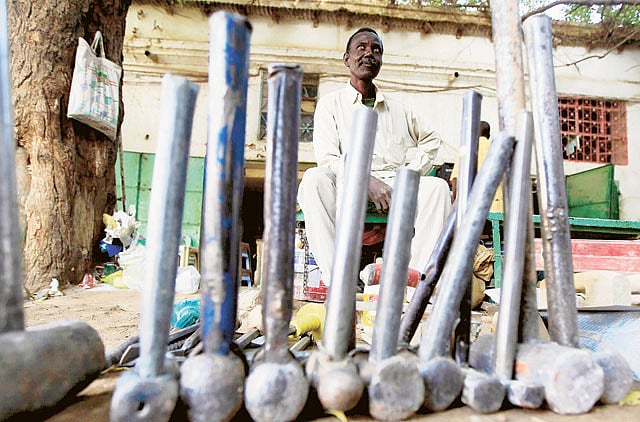
Sitting in front of a small metal workshop in downtown Khartoum, Sudanese construction worker Fateh Totu takes his time to recall when he last worked for longer than a week. At the moment he gets jobs for a couple of days, with sometimes a week in between.
"Three, four years ago life was much better. The country was in good shape. Construction work was good," Totu said, drawing nods from fellow workers sitting on chairs along a dusty road.
South Sudan's independence deprived Sudan — a country of 32 million people — of around 350,000 barrels per day (bpd) of the roughly 500,000 it pumped. Since then, oil exports, which made up 90 per cent of Sudan's total exports, have fallen to zero.
The remaining output in the north of around 115,000 bpd serves only domestic consumption. Industry insiders doubt significant new reserves will be found. But Azhari Abdullah, a senior oil official, said production would rise this year to 180,000 bpd, helped by more efficient technology and recovery rates.
Other officials are less optimistic. Central bank governor Mohammad Kheir Al Zubeir has asked fellow Arab countries to deposit $4 billion (Dh14.6 billion) with the central bank and commercial lenders to stabilise the economy. Finance Minister Ali Mahmoud said in September Sudan might need $1.5 billion in foreign aid annually.
"The state spends a vast proportion of available resources on the security services. With three conflicts ongoing, the military's claim on the national treasury is only growing," said Aly Verjee, an analyst at the Rift Valley Institute. "While some austerity measures have been implemented, there is a general unwillingness in the government to take any step that might lead to popular discontent."
Sign up for the Daily Briefing
Get the latest news and updates straight to your inbox
Network Links
GN StoreDownload our app
© Al Nisr Publishing LLC 2026. All rights reserved.