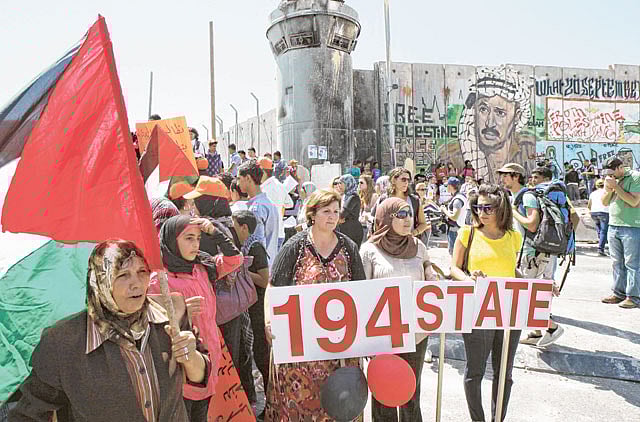
Ramallah/United Nations: Palestinian President Mahmoud Abbas announced on Friday that he will seek full UN membership for Palestine through the Security Council this week — setting the stage for a confrontation with Israel and a potentially image-damaging veto by the US.
The decision means the Palestinians are going for an option at the United Nations that they know cannot succeed, but which will nevertheless put the Israeli-Palestinian conflict on centre stage at the the UN General Assembly this week.
International efforts to dissuade Abbas from what is now his stated path of action at the UN are expected to continue up to the Palestinian leader's speech to the General Assembly next Friday, but chances of putting off the move dimmed considerably with the announcement.
Palestinian leaders have said for weeks that Abbas was almost certain to seek some form of action at the UN in light of ‘frustration' over the stalled peace talks and the utter lack of progress in direct negotiations with Israel that President Obama relaunched with great fanfare a year ago.
‘Observer' status
Some Palestinian leaders had suggested that Abbas might ultimately opt for a less confrontational ‘observer' UN status through a vote of the General Assembly. The Palestinians might eventually take that route, some UN experts point out, if as expected a bid for full membership is blocked by a US veto in the Security Council.
In any case, no dramatic immediate Security Council showdown is anticipated next week, since Abbas is expected to make his request for membership on Friday, with the Security Council likely to take several weeks to review the request before taking a vote.
At that time the Palestinians could then opt for a sort of ‘Plan B' of recognition through the General Assembly as a non-member observer state. An affirmative vote in the General Assembly is virtually assured, since more than 125 countries have already recognised Palestine as a state.
Dominant issue
Abbas' decision assures that the Palestinian issue will dominate the UN at a time when Obama, among other Western leaders, had been hoping to highlight Libya in particular and dramatic events across the Arab world over the last year more generally. But the decision is unlikely to do anything to bring the Middle East crisis any closer to resolution.
"This does nothing productive for the Palestinians," says Jon Alterman, director of the Middle East Programme at the Centre for Strategic and International Studies in Washington. "Yet they are in a position now where it is very hard to step down."
A US veto of Palestinian statehood in the Security Council risks souring US relations with Muslim countries — a region of particular focus for Obama — but White House officials say they know the administration's efforts at repairing American standing in the world have faced the most resistance in the Arab world anyway.
"The Arab world has continued to be very challenging ," said Ben Rhodes, the White House deputy national security adviser for strategic communications, briefing reporters on Friday on Obama's trip to the UN next week.
— Christian Science Monitor
Sign up for the Daily Briefing
Get the latest news and updates straight to your inbox
Network Links
GN StoreDownload our app
© Al Nisr Publishing LLC 2026. All rights reserved.