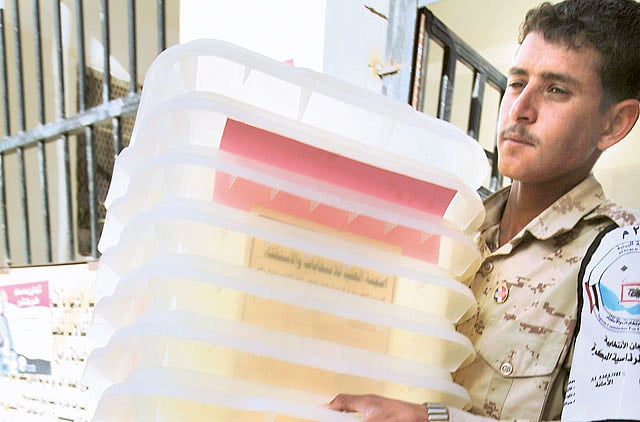
Sana'a: Four months after Ali Abdullah Saleh signed the GCC peace deal and agreed to end his 33-year-long stint as president, Yemenis are voting today to confirm Abd Rabbo Mansour Hadi, Saleh's deputy for the last 18 years, as his successor.
Since the election is uncontested, Yemenis' reactions have been varied.
Noah Al Wafi, an activist from the southern city of Taez, has recently changed his mind about the election and decided to vote for Hadi.
"We changed our minds about the election because anti-Saleh protesters could not bring the regime down by protests. I do not want to miss this peaceful opportunity for change. Our goal is to end legitimacy of Saleh's regime and we can achieve this goal by voting for Hadi."
Noah demanded the new president put into practice all terms of the GCC deal.
"I demand that he reorganise the army, build the foundation of a new country and take the country from instability to stability."
Restructuring the army
Ahmad Mousa Al Ahmri, a journalist from the province of Al Bayda where Al Qaida militants seized a city, has not decided whether or not to vote.
"I'm hesitant about the participation. I'm worried about what will happen on the day of election. I support the election as the best alternative to save the country from the abyss of civil war. We pin great hopes on Mr Hadi to disseminate justice, solve the unrest in the south and reorganise the army." Abdullah Ahmad, a teacher, will not vote because the election is uncontested and his vote will have no effect on the result.
"Whether I vote or not, he will win. My vote will not make any difference. I hope that the new president will kick-start the economy and improve education and people's standard of living."
Another person, who lives in a remote village, said that people in his area will not vote because of transportation issues.
"In the past, when there was competition in elections, parties were vying for people's votes. Voters used to be given free transport to the polling stations.
Many observers in Yemen, whom Gulf News interviewed, were almost unanimous that there is a great difference between Saleh's rule and Hadi's and the latter period is a make-or-break situation for Yemen.
Dr Abdullah Al Faqih, a professor of political science at Sana'a University, told Gulf News that the election serves as a termination of Saleh's three decades of autocratic rule.
"The significance of Hadi's nomination is that he is from the south. Hadi was not involved in any corruption cases. The man is not also known for his fabulous wealth or accounts in foreign banks."
International support
Dr Al Faqih thinks that the restructuring of the army is a real challenge Hadi faces and the support of the international community will push him forward.
"The first task of the future president is the army. He should make bold decisions and restructure the army and not make it a tool in the hands of warring parties. I'm sure that if he manages to bring the army under his command, the other problems like Al Qaida will come to an end."
Abdul Salam Mohammad, the director of Aba'ad Centre for Strategic Studies in the capital, told Gulf News that despite Hadi's military career, Yemen will not be ruled by a junta. "He was chosen by civilians to temporarily run the country. He cannot rule like the former regime because the revolution is now stronger than him and it will bring him down the next day."
Sign up for the Daily Briefing
Get the latest news and updates straight to your inbox
Network Links
GN StoreDownload our app
© Al Nisr Publishing LLC 2026. All rights reserved.