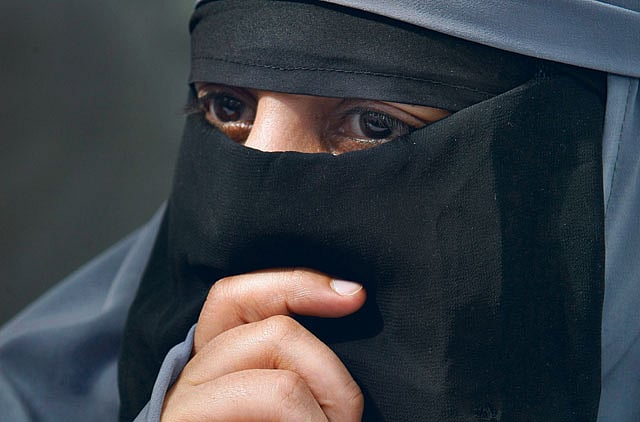
Paris: As France's parliament debates whether to ban burqa-like Muslim veils; one lawmaker has compared them to muzzles, or "walking coffins." Another has proclaimed that women who wear them must be liberated, even if it is against their will.
Amid little resistance, France's lower house of parliament looks likely to approve a ban on face-covering veils on Tuesday, and the Senate will probably follow suit in September.
Yet a big question mark hangs over the bill: Does it violate France's constitution? Law scholars say the ban could be shot down by France's constitutional watchdog, or later on, by the European Court of Human Rights.
That could dampen efforts in other countries toward banning such veils. It would also be a humiliation for President Nicolas Sarkozy's conservative government, which has devoted much attention to a bill that would affect only an estimated 1,900 women in France.
The main body representing French Muslims says face-covering veils are not required by Islam and not suitable in France, but it has raised worries that the law will stigmatise Muslims in general.
Polls show voters overwhelmingly support a ban. In parliament, criticism was mostly timid, and relatively few dissenters spoke out about civil liberties or fears of fanning anti-Islam sentiment in a country with an estimated five million-strong Muslim population, which is Europe's largest.
The niqab and burqa are widely seen in France as a gateway to extremism and an attack on women's rights and secularism, a central value of modern-day France. Critics, meanwhile, say the ban is a cynical ploy to attract far-right voters.
The ban is also a symbol of the government putting its foot down to insist that integration is the only path for minorities. France has had difficulty integrating generations of immigrants and their children, as witnessed by weeks of rioting by youths, many of them minorities, in troubled neighbourhoods in 2005.
Sarkozy's government has struggled and failed, some legal observers say, to come up with a strong legal basis for the ban.
In March, France's highest administrative body, the Council of State, warned that a ban could be found unconstitutional. It rejected possible legal justifications one by one, including the French tradition of secularism, equality for women, human dignity and concerns about public security.
In the end, the government's central legal argument is that covering one's face doesn't square with French values.
Life in France is "carried out with a bare face," Justice Minister Michele Alliot-Marie said last week, opening debate at the National Assembly.
As legal reasoning, she invoked the notion of public policy doctrine, a country's moral and social rules.
Face-covering veils "call into question the idea of integration, which is founded on the acceptance of the values of our society," Alliot-Marie said.
The legislation would forbid face-covering Muslim veils in all public places in France, even on the street. It calls for $150 fines or citizenship classes, or both.
The bill is also aimed at husbands and fathers who impose such veils on women. Anyone convicted of forcing someone else to wear the garb risks a year of prison and a $30,000 fine, with both those penalties doubled if the victim is a minor.
Officials have taken pains to craft language in the bill that does not single out Muslims. While the proposed legislation is colloquially referred to as the "anti-burqa law," it’s officially called "the bill to forbid concealing one's face in public." It refers neither to Islam nor to veils, leading to an often surreal disconnection between the text and discussion in parliament about it.
While officials insist the law against face-covering would apply to everyone, not just Muslims, they cite a host of exceptions, including masks for health reasons, for fencing, for carnivals and festivals.
Sign up for the Daily Briefing
Get the latest news and updates straight to your inbox
Network Links
GN StoreDownload our app
© Al Nisr Publishing LLC 2026. All rights reserved.