A person shelters from snow under an umbrella while walking outside the Kremlin during a snowstorm in Moscow on April 27, 2026.
Power knocked out, flights grounded: Moscow buried in record April snow amid rare arctic blast
Historic late-season snowstorm driven by an unusual North Atlantic weather pattern
Last updated:
2 MIN READ
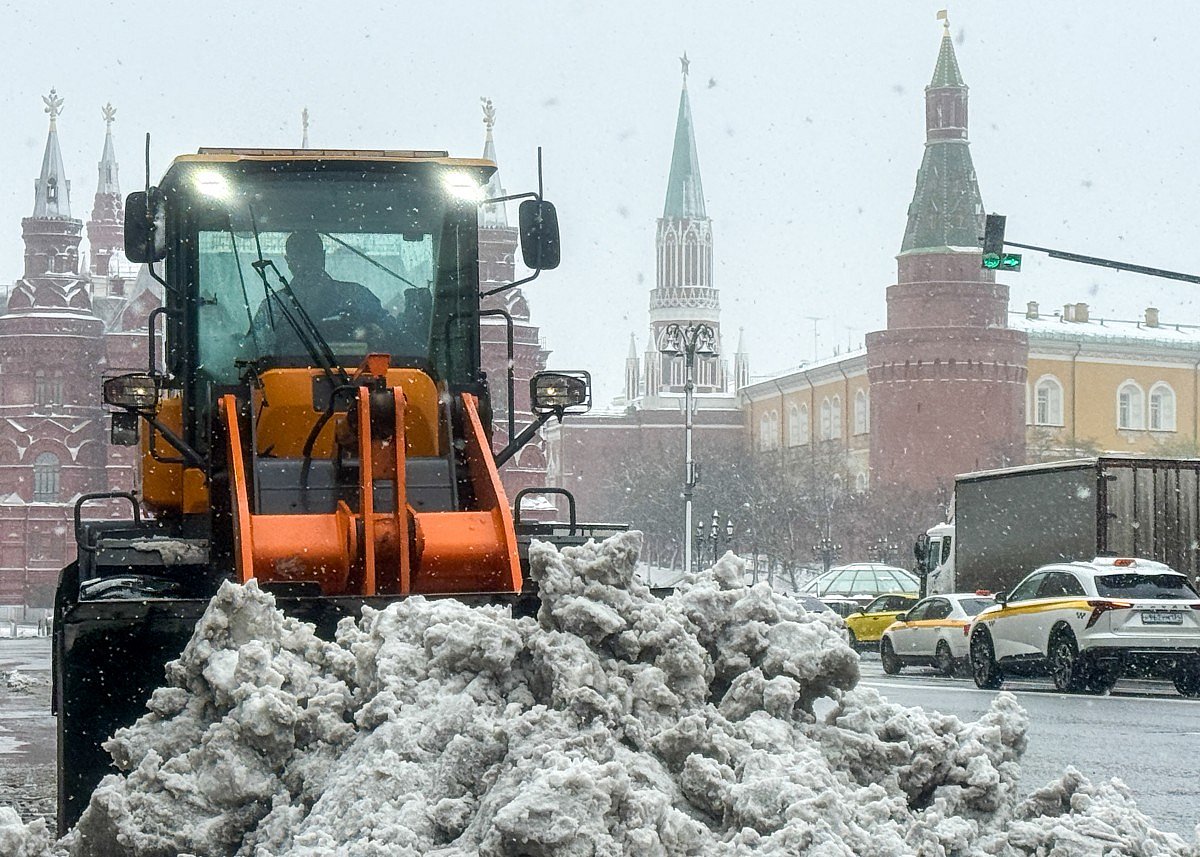
A communal worker operates a tractor to clear snow from a street in central Moscow during a snowstorm on April 27, 2026.
AFP
Residents of Moscow woke Monday to a record late-April snowfall after a rare winter storm swept into the Russian capital overnight, with authorities warning that snow and strong winds would continue for at least two more days.
About 21 millimeters of precipitation fell between Sunday night and Monday morning, according to the Phobos weather center — roughly equivalent to 21 centimeters (8.3 inches) of snow.
The centre said the past 24 hours broke a daily snowfall record set in 1880. “Never in the entire history of meteorological observation has there been this much snow on April 27,” wrote Phobos chief meteorologist Yevgeny Tishkovets stated on Telegram.
The heavy, wet snow toppled trees and downed power lines, cutting electricity to about 50 villages in the surrounding Moscow Oblast and snarling traffic across the capital.
Flights grounded
Several airports temporarily grounded flights due to poor visibility and hazardous conditions. City officials issued an “orange” weather alert, the second-highest warning level.
Beyond Moscow, emergency authorities said roughly 76,000 people across multiple regions were without power. At least three people, including a child, were killed in Samara after strong winds toppled trees, while dozens more were injured in several areas.
Snow also fell in the neighbouring regions of Ryazan Oblast, Tula Oblast and Vladimir Oblast, as well as in Saint Petersburg and Veliky Novgorod. Forecasters said snowfall was also expected in the regions of Voronezh, Kursk, Penza, Volgograd and Perm.
Moscow Mayor Sergei Sobyanin urged residents to prepare for more wet snow and wind gusts of up to 23 meters per second (50 miles per hour) as the system lingers for another 48 hours.
Meteorologists said the unusual blast of winter weather was driven by an “Omega block” over the North Atlantic — a persistent high-pressure pattern that funneled Arctic air deep into Eastern Europe. The rare setup allowed frigid polar air to bypass typical westerly flows and collide with early spring warmth, triggering an intense late-season snowstorm.
Sign up for the Daily Briefing
Get the latest news and updates straight to your inbox
Network Links
GN StoreAbout Gulf NewsTerms & ConditionsReach by GNSitemapContact usPrivacy PolicyGN FocusHave your sayWork with usAdvertise with usGulf News epaperPrinting Services
Download our app
© Al Nisr Publishing LLC 2026. All rights reserved.