Migrants sit on rocks after swimming through the waters close to the border with Morocco to enter Spain's north Africa's Ceuta enclave on July 31, 2026.
Ceuta explained: Why migrants are crossing into the Spanish territory from Morocco
Inside Ceuta’s surge: Morocco, Spain and the perilous swim toward Europe
Last updated:
3 MIN READ
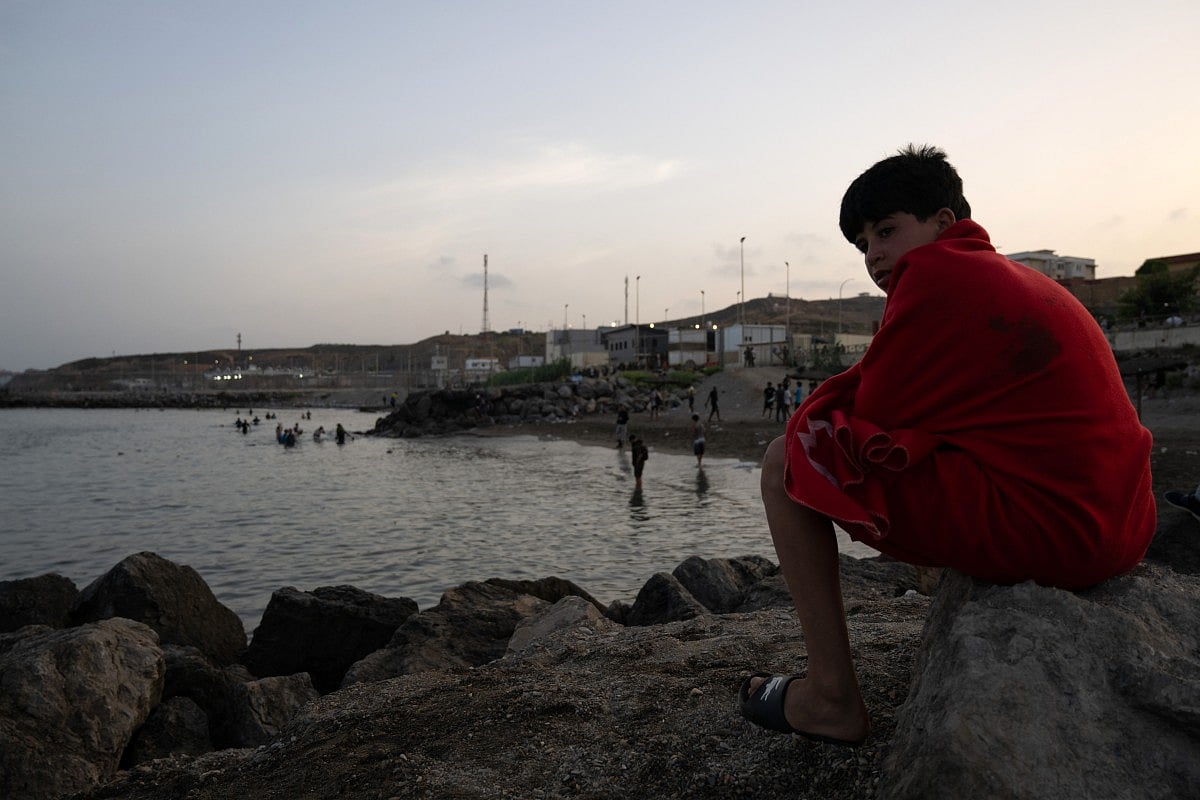
A young man sits on rocks as migrants arrive after swimming to the Spanish enclave of Ceuta in North Africa on July 31, 2026.
AFP
Thousands of migrants have entered Spain’s tiny North African territory of Ceuta from Morocco, with at least 57 people reported dead during the attempt, prompting Spain to deploy military support to reinforce the border.
Migrant arrivals surge at Ceuta border
Videos and images from the frontier showed large groups of people, mostly Moroccan nationals, moving through breakwaters near an urban beach and crossing towards local roads after reaching the border area.
Most of those arriving appeared to be young men, although families with women and children were also among the crowds.
Get updated faster and for FREE: Download the Gulf News app now - simply click here.
The surge followed a rise in attempts to reach Ceuta, mainly by swimming from Morocco. Authorities have not yet confirmed what triggered the sudden increase in crossings.
Spain’s government said it would deploy the Armed Forces to support the Civil Guard in managing the situation.
What is Ceuta?
Ceuta is a small autonomous Spanish city located on the northern coast of Africa, along with the larger Spanish territory of Melilla, around 400 kilometres (250 miles) to the east.
Both territories are part of Spain and the European Union, and they share the EU’s only land borders with Africa.
Spain has controlled Ceuta since 1580. The city has a population of about 85,000 and is home to a mix of Christian and Muslim communities, including Spanish and Moroccan residents and workers.
Morocco does not recognise Ceuta and Melilla as Spanish territory and considers them occupied lands.
A long-running Spain-Morocco flashpoint
Ceuta has been at the centre of diplomatic tensions between Spain and Morocco.
In May 2021, around 8,000 people from Morocco and sub-Saharan African countries entered Ceuta over two days after Moroccan authorities relaxed border controls.
The move was widely viewed as a response to Spain allowing Brahim Ghali, a leader of the Western Sahara independence movement, to receive medical treatment in Spain.
Relations later improved after Spain changed its position on Western Sahara and Spanish Prime Minister Pedro Sánchez met Moroccan King Mohammed VI.
A man is held by soldiers of the Spanish Army at the border of Morocco and Spain, at the Spanish enclave of Ceuta, on Tuesday, May 18, 2021.
A gateway for migrants seeking Europe
Ceuta and Melilla are key entry points for migrants attempting to reach Europe from Morocco and other parts of Africa.
Both territories have heavily fortified borders, but migrants continue to attempt crossings by land and sea.
Many attempt to swim from the Moroccan town of Fnideq, covering around 5 kilometres (3.1 miles) to reach Ceuta. Others cross from nearby Belyounech, where the distance is shorter.
Those who reach the territories may be returned to Morocco, while others are placed in migrant shelters and can apply for asylum in Spain.
A woman is escorted by Moroccan security forces during clashes with migrants attempting to cross into Spain's North African enclave of Ceuta near the town of Fnideq, on the Morocco-Spain border, on July 31, 2026.
Spain’s wider migration challenge
Although Ceuta and Melilla receive significant attention, most migrants reaching Spain arrive through routes such as the Canary Islands and the Balearic Islands.
Spain’s immigrant population has grown significantly in recent decades, with around 10 million of the country’s 50 million residents born abroad.
Many migrants come from countries including Colombia, Venezuela and Morocco, working in sectors such as agriculture, tourism and services.
Sign up for the Daily Briefing
Get the latest news and updates straight to your inbox
Network Links
GN StoreAbout Gulf NewsTerms & ConditionsReach by GNSitemapContact usPrivacy PolicyGN FocusHave your sayWork with usAdvertise with usGulf News epaperPrinting Services
Download our app
© Al Nisr Publishing LLC 2026. All rights reserved.