US President Donald Trump waves as he boards Air Force One at Joint Base Andrews, Maryland on his way to attend the 49th ASEAN Summit in Manila.
Trump heads to Manila for Quad talks, Marcos meeting
Trumps visit puts Philippines at centre of Indo-Pacific security, trade, China diplomacy
Last updated:
3 MIN READ
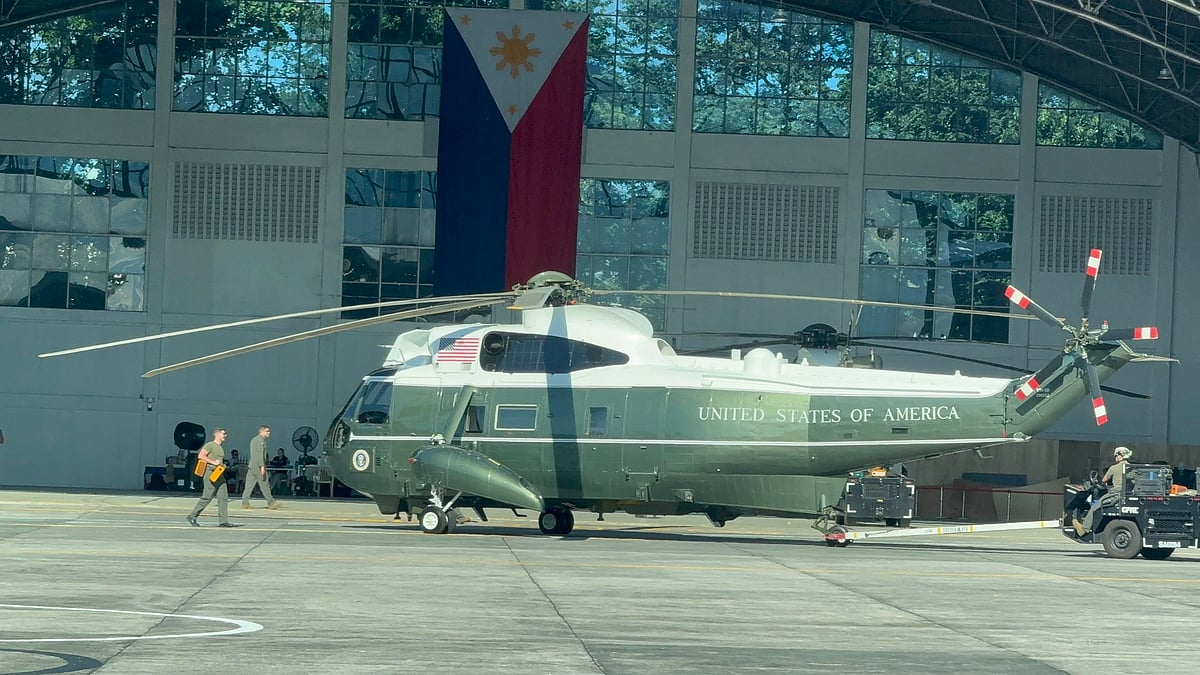
US presidential helicopter “Marine One” is seen at Manila's Villamor Air Base hours before President Donald Trump’s expected arrival. Trump is scheduled to attend the ASEAN Summit in Manila on Tuesday.
@News5E | @onenewsph | X
MANILA: US President Donald Trump is expected in Manila late on Tuesday, November 17, for high-level diplomatic engagements involving Southeast Asian leaders and the four-nation Quad, placing the Philippines at the centre of Washington's Indo-Pacific strategy.
Trump's visit includes discussions on regional security, trade, investment and maritime cooperation, ahead of a scheduled bilateral meeting with Philippine President Ferdinand Marcos Jr. on Wednesday, November 18.
TRUMP IN MANILA: US President Donald Trump's November 17–18 Manila visit puts the Philippines at the centre of US Indo-Pacific diplomacy. Quad discussions, South China Sea security, trade and investment dominate the agenda, ahead of his scheduled engagements with China's leadership at the APEC summit.
Quad meeting in Manila
The Quad brings together the United States, Japan, Australia and India.
Its discussions are expected to cover maritime security, critical minerals, artificial intelligence, semiconductor supply chains and regional stability.
The Philippines' longstanding defence treaty with Washington is also expected to feature prominently, particularly amid continuing tensions in the South China Sea, where Chinese and Philippine vessels have repeatedly confronted each other.
For Manila, the visit presents an opportunity to seek stronger American security commitments, expanded military cooperation and investments in energy, infrastructure, aviation and advanced manufacturing.
It also comes as Washington seeks to strengthen its regional partnerships amid strategic competition with Beijing.
A group of student-led militant protesters, bearing "Trump Out" and "Down with imperialism" placards, gathered in Manila's Liwasang Bonifacio on Tuesday (Nov. 17) hours before Trump's Air Force One is due to land in the Philippine capital.
The protesters chanted: "No. 1 terrorist, US imperialist".
Every It's the same idea and anti-US slogan being chanted by the Filipino leftist groups since the Philippine Marxists emerged in the 1930s, with the Partido Komunista ng Pilipinas (PKP), and its later permutations, including the Communist Party of the Philippines, founded in 1968.
Since the mid-1960s, virtually every other sitting US president has been met with organised demonstrations by nationalist, student, and activist groups protesting US military bases, foreign wars, or defence agreements.
US PRESIDENTIAL VISITS: In the history of US presidential visits to the Philippines, Dwight D. Eisenhower’s June 1960 state visit is the most notable example of an incumbent president arriving without the mass street protests that later became standard.
Trump to visit Shenzhen, China
Trump is scheduled to travel to Shenzhen, China, for the November 18–19 APEC leaders' meeting, where his engagements are expected to include discussions with Chinese President Xi Jinping.
The Philippines faces a delicate diplomatic balancing act: strengthening its security alliance with Washington while maintaining important economic relations with China.
The outcome of Trump's visit will be measured not only by diplomatic statements but also by concrete agreements on defence, trade, investment and technology.
The announced schedule and anticipated agreements remain subject to official confirmation and developments.
The visit could strengthen Philippine-US defence cooperation, attract American investments and expand technology partnerships.
It also tests Manila's ability to protect its maritime interests while balancing its longstanding security alliance with Washington and extensive economic ties with China.
Washington is seeking to maintain its Indo-Pacific influence amid growing competition with Beijing.
The Philippines' strategic location, defence alliance, maritime interests, mineral resources and potential as a manufacturing and technology hub make Manila an important diplomatic partner.
What's next
The international media contingent gathered in Manila will be watching for joint statements from the Marcos-Trump bilateral meeting, defence announcements, investment commitments and Quad outcomes.
Trump's subsequent engagements in China could also shape US-China relations, with implications for ASEAN, regional trade, maritime security and Philippine foreign policy.
What it means
Potential benefits include increased American investment, skilled employment, technology transfers and defence assistance.
However, Filipinos should watch whether announced commitments translate into funded projects, actual jobs, improved maritime security and sustained economic opportunities beyond presidential diplomacy.
Sign up for the Daily Briefing
Get the latest news and updates straight to your inbox
Network Links
GN StoreAbout Gulf NewsTerms & ConditionsReach by GNSitemapContact usPrivacy PolicyGN FocusHave your sayWork with usAdvertise with usGulf News epaperPrinting Services
Download our app
© Al Nisr Publishing LLC 2026. All rights reserved.