The Tanawon power complex located within the Bacon-Manito (Bac-Man) geothermal complex, which straddles two Philippine provinces (Sorsogon and Albay) south-east of Manila, and two the Asian nation’s 24 active volcanoes – Mayon and Bulusan. The Tanawon plant is projected to generate 159,000 megawatt-hours (MWh) or 159 GWh of electricity annually.
Philippines: Power generation gathers pace with multi-billion-dollar clean energy projects
Gigawatt-scale solar and storage reshape Luzon grid amid rising power demand
Last updated:
8 MIN READ
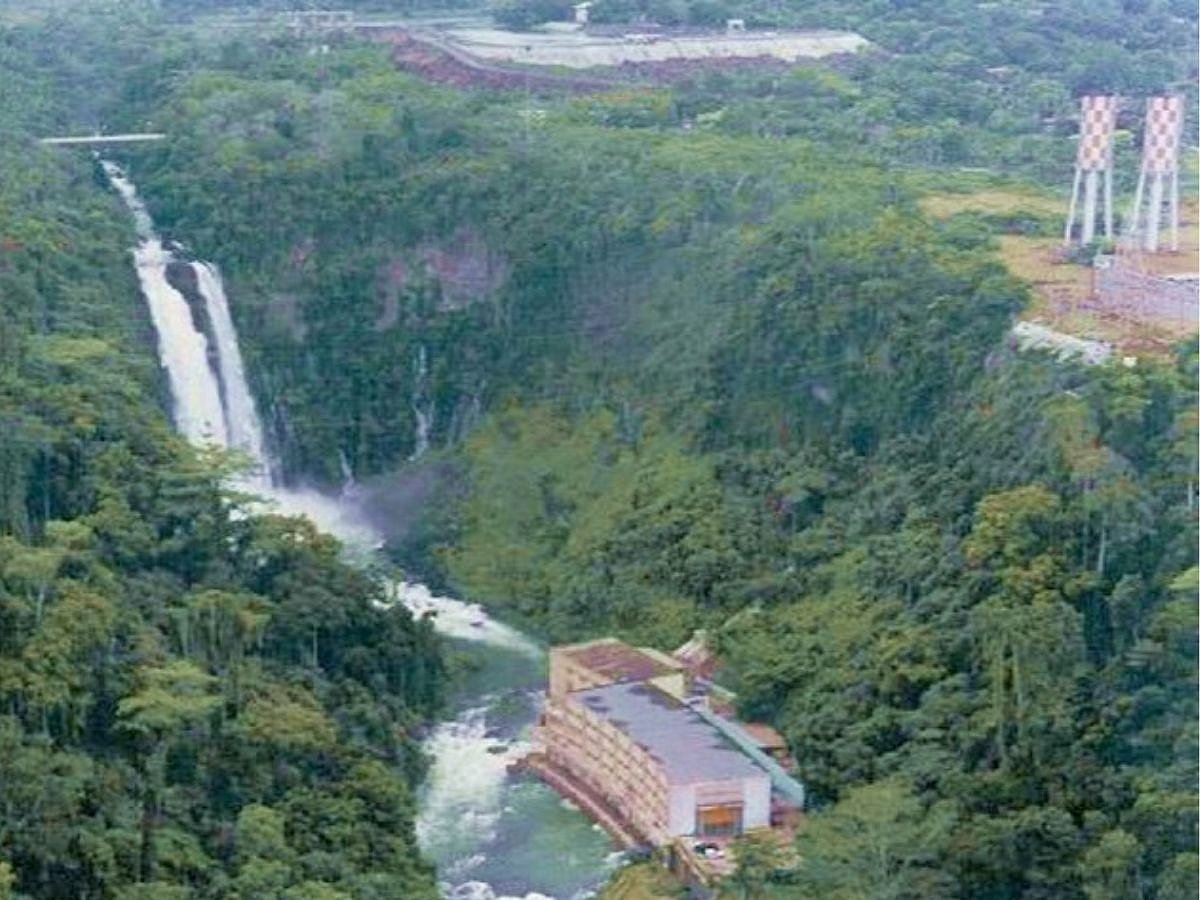
A view of the Maria Cristina Falls and the adjacent Agus IV hydro-electric powerplant (lower centre). in Mindanao, southern Philippines. The powerplant, first commissioned in 1953, forms part of the Agus-Pulangui hydropower complex (APHC). It is up for a multi-billion refurbishment-operate-maintain concession via public-private partnership deal. The hydropower complex the energy backbone of Mindanao, Philippines, supplying over 50% of the island's total energy consumption.
NPC
Manila: The Philippines is entering a new phase of investment in power generation, raising hopes for the eventual lowering of power rates.
Challenges are plenty, but investor interest is palpable.
As of June 11, 2026, the Board of Investments (BOI) announced that 13 renewable energy projects worth ₱344.62 billion ($5.63 billion) were certified by the government.
It’s dominated by solar (with grid-scale batteries), hydropower and wind projects.
There's a growing push, too, for geothermal power and small modular nuclear reactors (SMRs) even as demand for energy from industry and the nation's 116 million inhabitants continues to grow.
Spike in power demand
Electricity demand in the Philippines continues to grow by around 5% to 7% annually, driven by industrial expansion, data centre/digital infrastructure, urbanisation, and rising household consumption.
Meeting this demand requires a significant expansion of generation capacity over the next decade, particularly as aging coal plants gradually approach retirement and renewable energy assumes a larger role in the country's energy mix.
There are currently 46 renewable energy and related infrastructure projects under construction nationwide, valued at $5.9 billion (₱359.64 billion), according to the Department of Energy.
Driving this massive shift are the government's fast-tracked Green Lane initiatives, which have approved hundreds of clean energy projects, securing billions in investments.
Undergoing construction phase include:
The 22-Project fast-track drive: The Department of Energy (DOE) is accelerating the completion of 22 key power projects to provide critical near-term grid capacity.
Capacity under construction: These fast-tracked sites equate to roughly 1,471 MW of committed new capacity, including 12 solar projects (1,284 MW), six hydroelectric plants (48 MW), two biomass facilities (38 MW), one wind project, and renewable energy storage systems.
Investment boost: Within the first five months of 2026 alone, the Board of Investments (BOI) certified 13 major renewable energy projects, bringing in commitments valued at $5.72 billion (₱344.62 billion).
Energy transition
The transition is heavily supported by massive funding and recent policy overhauls aimed to bring reliable green capacity into the grid much faster.
An example: the $3-billion Pakil hydropower expansion backed by Filipino tycoon Ricky Razon’s Prime Infra.
Pakil hydro forms part of the integrated Pakil pumped-storage system that will crank up to 1,400 MW at full capacity.
The MTerra Solar and Battery Storage Project, which straddles the provinces of Nueva Ecija and Bulacan (estimate cost of $3.4 billion), is set to produce 3,500 MW solar with a 4,500 MWh battery storage, enough to capacity to power homes around ~2.4 million Filipino households.
Funding
The banks, meanwhile, are lining up to fund the massive power investment gap.
MTerra Solar is being financed through a combination of bank loans and international equity, including a ₱150-billion local bank loan and a $600-million strategic investment from the UK-based sustainable infrastructure firm Actis.
Phase 1 is due before 2026 is out, though full rollout is expected toward 2027–2028.
It is currently the largest integrated solar and battery storage project in the world — designed to provide firm renewable baseload power and stabilise the Luzon grid.
This comes amid surging electricity demand, rapid economic growth, and the push for cleaner energy reshape the country's power sector.
Developers are pouring billions of pesos into new generation projects spanning renewable energy, natural gas, battery storage, and grid modernisation, reflecting a broader effort to improve energy security while supporting the country's climate commitments.
Coal is still King
At present, coal remains the backbone of Philippine electricity generation, supplying roughly 60% of the country's power.
Renewable energy (geothermal, hydropower, solar, wind and biomass) currently accounts for approximately 22% to 24%, while natural gas contributes around 15%, primarily through facilities powered by the Malampaya gas field and imported liquefied natural gas (LNG).
The Malampaya gas project, which generates over 2 gigawatts for Luzon and forms a huge part of the Philippines’ power requirements, is controlled by Filipino business tycoon Enrique Razon Jr.
Oil-based plants provide only a small share and are mainly used for peaking capacity or in off-grid areas.
Though coal dominates the energy mix, the country's investment pipeline is increasingly shifting toward renewables.
Large-scale solar farms are being developed across Luzon, Visayas and Mindanao, while offshore and onshore wind projects are gaining momentum following the government's decision to allow 100% foreign ownership in renewable energy projects.
Battery energy storage systems are also expanding rapidly to help stabilize the grid and manage the intermittency of solar and wind generation.
Natural gas remains an important transition fuel.
As production from the Malampaya gas field declines, several LNG import terminals and gas-fired power plants have entered operation or are under development, providing flexible generation capable of complementing renewable energy.
Investors view LNG as essential in maintaining grid reliability while renewable capacity continues to expand.
The government has set an ambitious target of increasing renewable energy's share of the power generation mix to 35% by 2030 and 50% by 2040.
Achieving these goals will require substantial investment not only in generation assets but also in transmission infrastructure, energy storage, digital grid technologies, and ancillary services.
Challenges
Despite the strong investment outlook, significant challenges remain.
Transmission infrastructure continues to lag behind generation development, creating bottlenecks that delay the connection of new renewable projects to the grid.
Permitting processes, land acquisition, right-of-way (ROW) issues, and environmental approvals can also slow project implementation, increasing costs and investor uncertainty.
5 major solar projects
5 major upcoming renewable energy projects in the Philippines with latest updates:
#1. MTerra Solar and Battery Energy Storage Project
Location: Nueva Ecija and Bulacan
Capacity: 3,500 MW solar + 4,500 MWh battery storage
Company: Terra Solar Philippines Inc. (Meralco PowerGen / MGen Renewable Energy)
Expected completion: Phase 1 by 2026, full rollout toward 2027–2028
This is currently the largest integrated solar and battery storage project in the world, designed to provide firm renewable baseload power and stabilize the Luzon grid.
#2. Ilagan Solar Power Project (TotalEnergies–Nextnorth)
Location: Ilagan City, Isabela
Capacity: 440 MW solar
Company: TotalEnergies (France) + Nextnorth Holdings Corp (Philippines)
Expected completion: End of 2027
The project is backed by international financing and long-term power supply agreements for industrial and grid customers, making it one of the largest foreign-backed solar investments in the country.
#3. Citicore Solar + Battery Expansion
Location: Tuy, Batangas
Capacity: 197 MWp solar + 320 MWh battery storage
Company: Citicore Renewable Energy Corporation (CREC)
Expected completion: 2025–2026 (phased expansion ongoing)
This is the Philippines’ first large-scale “solar baseload” facility, capable of dispatching power beyond daylight hours through battery storage integration.
#4. Hermosa Solar Expansion Cluster
Location: Hermosa, Bataan
Capacity: ~20–30 MW per unit (part of a wider solar cluster pipeline)
Company: Solana Solar Alpha Inc. / Citicore-linked developers
Expected completion: 2026 (various units already energizing)
Part of a broader pipeline of distributed solar projects being synchronized with the grid under DOE’s renewable energy expansion program.
#5. Isabela 440 MW Solar Farm
Location: Isabela Province
Capacity: 440 MW
Company: TotalEnergies + Nextnorth (same project cluster development stage)
Expected completion: 2027
This is aligned with the Philippines’ Green Energy Auction Program (GEAP), designed to accelerate competitively bid renewable projects with guaranteed offtake agreements.
The Philippines’ renewable pipeline is increasingly dominated by:
Gigawatt-scale solar + storage projects (especially MTerra)
Foreign-backed utility solar farms (TotalEnergies, Masdar-linked capital, etc.)
Battery storage integration as a standard feature
Fast-expanding private sector participation
Top 5 hydropower projects
Top 5 hydropower projects (including pumped storage hydro power plant) under construction by name, location, capacity, cost, company, completion date:
#1. Pakil Pumped Storage Hydroelectric Project
Location: Pakil, Laguna
Capacity: 1,400 MW
Company: Prime Infrastructure Capital Inc. (Prime Infra) / Ahunan Power Inc.
Estimated cost: ~USD 3–4 billion (≈ PHP 200+ billion, project portfolio estimate)
Completion date: 2030 (target)
This is one of Asia’s largest pumped-storage projects, designed to act as a “giant battery” for the Luzon grid, storing up to 14,000 MWh daily and providing long-duration energy storage.
#2. Wawa Pumped Storage Hydroelectric Project
Location: Rodriguez, Rizal
Capacity: 600 MW
Company: Prime Infra / Olympia Violago Water & Power Inc.
Estimated cost: ~USD 2.5–2.6 billion
Completion date: 2029–2030 (target)
The Wawa project is designed to supply peak and mid-merit power to the Luzon grid and includes underground powerhouse tunnels, dams, and upper reservoir infrastructure.
#3. Kalayaan Pumped Storage Expansion (CBK Complex modernisation)
Location: Kalayaan, Laguna (CBK hydro complex)
Capacity: ~370 MW (Kalayaan 2 existing; upgrades and integration ongoing)
Company: CBK Power / Cleanergy consortium
Estimated cost: Multi-billion peso rehabilitation and upgrade program
Completion date: Ongoing modernisation through late 2020s
This long-running hydro complex is being optimized to improve efficiency and grid balancing capability in Southern Luzon, leveraging the Caliraya–Botocan–Kalayaan system.
#4. Wawa 2 Pumped Storage Hydro Project (Phase expansion)
Location: Rodriguez, Rizal
Capacity: ~100 MW (initial expansion phase)
Company: Olympia Violago Water & Power Inc.
Estimated cost: Not fully disclosed (part of Wawa system CAPEX)
Completion date: Late 2020s
This is a smaller-scale expansion within the broader Wawa pumped-storage system, supporting staged commissioning and grid integration testing.
#5. Pakil Hydropower Expansion / Ahunan Integrated Development (early phases)
Location: Pakil, Laguna
Capacity: ~500 MW (early-stage component within broader 1.4 GW PSH system)
Company: Ahunan Power Inc. / Prime Infra
Estimated cost: Included in Pakil PSH total (~USD 3B+)
Completion date: 2028–2030 (staged rollout)
This forms part of the integrated Pakil pumped-storage system and represents earlier construction phases feeding into the full 1,400 MW facility.
Top 5 wind power projects (approved/under construction)
#1. Alabat Wind Power Project
Location: Alabat Island, Quezon
Capacity: 64 MW
Company: Alternergy Holdings Corp. (Alabat Wind Power Corp.)
Project value: ~PHP 7.1 billion
Completion date: Target end-2025
This is one of the most advanced wind projects in the country and is expected to be among the first awarded under the DOE Green Energy Auction Program to reach completion. It is also the first wind farm along the Pacific coastline of Quezon.
#2. Balaoi and Caunayan Wind Farm
Location: Pagudpud, Ilocos Norte
Capacity: 160 MW
Company: UPC Renewables / ACEN (Ayala Group)
Project value: Estimated ~USD 300–400 million (industry range)
Completion date: Phased commissioning (late-2025 to 2026 updates depending on grid integration)
This is currently the largest onshore wind farm in the Philippines under construction, featuring 32 Siemens Gamesa turbines and significantly expanding Ilocos Norte’s wind corridor.
#3. Aklan Wind Power Project (Onshore cluster development)
Location: Nabas, Aklan
Capacity: ~112 MW (phase-based development under Triconti/partners)
Company: Triconti Windkraft Group (and partners)
Project value: Not publicly finalised (multi-billion peso investment scale)
Completion date: Expected 2026–2028This project is part of the Western Visayas wind corridor development and supports grid diversification beyond Luzon.
#4. Bohol Wind Power Project (Anda Wind Cluster)
Location: Anda, Bohol
Capacity: ~150 MW (staged development)
Company: Triconti / joint venture partners
Project value: Undisclosed (multi-phase EPC investment)
Completion date: Around 2027–2028
This is one of the first major wind projects in Central Visayas, helping reduce dependence on diesel and imported fuel in island grids.
5. Quezon Wind Power Cluster (Atimonan / Plaridel developments)
Location: Quezon Province (multiple sites including Atimonan and Plaridel)
Capacity: ~150–350 MW (clustered development pipeline)
Company: Triconti Windkraft / local-foreign JV developers
Project value: Multi-billion peso pipeline
Completion date: 2027–2028
This cluster represents the next wave of large-scale wind development outside Ilocos, leveraging strong coastal wind resources in Southern Luzon.
The Philippines has seen a surge in renewable energy investments. The Department of Energy expects an additional $433 billion to be pumped into wind, solar, batteries, geothermal, run-of-the-river/pumped-storage hydroelectric power projects backed by a new policy that makes long-term investments more attractive to investors. Photo shows a wind farm in Pililia, near Manila.
100 water falls
There are at least 100 known waterfalls in the country. The Philippines’ hydropower pipeline is now dominated by pumped-storage projects rather than traditional run-of-river dams, reflecting a shift toward grid-scale energy storage, renewable integration (solar + wind balancing) and peak demand management for Luzon.
High electricity rates
The Philippines, facing one of Asia's highest electricity prices, remains dependent on imported fuel, limited domestic energy resources, and the archipelagic nature of the country, complicating transmission and distribution.
Boosting competition, improving market efficiency, and accelerating grid expansion will be critical to reducing costs for consumers and businesses.
Typhoons, flooding, and extreme weather events threaten power generation facilities, transmission and distribution. This underscores the need for resilient infrastructure.
Financing the energy transition also requires policy consistency. Local and foreign investors continue to monitor regulatory reforms, competitive renewable energy auctions, carbon reduction policies, and incentives designed to attract long-term capital into the sector.
Nevertheless, the long-term outlook remains positive.
Combined with strong economic growth and rising electricity demand, these advantages position the country as one of Southeast Asia's most attractive destinations for energy investment.
Sign up for the Daily Briefing
Get the latest news and updates straight to your inbox
Network Links
GN StoreAbout Gulf NewsTerms & ConditionsReach by GNSitemapContact usPrivacy PolicyGN FocusHave your sayWork with usAdvertise with usGulf News epaperPrinting Services
Download our app
© Al Nisr Publishing LLC 2026. All rights reserved.