System loss charges in the Philippines are pass-through fees on electricity bills covering power lost during transmission and distribution. President Ferdinand Marcos Jr. called for their removal, and lawmakers have proposed caps or tax exemptions.
UPDATE
Philippines: Marcos enters final stretch, focuses on electricity, food, healthcare, OFWs, security — Filipinos demand results on corruption, jobs, cost of living
After "Mahiya naman kayo!" speech in 2025, president lays out most ambitious targets
Last updated:
8 MIN READ
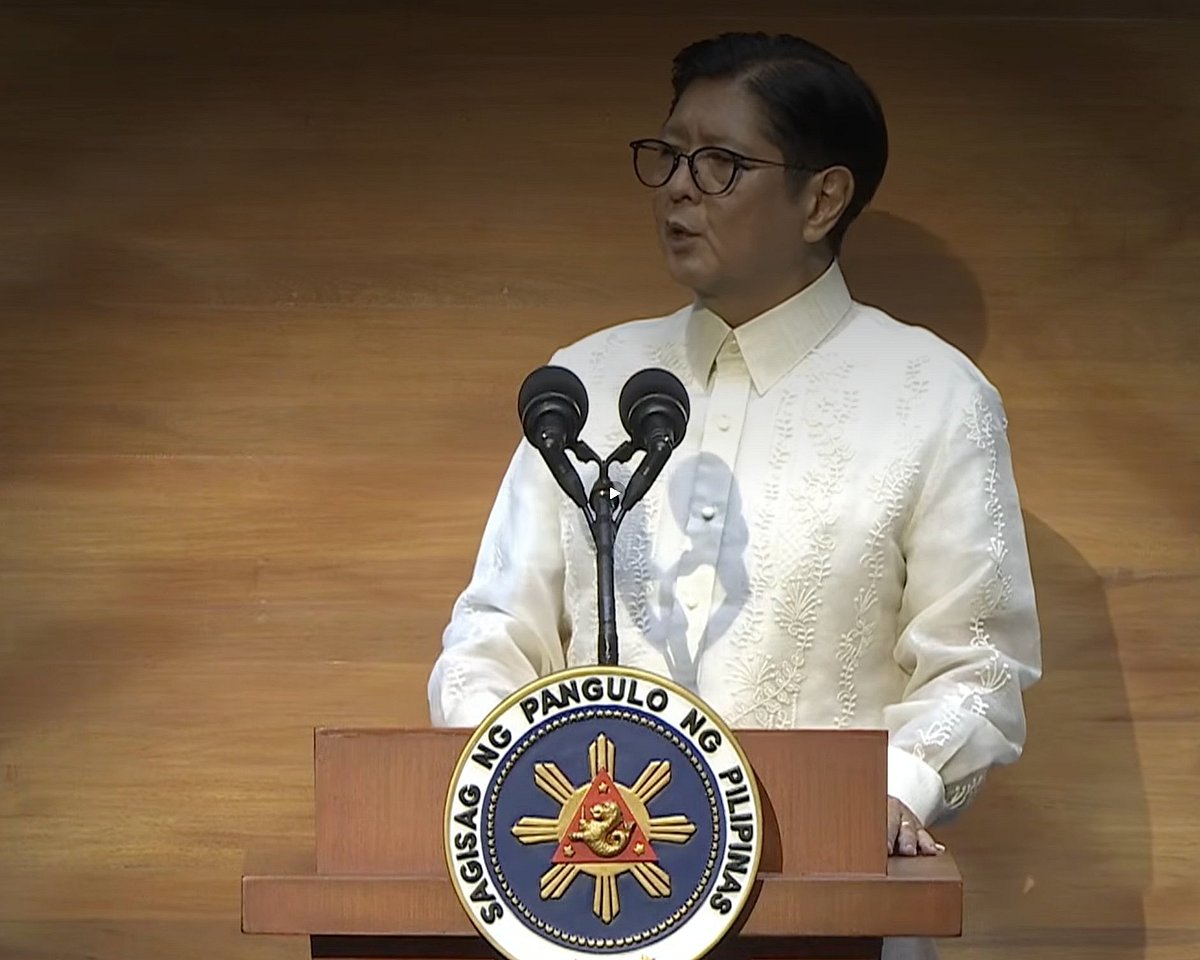
President Ferdinand R. Marcos Jr appealed to Filipino lawmakers to scrap the "system loss" charge on electricity bills paid more than millioons of electricity consumers in the country during his Monday (June 27) State of the Nation Address (SONA), during which he laid out his administration's accomplishments and agenda as he enters the final stretch of his six-year term.
RTVM Screenshot
Manila: June Palomar, an entrepreneur, is paying about $141 per year (₱730.30 pesos per month) in "system loss charges" to the local power distributor, excluding month value-added tax (VAT, ₱89 in June) for the same thing.
It's the second-biggest item after "generation charge" on his monthly bill.
President Ferdinand Marcos Jr now wants it scapped.
Each month, 26.47 million households/consumers in the country pay this charge, currently enshrined in Philippine law.
Scrubbing the "system loss charge" is one of the bold appeals made by the chief executive to Filipino lawmakers on Monday (June 27) as he delivered his State of the Nation Address (SONA), laying out his administration's accomplishments and agenda in the final stretch of his six-year term (which ends in 2028).
The system losses are not the consumers' fault. So they should not pay for it.Philippine President Ferdinand Marcos Jr
"The system losses are not the consumers' fault. So they should not be charged for it," President Marcos Jr told the joint assembly on Monday, even as he appealed to the nation to "revisit" nuclear energy.
System loss charges are legal under Section 43(f) of the Electric Power Industry Reform Act (EPIRA, which empowers the Energy Regulatory Commission (ERC) to allow distribution utilities to "recover" power lost during transmission and distribution.
Speaking before a joint session of Congress at the Batasang Pambansa in Quezon City, the president highlighted the following:
Crisis response
Investments in agriculture
Improvements in healthcare
Insurance Economic resilience amid global challenges
Energy reforms, including renewables (including amendments to EPIRA Act)
Anti-corruption effort, boosting transparency
Infrastructure development
Digitalisation
National defence
Foreign investments
System loss is defined as the difference between the total electricity supplied to a power grids and the actual amount billed to consumers, categorised primarily into "technical losses", "non-technical losses", and "utility use".
Push for nuclear energy
Marcos, who declared a national energy emergency this year, said on Monday that nuclear power might hold answers for a country paying the highest electricity prices in the region.
"Perhaps it is time for us to revisit nuclear energy production," he told a joint session of Congress in a nationally televised speech.
"We will ensure it is safe. We will ensure the good benefits of nuclear energy will be explained properly to the public."
The address, broadcast live by state television PTV and other networks, comes as Marcos navigates a politically charged environment that includes the impeachment proceedings against Vice President Sara Duterte, investigations into alleged corruption in flood control projects, and public concerns over inflation and living costs.
Philippine president Ferdinand R. Marcos Jr (centre), flanked by Senate President Win Gatchalian and House Speaker Faustino "Bojie" De Guzman Dy III on Monday (July 27, 2026) before his 4th State of the Nation Address.
Filipino space rocket due in 2027
He also announced that Cagayan will host the country's first space port, with the first rocket launch into space set for 2027, in partnership with a South Korean aerospace company.
Key issues he tackled include sustaining economic growth and job creation, lowering rice prices and boosting agriculture, improving education and health services, modernising defence amid South China Sea tensions, and advancing anti-corruption efforts.
The event marks the opening of the second regular session of the 20th Congress.
Analysts view this as one of Marcos' most significant SONAs, coming at a time of heightened expectations for tangible results in poverty reduction, governance and sovereignty issues.
'Simple, yet dignified'
Government officials described this year's SONA as "simple yet dignified" in line with austerity measures prompted by external economic pressures, including conflicts in the Middle East.
Marcos, who assumed office in 2022, is using the annual speech — a constitutional requirement — to report on the past year's developments and set the legislative agenda through 2028.
His previous address drew attention for a pointed remark — "Mahiya naman kayo!" (Have some shame!) — urging shame on those involved in corruption scandals.
He also tackled the development of the country's Halal industry, and mentioned the CEPA with the United Arab Emirates (UAE).
"We continue to strive for greater things in pharamaceutial, advanced manufacturing, luxury goods and technology".
"Pax Silica industrial hub will create an ecosystem that will have AI at its core, and revitalise our economy, the hub will be an logistics centre," he said.
"Filipinos are noble and kind. We are not greedy, we're not racists, we are not liars. We are respectful and we are dignified. We are Filipinos, and we do not yield," said Marcos Jr, when he mentioned the 10th anniversary of the Arbitral Award.
President says 7.5 million families to benefit as government shifts from crisis response to long-term resilience
President Ferdinand Marcos Jr. on Monday unveiled one of the broadest packages of economic relief and structural reforms of his administration, promising tax cuts, subsidies, lower power costs, transport assistance and stronger food and energy security as he entered the final two years of his six-year term.
In his fourth State of the Nation Address (SONA), Marcos framed the measures as an integrated response to global economic uncertainty, volatile oil prices and natural disasters, while pledging that the government would continue investing in infrastructure, agriculture, education and energy to make the economy more resilient.
"Balik-tanaw upang harapin ang epekto ng krisis," Marcos said, describing a "whole-of-government" approach that combines immediate assistance with long-term reforms.
Relief for millions
Marcos said around 7.5 million Filipino families would receive various forms of government assistance during the current crisis.
The beneficiaries include:
2.5 million families receiving subsidised P10-per-kilogram rice;
about 12 million Filipinos benefiting from the low-cost rice programme;
recipients of the Pantawid Pamilyang Pilipino Program (4Ps);
transport workers, overseas Filipino workers (OFWs), and vulnerable households.
He said 800 Kadiwa centres nationwide are helping connect farmers and fishermen directly with consumers while keeping food prices affordable.
The President also announced that funds recovered from corrupt officials would be redirected to public assistance programmes.
Oil shock response
With global oil prices surging amid geopolitical tensions, Marcos outlined emergency measures aimed at cushioning consumers and businesses.
The government declared a State of Energy Emergency, while assuring Filipinos that the country has secured sufficient fuel supplies through agreements with Japan, South Korea, Oman, India, Russia and China.
Among the emergency measures:
mandated oil price rollbacks;
three-month suspension of excise taxes on kerosene and premium gasoline;
diesel subsidies of P10 per litre for jeepney, UV Express and other public utility vehicle operators;
free rides and expanded service contracting for commuters;
suspension of selected port, anchorage, terminal and toll fees;
toll-free passage for accredited food and agricultural cargo trucks;
reduced roll-on/roll-off (RORO) shipping charges for agricultural products.
Marcos described public transportation as "the piston" that keeps the economy moving and said drivers, operators, workers and passengers deserve government protection during periods of high fuel prices.
Relief for households and businesses
To ease financial pressure on consumers, Marcos announced that:
banks have agreed to waive selected online transaction fees;
GSIS, SSS, Pag-IBIG Fund and other government financial institutions will extend payment relief for borrowers;
electricity consumers affected by recent price spikes may pay their bills in instalments for May through July;
power utilities are prohibited from disconnecting customers during the payment relief period.
Micro and small enterprises would also receive a one-time tax abatement to help struggling businesses recover.
Push for tax reforms
Marcos appealed to Congress to approve a broad package of tax relief measures designed to benefit workers and businesses.
Among the proposals:
raising the annual income tax exemption threshold to P350,000;
lowering income tax rates for other income brackets;
exempting small businesses from the minimum corporate income tax;
granting tax amnesty covering income tax, estate tax, value-added tax and related penalties.
"We will pursue tax-relief measures that promote growth," the President said.
Energy security and lower electricity costs
Energy security emerged as one of the central themes of the address.
Marcos said the administration is pursuing around 200 energy projects with a combined capacity of nearly 10,000 megawatts.
According to the President:
45 projects have already been completed;
another 31 are expected to come online this year;
124 additional projects are scheduled through 2028.
Battery energy storage projects totalling 1,700 MW are expected to supply electricity to roughly three million homes.
He said the country is expanding investments in geothermal, solar, wind, hydro and biomass energy while continuing to develop indigenous natural gas resources.
Marcos announced that drilling has resumed in the Malampaya gas field for the first time in eight years.
The new discovery of about 220 billion cubic feet of natural gas, he said, could supply around 1.6 million households and extend domestic gas production through 2034.
The administration has also awarded 14 petroleum service contracts, the highest number issued during a single presidential term, while beginning projects involving hydrogen production as backup power for power plants.
Nuclear power revisited
Marcos said the country should revisit nuclear energy as part of its long-term energy strategy.
He noted that nuclear technology is already being used in medicine, agriculture and industrial applications and pledged that any move toward nuclear power generation would prioritise public safety and transparency.
"We will ensure this will be safe and clearly explained to the public," he said.
Power bill reforms
The President also called for sweeping reforms to electricity pricing.
He urged Congress to:
pass the proposed Sariling Kuryente Act to simplify rooftop solar and battery installations;
amend the Electric Power Industry Reform Act (EPIRA);
eliminate the "systems loss" charge and its corresponding VAT from consumers' electricity bills.
"It is not the consumers' fault," Marcos said to loud applause from lawmakers.
Agriculture and food security
Marcos said food security remains a national priority.
The government plans to:
expand mechanisation;
construct additional cold storage facilities;
strengthen crop insurance;
provide life insurance for farmers and fishermen;
forgive certain agricultural loans;
improve irrigation, farm roads and access to machinery.
The administration also aims to plant 100 million coconut trees, building on the 18 million already planted.
The National Food Authority will continue buying palay at higher prices while expanding grain storage facilities.
Disaster preparedness
Marcos announced a shift from a reactive disaster response to a predictive system using new technology.
The government plans to establish:
15 disaster logistics hubs;
76 regional spokes;
919 local distribution facilities operating around the clock.
Other initiatives include:
mobile emergency energy systems;
satellite-to-mobile communications during disasters;
Ligtas Pinoy Centres designed to withstand super typhoons with winds of up to 340 kilometres per hour and earthquakes as strong as magnitude 8.4.
The President also proposed updating the National Building Code to require stronger earthquake standards for private buildings.
Transport and infrastructure
Despite the current economic challenges, Marcos said the government will continue investing in transport infrastructure.
Projects highlighted included:
the North-South Commuter Railway extension to Clark;
MRT-7's Sacred Heart station targeted for 2027;
Toll Road 4 connecting Sto. Tomas, Batangas to Quezon Province;
expanded electric vehicle adoption, including electric buses and ferries.
The government also plans to develop a domestic EV manufacturing ecosystem, including battery production, while requiring government agencies to prioritise electric vehicles.
Social protection
Marcos announced expanded protection through SSS, GSIS and Pag-IBIG.
Key initiatives include:
wider SSS coverage for informal workers, gig workers and job-order personnel;
increased Pag-IBIG housing loan ceilings to P10 million;
expanded affordable housing under the Pambansang Pabahay para sa Pilipino (4PH) programme;
insurance coverage for around 7 million OFWs.
Education and jobs
Calling education the administration's "first priority," Marcos outlined reforms aimed at improving employability.
The initiatives include:
strengthening senior high school work immersion;
expanding TESDA training linked to industry needs;
introducing a digital TESDA Passport;
integrating artificial intelligence into education;
promoting lifelong learning and entrepreneurship.
The government also announced:
more than 300,000 job fairs, with over 6,000 applicants hired on the spot;
promotion of 8,000 teachers and school heads;
creation of 3,000 additional teaching positions;
hiring of 8,000 school counsellor associates;
expansion of school feeding programmes for young learners.
Marcos said technology—including tablets, Smart TVs, free mobile data and digital learning tools—would continue to modernise classrooms.
Looking beyond the crisis
Throughout the nearly two-hour speech, Marcos repeatedly stressed that emergency relief would be paired with structural reforms intended to make the economy more resilient.
The President said the administration's priorities remain clear: ensuring affordable food and energy, modernising transport, strengthening disaster preparedness, creating quality jobs, and protecting Filipino families against future shocks.
"Our goal is not only to uplift our fellow Filipinos," Marcos said, "but to ensure that they become self-sufficient."
Sign up for the Daily Briefing
Get the latest news and updates straight to your inbox
Network Links
GN StoreAbout Gulf NewsTerms & ConditionsReach by GNSitemapContact usPrivacy PolicyGN FocusHave your sayWork with usAdvertise with usGulf News epaperPrinting Services
Download our app
© Al Nisr Publishing LLC 2026. All rights reserved.